

 USA
USA
 Canada
 Australia


The global tax landscape has never been more complex or more consequential. As businesses scale across borders in 2026, the demand for comprehensive global tax services has intensified significantly. Regulatory reforms, the OECD’s Pillar Two framework, evolving transfer pricing rules, and increasingly stringent VAT compliance requirements are reshaping how multinational organisations plan and manage their tax obligations.
NCSGX delivers end-tzzo-end global tax services that equip businesses with the strategic insight, technical rigour, and cross-border expertise required to navigate this environment. Whether your organisation is expanding into new markets, restructuring its international operations, or aligning with new reporting mandates, NCSGX provides a trusted advisory framework built for 2026 and beyond.
The 2026 Global Tax Landscape: What Has Changed
2026 marks a pivotal transition for multinational enterprises. The combined impact of OECD Pillar Two, updated BEPS Action Plans, and country-specific reforms requires a proactive compliance strategy rather than reactive adjustments.
Key developments shaping the 2026 tax environment include:
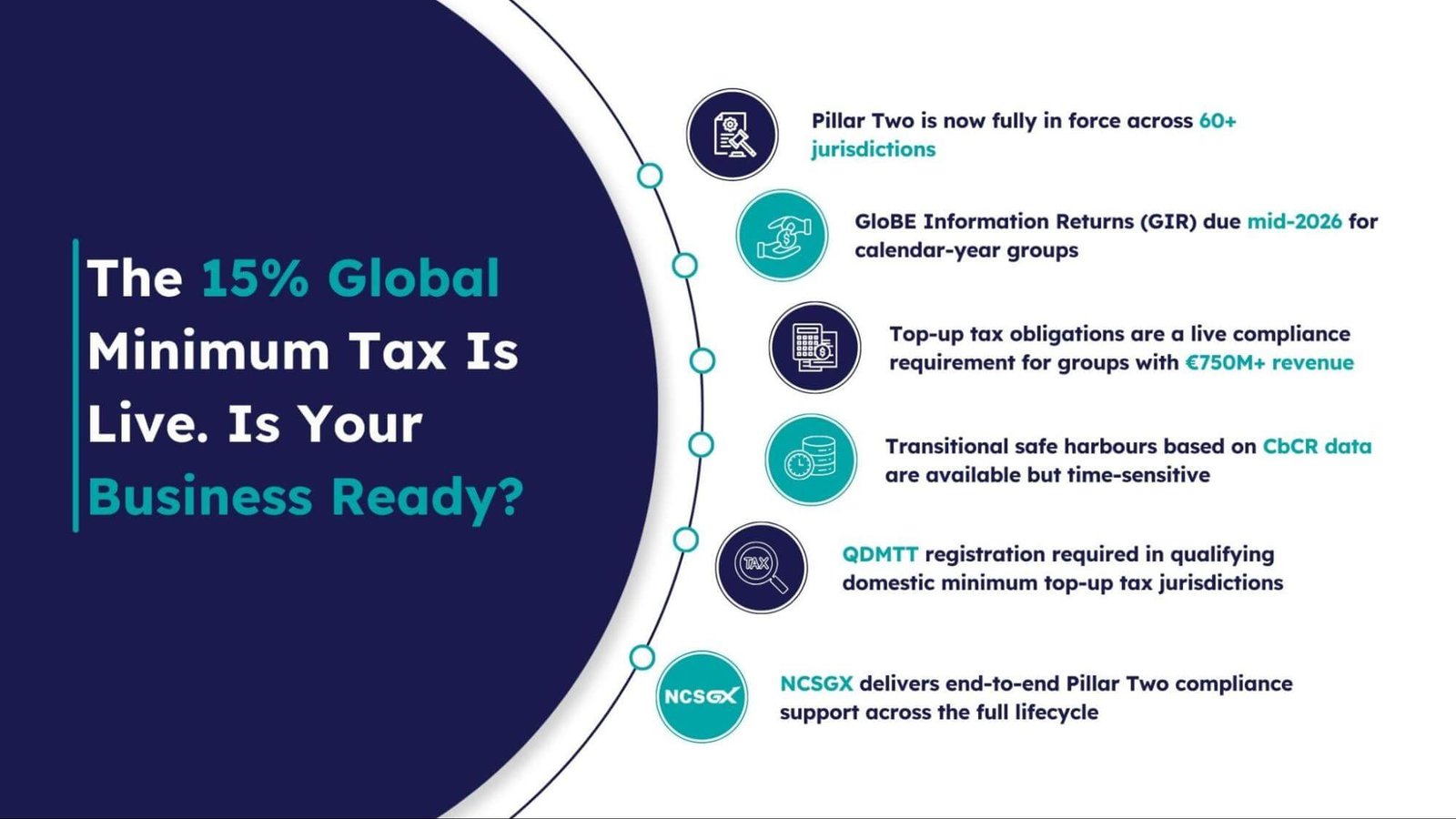
- Pillar Two global minimum tax of 15% now fully in force across more than 60 jurisdictions, with GloBE Information Returns (GIR) due mid-2026 for calendar-year groups.
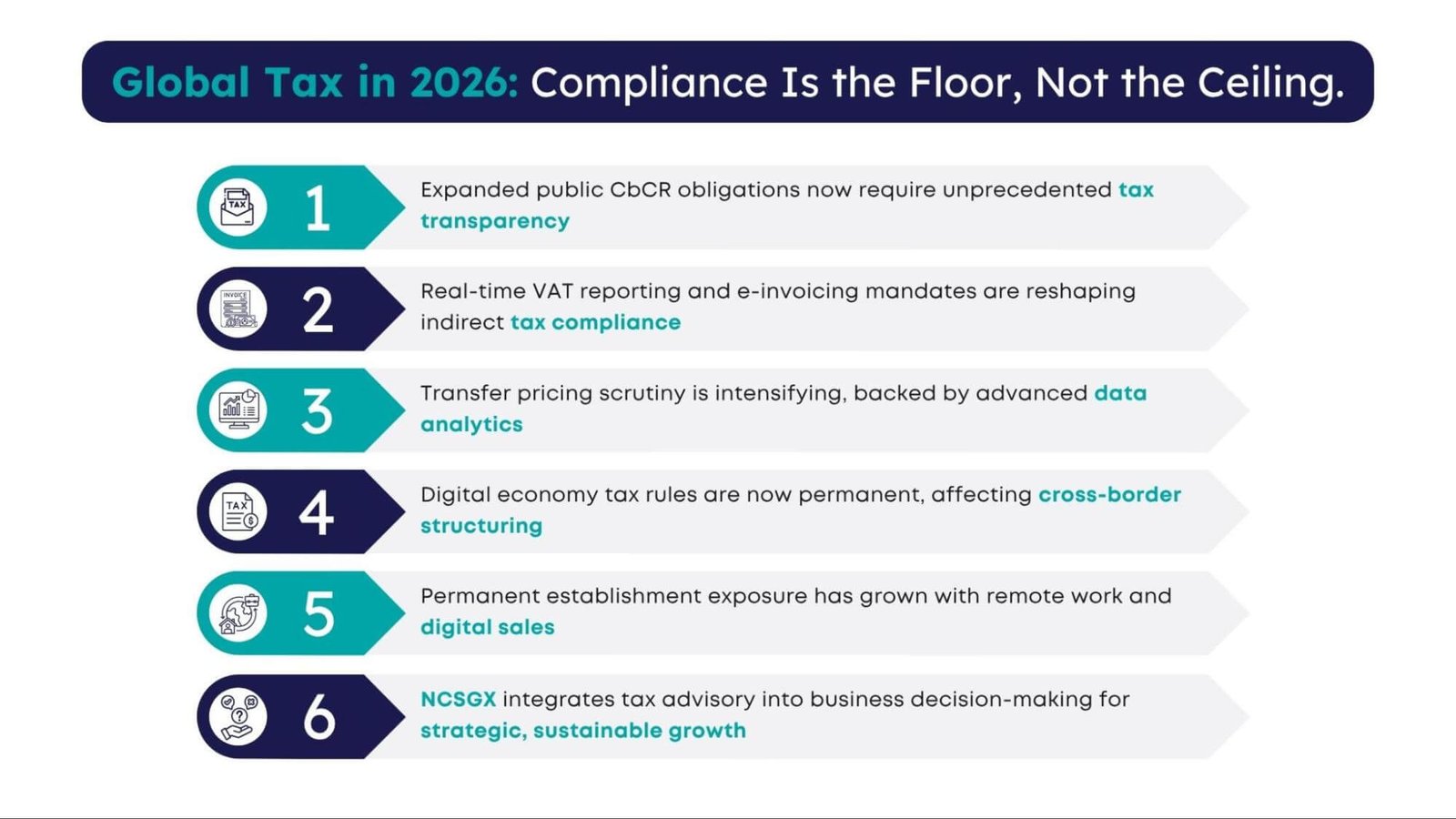
- Expanded public Country-by-Country Reporting (CbCR) obligations in the EU and Australia, requiring unprecedented levels of tax transparency.
- Rising tariff-driven inventory cost pressures are compelling a fresh look at LIFO adoption and transfer pricing adjustments.
- Digital economy tax rules for cloud transactions and digital content are now embedded in permanent regulations, affecting cross-border structuring decisions.
- Heightened scrutiny on intercompany pricing arrangements, with tax authorities deploying data analytics to identify inconsistencies.
NCSGX Insight
Businesses that treat 2026 tax changes as compliance events will miss the strategic value hidden within them. The organisations best positioned for sustainable growth are those that integrate tax planning into business decision-making at the earliest stage.
International Tax Structuring: Building a Resilient Cross-Border Framework
Effective international tax structuring now requires building commercially coherent, legally defensible structures that align with global regulatory expectations. In 2026, this involves re-evaluating entity structures, profit attribution models, and cross-border financing arrangements to address evolving rules.
NCSGX’s international tax structuring practice focuses on three core priorities:
1. Entity Rationalisation and Holding Structures
As jurisdictions tighten controlled foreign corporation (CFC) rules and digital services taxes proliferate, the placement and legal form of operating entities carry significant tax implications. NCSGX advises clients on optimal holding company locations, branch-versus-subsidiary decisions, and the repatriation of profits in a post-Pillar Two environment.
2. Cross-Border Financing and Treasury Structures
Interest deductibility rules, thin capitalisation limits, and hybrid mismatch arrangements remain areas of heightened OECD focus. NCSGX assists multinational groups in designing treasury structures that are both commercially efficient and compliant with local and international norms, including the OECD’s BEPS Action 4 recommendations.
3. Permanent Establishment Risk Management
Remote work, digital sales channels, and distributed operational models have materially expanded permanent establishment (PE) exposure for many organisations. NCSGX conducts PE risk reviews and guides operational changes required to manage inadvertent tax presence across jurisdictions.
Transfer Pricing Compliance: Navigating a Tightening Regulatory Environment
Transfer pricing compliance remains one of the highest-risk areas of international tax for multinational enterprises. Tax authorities globally are intensifying their scrutiny of intercompany transactions, supported by increased data access through CbCR and mutual exchange of information agreements.
In 2026, robust transfer pricing compliance requires:
- Contemporaneous documentation that clearly articulates the economic rationale behind intercompany pricing policies.
- Benchmarking studies are conducted with current market data, particularly for arrangements involving intellectual property, financial transactions, and services.
- Alignment of transfer pricing policies with the OECD’s revised guidance on financial transactions and the arm’s length principle.
- Proactive consideration of Advance Pricing Agreements (APAs) for high-value or high-risk intercompany arrangements.
- Coordination between transfer pricing positions and Customs valuations to reduce dual audit exposure.
NCSGX Insight
Transfer pricing now relies as much on data as on legal analysis. Organisations that invest in clear, well-documented policies reduce the risk of costly adjustments and penalties during audits. NCSGX works with clients to build defensible, practical intercompany pricing frameworks.
Global VAT Compliance: Managing Indirect Tax Across Borders
Global VAT compliance has emerged as one of the most operationally demanding areas of international tax management. The expansion of digital services, VAT regimes, real-time reporting requirements, and e-invoicing mandates across jurisdictions has significantly increased the compliance burden for businesses operating across multiple markets.
Key areas of focus for 2026 global VAT compliance include:
Digital Services and E-Commerce VAT
Following widespread adoption of OECD recommendations on digital services taxation, most major economies now require non-resident businesses to register for and remit VAT on B2C digital sales. NCSGX assists clients in managing their registration obligations, return filing cycles, and rate determinations across jurisdictions, including the EU, UK, Australia, Singapore, and more.
Real-Time Reporting and E-Invoicing
Countries such as Italy, France, Poland, and India have introduced or expanded mandatory e-invoicing and real-time VAT reporting. Compliance in these markets requires integrating ERP systems with local tax authority platforms. NCSGX advises clients on mapping transaction flows and implementing compliant invoicing solutions.
VAT Recovery and Cash Flow Optimisation
Input VAT recovery processes are frequently underoptimised in multinational groups, resulting in unnecessary cash leakage. NCSGX conducts VAT recovery reviews to identify reclaim opportunities across jurisdictions, with particular focus on cross-border input tax and refund mechanisms available to non-established businesses.
Business Tax Planning Priorities for 2026
Strategic business tax planning in 2026 requires a multi-layered approach that aligns tax efficiency with compliance certainty. The interaction between domestic corporate tax regimes, Pillar Two top-up taxes, withholding tax treaties, and transfer pricing outcomes demands coordinated modelling across all relevant dimensions.
NCSGX’s business tax planning advisory focuses on the following high-priority areas for 2026:
- Pillar Two: effective rate modelling to quantify top-up tax exposure by jurisdiction and identify planning opportunities within the GloBE framework.
- R&D and innovation incentives, including patent boxes, R&D tax credits, and innovation relief regimes, to optimise returns on intellectual property investment.
- Capital allowances and investment incentives planning, especially for capital-intensive industries, is essential for navigating new asset investment decisions.
- Tax attribute utilisation, including loss carry-forwards and group relief mechanisms, to maximise the value of available tax assets.
- Restructuring and M&A tax planning to ensure transactions are structured to achieve commercial objectives with tax efficiency and regulatory approval.
NCSGX Insight
Business tax planning is most valuable when it begins at the business case stage, not after a transaction has been structured or a supply chain has been redesigned. NCSGX embeds tax advisory alongside commercial decision-making to ensure that planning is both strategic and sustainable.
Pillar Two and the Global Minimum Tax: 2026 Compliance Imperatives
Pillar Two represents the most significant structural change to international taxation in decades. The 15% global minimum tax, administered through the Income Inclusion Rule (IIR), the Qualified Domestic Minimum Top-up Tax (QDMTT), and the Undertaxed Profits Rule (UTPR), is now a live compliance requirement for multinational groups with annual revenues exceeding €750 million.
For calendar-year groups, mid-2026 represents the first major wave of GloBE Information Return filings and associated top-up tax payments. NCSGX supports multinational clients across the full Pillar Two compliance lifecycle:
- Scope and exposure assessment to determine whether a group is in scope and identify jurisdictions where top-up tax may arise.
- Effective tax rate calculations under GloBE rules, including application of transitional safe harbours based on CbCR data.
- GIR preparation and filing, including surrogate filer designation and coordination with local constituent entity filings.
- QDMTT analysis and registration in jurisdictions where a qualifying domestic minimum top-up tax applies.
- Ongoing monitoring of Pillar Two policy developments and guidance as the OECD Inclusive Framework continues to refine the rules.
Why NCSGX: A Trusted Partner for Global Tax Services
NCSGX brings together deep technical expertise, cross-jurisdictional reach, and a client-centric service model to deliver global tax services that create measurable value for multinational organisations. Our approach is grounded in three principles:
Technical Excellence
Our tax professionals maintain up-to-date expertise across international tax, transfer pricing, VAT, and Pillar Two, providing clients with advice that is technically precise and commercially relevant.
Integrated Advisory
We work across practice areas to ensure that business tax planning, international tax structuring, transfer pricing compliance, and global VAT compliance are aligned, avoiding fragmented advice that creates gaps or inconsistencies in a client’s global tax position.
Proactive Risk Management
NCSGX takes a forward-looking approach to compliance, helping clients identify and address exposures before they become disputes. From PE risk reviews to transfer pricing health checks and Pillar Two readiness assessments, our advisory framework is designed to keep clients ahead of regulatory developments.
Conclusion: Positioning for 2026 and Beyond
The global tax environment of 2026 demands more than compliance; it demands strategy. As regulatory complexity intensifies and tax authorities become more sophisticated in their enforcement capabilities, the organisations best positioned for sustainable growth are those with a coherent, well-executed global tax strategy.
NCSGX’s global tax services are designed to help multinational enterprises navigate this environment with confidence, combining technical rigour, cross-border expertise, and a deep understanding of the commercial context in which our clients operate.
To discuss how we can support your organisation’s global tax planning, transfer pricing compliance, international tax structuring, or global VAT compliance needs in 2026, contact our advisory team today.