

 USA
USA
 Canada
 Australia
In 2026, payroll compliance in Australia has evolved into a high-stakes, highly regulated function that demands precision, transparency, and real-time reporting. Organisations working with partners like NCSGX Australia are increasingly shifting from reactive compliance approaches to proactive, technology-enabled payroll governance models.
With ongoing regulatory scrutiny from the Australian Taxation Office (ATO), expanding Single Touch Payroll (STP) requirements, and tightening payroll legislation Australia-wide, businesses must ensure their payroll systems, processes, and controls are robust, scalable, and audit-ready.
This guide outlines the essential components of payroll compliance in Australia for 2026, including key regulatory frameworks, reporting obligations, and practical strategies to stay compliant.
Understanding Payroll Compliance in Australia
Payroll compliance refers to an organisation’s ability to accurately calculate, report, and remit employee wages, taxes, and entitlements in accordance with Australian laws and regulations.
It goes beyond simply paying employees correctly. It involves:
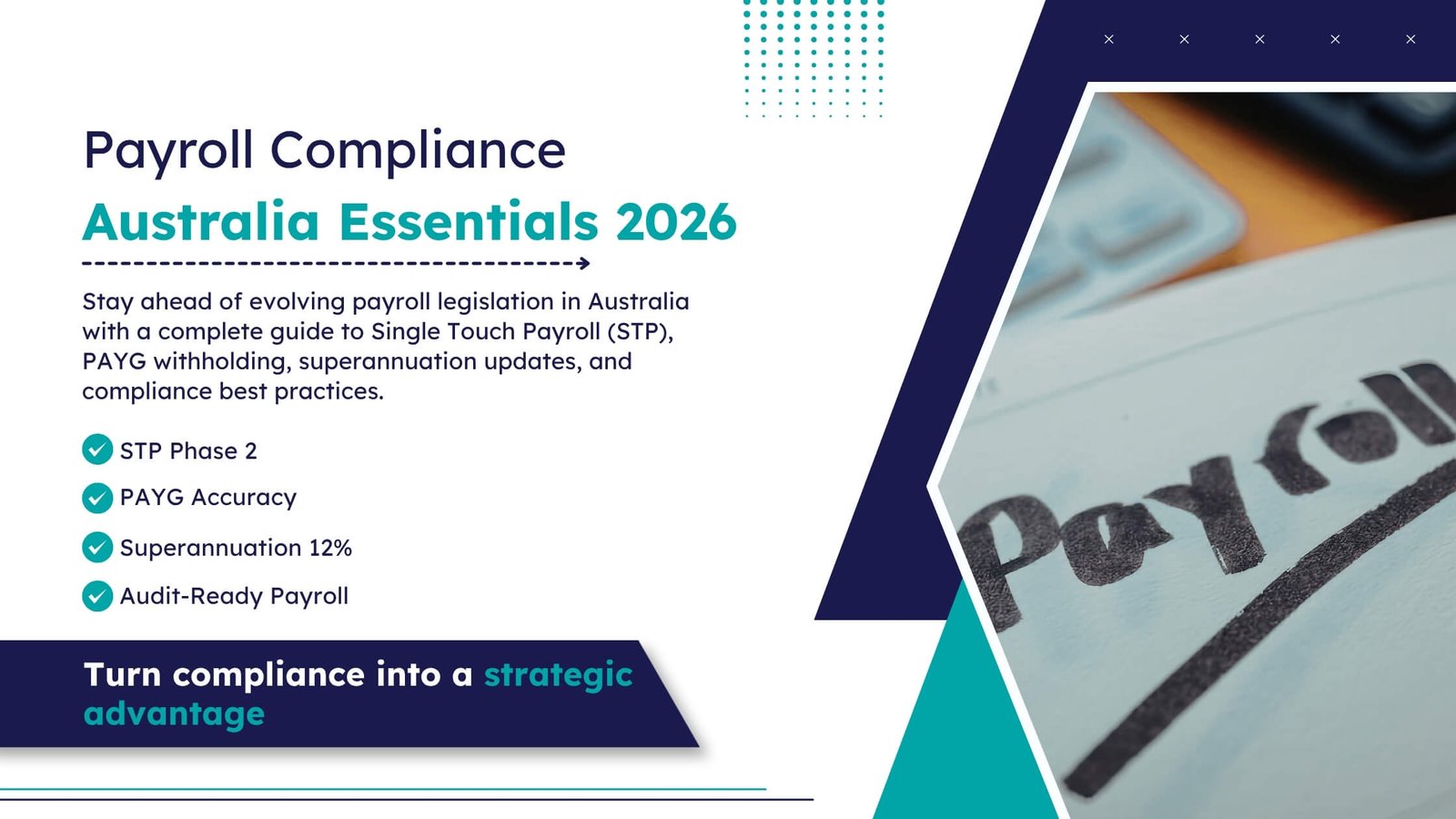
- Adhering to payroll legislation Australia mandates
- Maintaining accurate employee records
- Meeting reporting obligations such as Single Touch Payroll
- Ensuring correct PAYG withholding and superannuation contributions
Failure to comply with can result in penalties, reputational damage, and operational disruption.
Key Payroll Legislation Australia Businesses Must Follow
Australia’s payroll framework is governed by multiple regulatory bodies and legislative instruments. Understanding these is fundamental to maintaining compliance.
- Fair Work Act and Modern Awards
The Fair Work Act 2009 establishes minimum employment standards, while Modern Awards define industry-specific pay rates and conditions.
Key compliance areas include:
- Minimum wages and overtime
- Leave entitlements
- Penalty rates and allowances
Errors in award interpretation remain one of the most common causes of payroll non-compliance.
- Australian Taxation Office (ATO) Requirements
The ATO enforces tax-related payroll obligations, including:
- PAYG withholding
- Superannuation Guarantee (SG) contributions
- Single Touch Payroll reporting
According to the ATO, payroll errors and underpayments continue to be a major compliance focus area, with increasing audit activity across industries.
- Superannuation Guarantee Updates
As of 2026, the Superannuation Guarantee rate has reached 12%, requiring employers to contribute a higher percentage of employees’ ordinary time earnings.
Employers must ensure:
- Timely contributions to super funds
- Accurate calculation of earnings subject to SG
- Compliance with fund choice requirements
Single Touch Payroll (STP): The Backbone of Modern Payroll Compliance
What is Single Touch Payroll?
Single Touch Payroll is a real-time reporting system that requires employers to report payroll information to the ATO each time they process payroll.
This includes:
- Salaries and wages
- PAYG withholding
- Superannuation information
STP has fundamentally changed how payroll compliance operates in Australia.
STP Phase 2 Enhancements
The transition to STP Phase 2 has introduced greater reporting granularity and transparency.
Key changes include:
- Detailed income type classification
- Disaggregation of allowances and deductions
- Enhanced visibility into employee entitlements
These changes allow regulators to detect discrepancies faster, increasing compliance pressure on businesses.
Compliance Challenges with STP
While STP improves transparency, it also creates new challenges:
- Increased data accuracy requirements
- Real-time error exposure
- System integration complexities
Organisations must ensure their payroll systems are aligned with STP requirements to avoid reporting errors.
PAYG Withholding: Accuracy is Critical
PAYG withholding remains a cornerstone of payroll compliance in Australia.
1. What is PAYG Withholding?
PAYG (Pay as You Go) withholding requires employers to deduct tax from employee wages and remit it to the ATO.
2. Key Compliance Considerations
Employers must ensure:
- Correct tax rates are applied
- Employee tax file numbers (TFNs) are recorded accurately
- Withheld amounts are remitted on time
Errors in PAYG withholding can result in penalties and cash flow issues.
3. Common PAYG Errors
- Incorrect tax table application
- Failure to update employee tax details
- Late or missed remittances
Implementing automated payroll systems can significantly reduce these risks.
Payroll Rules and Regulation Australia: 2026 Trends
Payroll rules and regulation Australia are becoming increasingly complex, driven by regulatory tightening and workforce changes.
- Increased Regulatory Scrutiny
Government agencies are intensifying audits and compliance checks, particularly in industries with high rates of wage underpayment.
- Wage Theft Legislation
Several Australian states are introducing or strengthening wage theft laws, making underpayment a criminal offence in some cases.
This significantly raises the stakes for payroll accuracy.
- Data and Reporting Transparency
Regulators are leveraging STP data to:
- Identify inconsistencies
- Cross-check employer reporting
- Enforce compliance in real time
- Digital Transformation of Payroll
Businesses are increasingly adopting:
- Cloud-based payroll systems
- Automation tools
- Integrated HR and payroll platforms
These technologies enhance accuracy, efficiency, and compliance.
For example, organisations leveraging outsourced payroll solutions are better positioned to manage regulatory complexity and scale efficiently.
Building a Compliant Payroll Framework
Achieving payroll compliance requires a structured and proactive approach.
- Implement Robust Payroll Systems
Modern payroll systems should:
- Support STP reporting
- Automate tax calculations
- Integrate with HR systems
- Maintain Accurate Employee Data
Data accuracy is critical for compliance.
Key data points include:
- Employment status
- Pay rates and classifications
- Tax and superannuation details
- Regular Compliance Reviews
Conduct periodic payroll audits to:
- Identify discrepancies
- Ensure award compliance
- Validate reporting accuracy
- Staff Training and Awareness
Payroll teams must stay updated on:
- Legislative changes
- ATO requirements
- System updates
Continuous training reduces the risk of errors.
- Leverage Expert Support
Partnering with experienced providers can enhance compliance and reduce operational burden. Explore how NCSGX can support your broader finance and payroll strategy.
Common Payroll Compliance Risks in 2026
Despite technological advancements, several risks persist.
- Award Misclassification
Incorrectly classifying employees under Modern Awards can lead to underpayments.
- Manual Processing Errors
Manual payroll processes increase the likelihood of:
- Calculation errors
- Data entry mistakes
- Compliance gaps
- System Integration Issues
Disconnected systems can result in in inconsistent data and reporting errors.
- Delayed Superannuation Payments
Late super contributions can attract penalties and interest charges.
Payroll Compliance Checklist for Australian Businesses
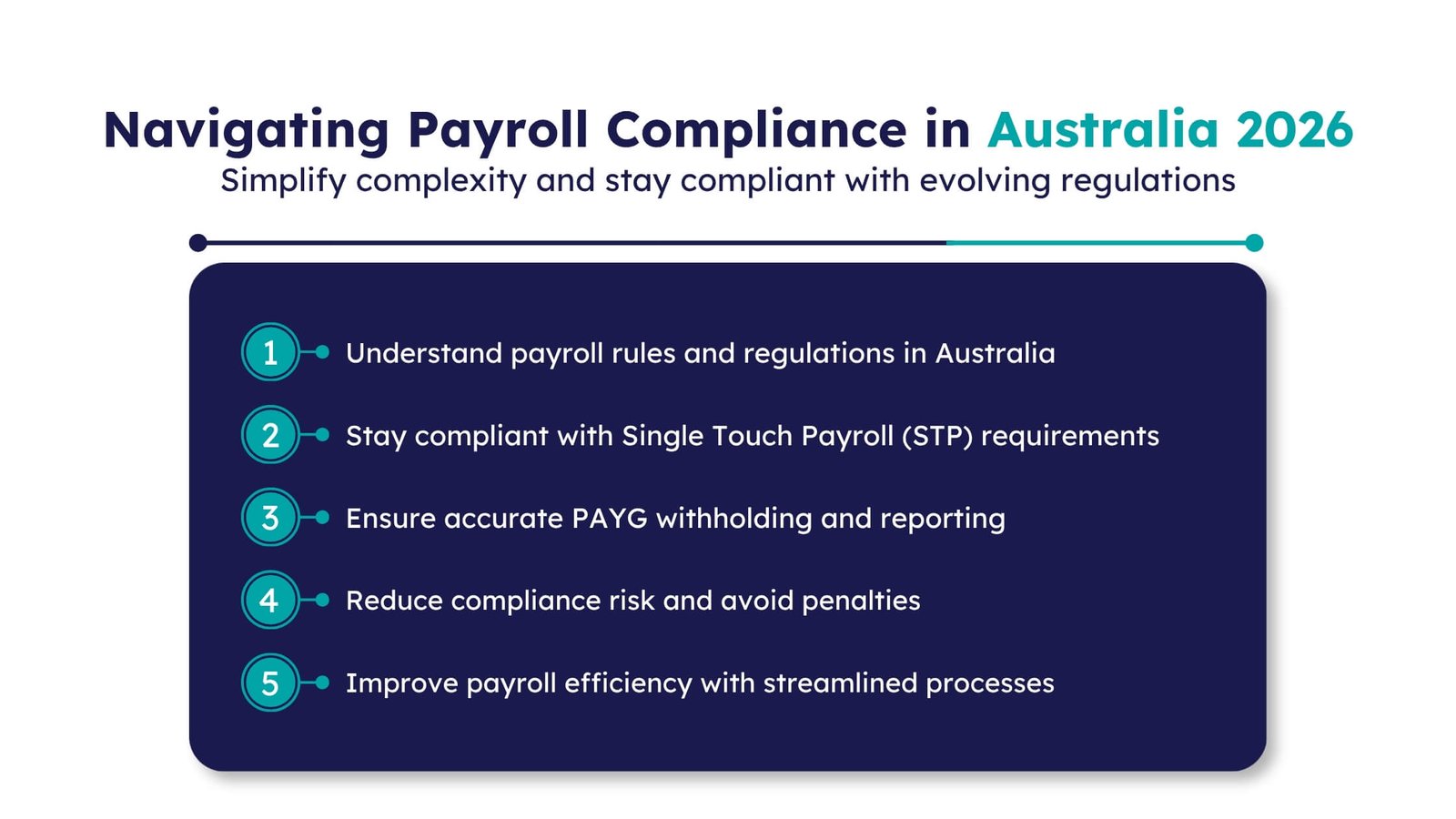
To stay compliant in 2026, businesses should ensure:
- Accurate employee classification under awards
- Correct PAYG withholding calculations
- Timely superannuation contributions
- Full compliance with Single Touch Payroll reporting
- Regular payroll audits and reconciliations
- Updated payroll systems aligned with legislation
The Future of Payroll Compliance in Australia
Payroll compliance is no longer just an administrative function. It is a strategic priority that directly impacts financial performance, employee trust, and regulatory risk.
In 2026 and beyond, organisations that succeed will:
- Embed compliance into payroll processes
- Leverage technology for real-time reporting
- Adopt proactive governance frameworks
The shift from compliance as a task to compliance as a capability is already underway.
Conclusion: Turning Compliance into a Strategic Advantage
Payroll compliance in Australia is becoming more complex, more visible, and more critical to business success. Organisations that fail to adapt to risk of financial penalties and reputational damage, while those that invest in robust systems and expert support can turn compliance into a competitive advantage.
As regulatory expectations continue to evolve, partnering with experienced providers becomes essential. If you are looking to strengthen your payroll compliance framework, streamline operations, and reduce risk, connect with the experts to explore how NCSGX can support your organisation.
How NCSGX Can Help
Managing payroll compliance in Australia requires accuracy, system integration, and constant regulatory alignment. NCSGX supports businesses with end-to-end payroll solutions, ensuring compliance with Single Touch Payroll, PAYG withholding, and evolving payroll legislation Australia.
With the right mix of expertise and technology, NCSGX helps streamline processes, improve data accuracy, and reduce compliance risks. This allows organisations to move from reactive payroll management to a more efficient and future-ready approach.