

 USA
USA
 Canada
 Australia

Ask three advisers what a paraplanner does, and you’ll get three different answers, usually some version of “they write the SOAs.” That’s a visible part of the role. It isn’t the whole role. The technical research, strategy modelling, compliance build, and review work that underpins every piece of advice all sit on the paraplanner’s desk too, and how well that work is done shows up later in audit, in AFCA matters, and in the SOA turnaround you can credibly promise a client.
So what does a paraplanner do, really? This piece breaks down the paraplanner role in financial planning, the duties and responsibilities that sit behind it, and where in-house and outsourced paraplanning services fit in the workflow. Written for advisers, paraplanners, and practice managers who want the practitioner-level answer.
What is a paraplanner?
A paraplanner is the technical engine behind financial advice. They take the adviser’s strategy and translate it into the research, modelling, and documents that make advice deliverable, defensible, and compliant with the Corporations Act and the Code of Ethics.
They sit between the adviser and the compliance team. The adviser owns the client relationship and the recommendation; the paraplanner owns the technical build that supports it. In most Australian practices, paraplanners don’t meet clients directly, though senior paraplanners often join strategy meetings or sit on the compliance review.
Most paraplanners hold a Diploma of Financial Services or Advanced Diploma, with many working toward FAAA Associate or Certified Financial Planner status. The good ones know super, social security, insurance underwriting, and platform construction at a depth most advisers can’t sustain across a full client book.
What does a paraplanner do day-to-day?
The day-to-day work is broader than drafting. A typical week includes:
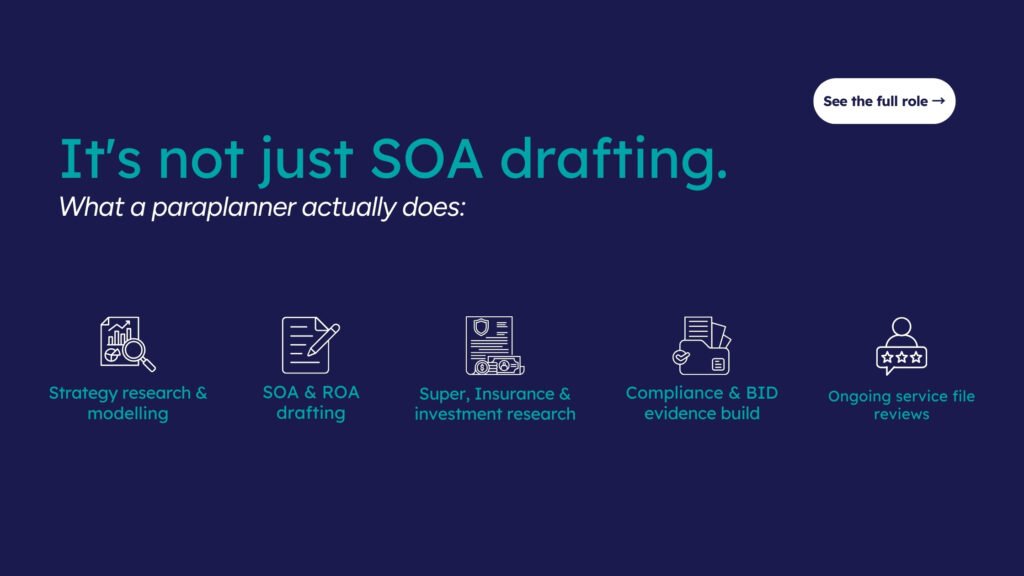
- Drafting Statements of Advice (SOAs) and Records of Advice (ROAs)
- Researching and modelling super contribution, retirement income, and Centrelink strategies
- Running insurance research, sum insured calculations, policy comparisons, retention reviews
- Building investment portfolios within the licensee’s Approved Product List (APL)
- Reviewing existing strategies for ongoing service clients
- Liaising with the adviser, the compliance team, and occasionally product providers
- Updating templates and process docs as licensee standards or RG guidance shift
A senior paraplanner running a full client book inside a busy practice might draft 40–60 SOAs and ROAs a quarter, plus the modelling and review work that goes with them. That’s why the workflow tends to break long before the writing does.
Paraplanner duties and responsibilities – the technical core
SOA and ROA drafting
The SOA is the foundational personal advice document under the Corporations Act s946A. The ROA is allowed only when the client’s circumstances and the basis of advice haven’t materially changed (s946B). A paraplanner who treats the ROA as a “shortcut SOA” is the reason a lot of files get pulled in audit.
Both documents need to show the recommendation, the reasoning, the alternatives considered, and the Best Interests Duty (BID) evidence, not just record it. Standard 6 of the Code of Ethics (broader effects) and Standard 5 (informed consent) are the ones most often flagged when a complaint reaches AFCA, and they’re built into the document at draft stage or rebuilt later under time pressure.
Strategy research and modelling
This is where paraplanners earn their keep. Super contribution strategies sit on top of the concessional and non-concessional caps, total super balance thresholds, and bring-forward rules all moving parts that need current numbers, not last year’s. Retirement income modelling brings in the Transfer Balance Cap, account-based pensions, and TTR strategies. Add Centrelink modelling for clients near age pension eligibility and the technical surface area gets wide quickly.
A worked example: Sarah, 56, super balance $640,000, salary $148,000, considering a TTR strategy from age 60. The paraplanner’s job is to model the salary sacrifice, the TTR drawdown, the tax outcome, and the contribution cap implications across multiple scenarios and then surface the trade-offs in the SOA so the adviser can defend the recommendation in a review meeting or an AFCA complaint three years later.
Compliance and BID evidence
Best Interests Duty under s961B isn’t satisfied by ticking a box. The paraplanner builds BID evidence into the document: the client’s stated objectives, the strategies considered, the reasoning for the recommended path, and the disclosure of alternatives. The same applies to Code of Ethics standards. ASIC’s RG 175 sets out the conduct and disclosure expectations that the SOA needs evidence.
What is the paraplanner role in financial planning?
In a typical advice practice, the paraplanner sits in the middle of a five-stage workflow:
- Adviser meets the client: fact-find, objectives, risk profile
- Adviser sets strategy: the recommendation in principle
- Paraplanner builds the file: research, modelling, SOA or ROA draft
- Adviser reviews and refines: the technical build is checked against the conversation
- Compliance signs off: final review against licensee standards
Where this break is almost always at handover: a thin intake means the paraplanner must chase the adviser for missing information; the strategy gets re-cut mid-draft, and compliance ends up rebuilding sections at the back end. A clean intake template and a same-day strategy confirmation cuts SOA turnaround in half before a paraplanner writes a single sentence.
In-house vs outsourced paraplanning services
Both models work. The right choice depends on volume, complexity, and what the practice can absorb at a fixed cost.
| Factor | In-House Paraplanner | Outsourced Paraplanning Services |
|---|---|---|
| Cost structure | $90k–$130k salary + super + leave + training | Per-SOA or retainer, scales with volume |
| Capacity | Fixed - one person, one queue | Flexible - peak EOFY or review-season scaling |
| Specialist expertise | Limited to one person's depth | Broader team across SMSF, aged care, complex super |
| Onboarding | Weeks to months | Days |
| Continuity | Risk if the paraplanner resigns or takes leave | Process continues regardless |
| Cultural fit | Direct integration with the practice | Workflow integration, not desk integration |
The honest read: in-house works well at high, steady volume with a paraplanner you trust. Outsourced paraplanning works well at variable volume, mixed complexity, or when you’re scaling from solo adviser to small team and don’t want to commit a full salary yet.
When does outsourcing paraplanning services make sense?
The triggers are usually operational, not strategic. If any of the following sound familiar, it’s worth a conversation:
- Your SOA turnaround has crept past three weeks and clients are noticing
- One paraplanner is doing 40+ SOAs a quarter and quality is slipping at the back end
- You’re getting complex files (SMSF, aged care, defined benefit conversions) outside your in-house capability
- Your only paraplanner is on parental leave or long service leave
- You’re scaling and don’t yet have the volume to justify a full salaried hire
- Compliance is rebuilding more secti
How does outsourced paraplanning work in practice?
A clean engagement looks like this: adviser sends a brief and the fact-find, the paraplanner returns a draft SOA inside an agreed turnaround (usually 3–5 business days for standard files, longer for complex), the adviser reviews and requests revisions, and the document goes to compliance. A good outsourced provider builds your licensee’s template, APL, and disclosure standards into their workflow, so the file reads like an in-house build.
What it isn’t: a black box where you send a brief and hope. The adviser still owns the strategy, the BID evidence, and the relationship. Outsourcing buys capacity and technical depth, not accountability.
Conclusion
The paraplanner’s role in financial planning has changed shape since the FASEA wind-up and the DBFO reforms. There’s more documentation pressure, more compliance expectation, and (post-Royal Commission) fewer advisers absorbing the same volume of advice work. Australia’s adviser numbers have settled well below pre-2019 levels per ASIC’s Financial Adviser Register, which means the technical support behind every adviser matters more, not less.
Whether you build that support in-house or outsource it, the question isn’t really what a paraplanner does. It’s what’s your paraplanning capacity actually delivers and where it’s quietly costing you.
How NCSGX can help
NCSGX provides outsourced paraplanning services to Australian financial advisers, self-licensed practices, and licensee groups, covering SOA and ROA drafting, strategy research, modelling, and the file preparation behind every piece of advice. We work inside your licensee’s templates, APL, and compliance standards, so the output reads like an in-house build, not a generic outsourced one.
If your SOA turnaround is creeping past three weeks or you’re scoping whether outsourced paraplanning fits your practice, book a 20-minute review of your workflow, send through a sample brief, and we’ll return a turnaround quote and a sample draft against your template. Learn more about our paraplanning services and SOA and ROA drafting support.
Frequently Asked Questions
1. What's the difference between a paraplanner and a financial adviser?
The adviser owns the client relationship, the recommendation, and the regulated advice. The paraplanner builds the research, modelling, and documents that support it. Paraplanners don’t typically provide personal advice to retail clients, that requires AFSL authorisation under the Corporations Act.
2. Do paraplanners need to be qualified?
There’s no statutory minimum qualification for paraplanners (unlike advisers, who must meet the FAR education standards). In practice, most hold a Diploma or Advanced Diploma of Financial Services, and senior paraplanners often hold or are working toward FAAA Associate or Certified status.
3. Can a paraplanner give financial advice?
No, not without being authorised under an AFSL. A paraplanner can prepare technical analysis and draft documents, but the personal advice is given by the authorised adviser whose name and authorisation appear on the SOA.
4. How long does it take a paraplanner to write an SOA?
For a standard file, 3–5 business days from a complete brief is realistic. Complex strategies (SMSF establishment, aged care, multi-generational super) take longer. The biggest variable isn’t writing speed, it’s how clean the intake is.
5. What's the typical cost of outsourced paraplanning services in Australia?
Pricing varies by complexity and provider, typically structured per-SOA or as a retainer. The relevant comparison isn’t the per-SOA fee, it’s the all-in cost of an in-house paraplanner (salary, super, leave, training, software) divided by your annual SOA volume.
6. What software do paraplanners use?
The common tools are XPlan, Midwinter, and AdviserLogic for advice software; Lonsec, Zenith, and Morningstar for research; and licensee-specific cashflow and modelling tools. Most outsourced paraplanning teams work inside the adviser’s platform, not a separate one.