

 USA
USA
 Canada
 Australia

Outsourcing finance operations Australia-wide has moved from a cost play to a structural decision. In 2026, more Australian businesses are handing their bookkeeping, payroll, BAS preparation, and management reporting to specialist teams, not because they can’t do it in-house, but because doing it well in-house has become harder, slower, and more expensive.
The pressure is real. A persistent shortage of qualified finance staff, rising compliance obligations, and tighter margins are pushing owners and finance leaders to rethink how the back office runs. It’s exactly the gap providers like NCSGX are built to fill. This guide walks through what’s changing, what businesses are outsourcing, and how to know if your business is ready.
The Shift Happening Across Australian Businesses
A few years ago, outsourcing finance work was something larger firms did quietly. Now it’s mainstream across SMEs, accounting practices, and professional services firms.
Two things are driving the shift. First, finding and keeping experienced finance staff has become genuinely difficult accounting has sat on the federal skills shortage list, and salaries have climbed accordingly. Second, the work itself has become more demanding, with more reporting, more compliance, and less tolerance for error.
For many businesses, the maths is simple: keep wrestling with an under-resourced internal function, or partner with a team built to do exactly this work.
What Finance Operations Businesses Are Commonly Outsourcing
Finance operations cover more than just “the books.” When businesses outsource, they typically start with the high-volume, process-driven work and expand from there.
Commonly outsourced functions include:
- Outsourced bookkeeping Australia: day-to-day transaction processing, bank reconciliations, and ledger management
- Accounts payable and receivable: invoice processing, supplier payments, and debtor follow-ups
- Payroll and superannuation: pay runs, payroll processing, STP reporting, and super guarantee payments
- BAS, IAS, and GST preparation: quarterly and monthly lodgement support
- Management reporting: monthly P&L, cash flow, and board-ready packs
- Back-office outsourcing Australia: month-end close, fixed-asset registers, and reconciliations
Many businesses begin with outsourced bookkeeping and grow into broader outsourced accounting services in Australia as trust builds.
How Outsourcing Helps Businesses Stay Operationally Efficient
Efficiency isn’t about doing the same work faster, it’s about freeing your people to do work that actually moves the business.
When transactional finance tasks move to a dedicated team, internal staff stop spending evenings on reconciliations and start focusing on analysis, planning, and decisions. The reporting cycle tightens because the work is run by people who do nothing else.
The practical gains usually show up as:
- Faster month-end close and more reliable numbers
- Fewer single-points-of-failure when a key staff member is on leave or leaves entirely
- A scalable function that flexes up at EOFY and down in quieter months
- Clearer separation between the people recording transactions and the people approving them
The Main Reasons Australian Businesses Are Outsourcing Finance Operations
Finance outsourcing trends Australia-wide in 2026 come down to a handful of consistent drivers.
Cost control: A full in-house finance team bookkeeper, payroll officer, and finance manager, carries salaries, super, software, training, and recruitment costs. Outsourcing converts much of that fixed cost into a predictable monthly engagement.
Access to skills: With qualified staff hard to find, outsourcing gives businesses a ready-built team instead of a 12-week recruitment process and the risk of a bad hire.
Scalability: Workloads aren’t flat. EOFY, BAS quarters, and growth spurts create spikes that a fixed headcount struggles to absorb.
Focus: Owners and managers want to spend their time on customers, strategy, and growth not chasing a reconciliation that won’t balance.
Why Compliance and Risk Management Are Influencing Outsourcing Decisions
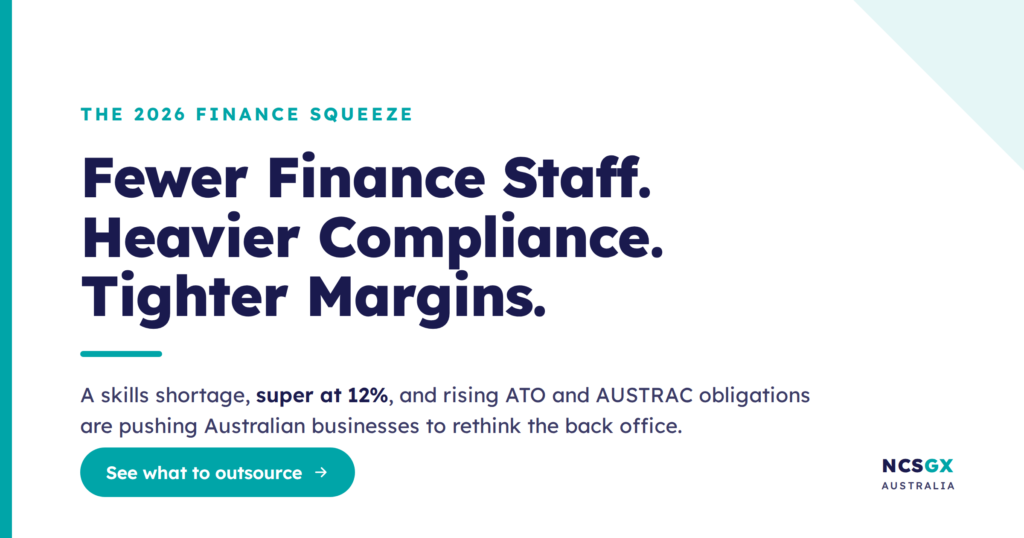
Finance compliance Australia has become noticeably heavier. Single Touch Payroll, the super guarantee now at 12%, ongoing ATO data-matching, and the expansion of AUSTRAC’s AML/CTF obligations to more professional services have all raised the stakes of getting it wrong.
For a small internal team, keeping current with every change is a real burden. A specialist outsourcing partner has compliance built into its workflow, current rates, current lodgement rules, current reporting standards because compliance is its core business, not a side task squeezed in around everything else.
That’s a meaningful risk reduction. Penalties, interest, and director liabilities for things like unpaid super are too costly to leave to an overstretched team.
Common Concerns Businesses Have Before Outsourcing Finance Functions
Hesitation is healthy. The finance function touches sensitive data and core operations, so the concerns are worth naming.
The most common ones:
- “Will I lose control?” The opposite, usually. A good partner gives you more visibility than a stretched internal team ever did, through regular reporting and clear points where you sign off on what matters.
- “Is my data secure?” Established providers work within defined security controls, access permissions, and protocols built specifically to protect financial data. It’s fair to ask exactly what those look like.
- “Will they understand Australian rules?” This is the one that separates a capable partner from a cheap one. ATO, ASIC, and Fair Work obligations aren’t optional knowledge, and local capability is non-negotiable.
- “What if something goes wrong?” Most of this risk disappears with a clear scope, agreed service standards, and a named contact who answers when you call.
What Businesses Should Evaluate Before Outsourcing Finance Operations
Choosing a partner is a procurement decision, not a leap of faith. A short evaluation checklist keeps it grounded.
Before signing, assess:
- Australian compliance capability: Do they genuinely understand BAS, STP, super, and ATO obligations?
- Security and data handling: What controls protect your financial data?
- Reporting and transparency: How and how often will you see the numbers?
- Scalability: Can they grow with you through busy periods and expansion?
- Service model: Who is your contact, what’s the response time, and how is quality checked?
- Onboarding: How will they transition your current processes without disruption?
For complex obligations, it also helps to confirm how they handle BAS and GST compliance specifically.
Signs a Business May Be Ready to Outsource Finance Operations
You don’t need every box ticked. A few clear signals usually mean it’s time to look seriously.
Common signs include:
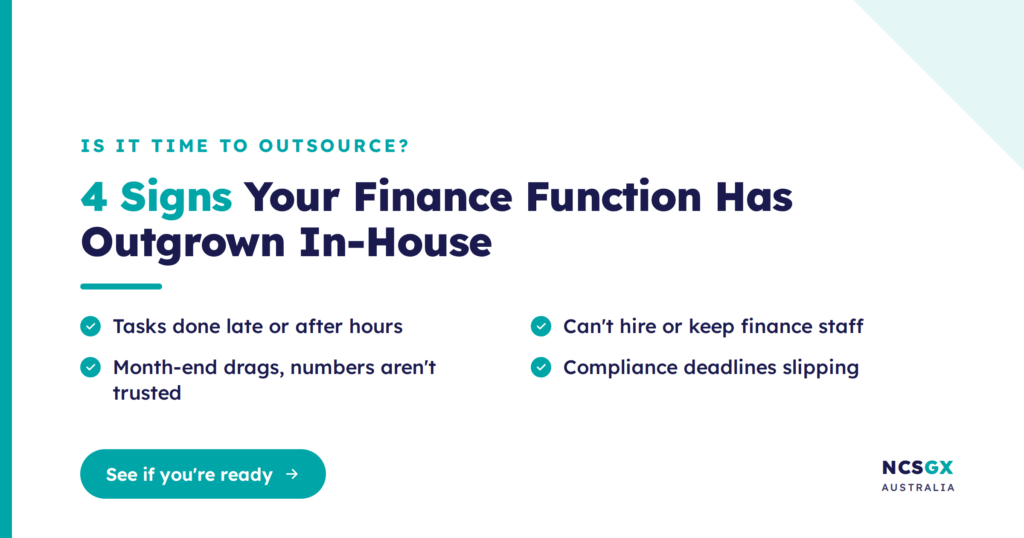
- Finance tasks are consistently late or done after hours
- You’ve struggled to hire or retain a bookkeeper or finance officer
- Month-end takes too long and the numbers aren’t trusted
- Compliance deadlines are slipping or causing stress
- Growth has outpaced your current finance setup
- Your senior people are stuck doing data entry instead of strategy
Final Thoughts on the Future of Finance Operations in Australia
Outsourcing finance operations Australia-wide is no longer a fringe choice, it’s becoming a standard part of how well-run businesses operate. As the skills shortage persists and compliance keeps tightening, the businesses that thrive will be the ones that put their finance function in capable, specialist hands and redirect their own energy toward growth.
The decision isn’t really “in-house or outsourced.” It’s whether your finance function is set up to support the business you want to be in two years and if it isn’t, what you do about that now.
Conclusion
Outsourcing finance operations isn’t about giving up control of your numbers; it’s about putting them in the right hands so your business can keep moving. As the skills shortage holds and compliance keeps tightening through 2026, the businesses that stay ahead are the ones that stop stretching an internal team thin and build a finance function designed to scale. That’s the work NCSGX Australia does every day, supporting business owners, finance teams, and accounting firms with bookkeeping, payroll, BAS and GST preparation, management reporting, and broader back-office support.
Everything is handled to Australian standards, integrated with the software you already use, and built so you keep clear visibility over every step. Whether you need to take the pressure off a stretched team or build a finance function from the ground up, you can learn more at ncsgx.com.au or book a short discovery call with the NCSGX team.
Frequently Asked Questions (FAQ)
1. What does finance operations outsourcing include?
It typically covers bookkeeping, accounts payable and receivable, payroll and super, BAS and GST preparation, bank reconciliations, month-end close, and management reporting. Engagements range from a single function, such as outsourced bookkeeping Australia, through to a full back-office finance team.
2. Is finance outsourcing common in Australia?
Yes. Finance outsourcing trends Australia-wide show steady growth across SMEs, professional services, and accounting practices, driven largely by the shortage of qualified finance staff and rising compliance demands.
3. Can small businesses outsource finance operations?
Absolutely. Small businesses are often the biggest beneficiaries, because they rarely have the volume to justify a full in-house finance team but still carry the same compliance obligations as larger firms.
4. How do outsourced finance teams handle Australian compliance requirements?
A capable partner builds finance compliance Australia into its standard workflow, applying current ATO rules, STP reporting, super guarantee rates, and lodgement deadlines and keeps current as those obligations change.
5. What are the risks of outsourcing finance functions?
The main risks are data security, loss of visibility, and a provider that doesn’t understand local rules. These are managed by choosing a partner with clear security controls, transparent reporting, defined approval points, and genuine Australian compliance capability.
6. How do businesses maintain control over outsourced finance processes?
Control comes from structure, not headcount. Regular reporting, defined approval workflows, a named point of contact, and agreed service standards mean you keep oversight and final sign-off while the processing work is handled for you.