

 USA
USA
 Canada
 Australia

The AML/CTF reforms for accountants have moved from “something coming down the track” to a hard deadline. From 1 July 2026, Australian accounting firms are formally brought into the anti-money laundering and counter-terrorism financing regime that, until now, has applied mainly to banks, casinos and remittance providers. If your firm does more than lodge tax returns, and most do, the Tranche 2 AML/CTF reforms will change how you onboard clients, what records you keep, and what you report to AUSTRAC.
At NCSGX, we’re already helping Australian firms get ready, so this guide cuts to the practical detail: who the reforms capture, the dates that matter, the obligations you’ll carry, and how to start preparing before the deadline lands.
Are accounting firms covered?
Short answer: many are, but not automatically. The reforms don’t capture “accountants” as a profession. They capture firms that provide specific designated services to clients.
For accounting practices, the designated services that trigger AML/CTF obligations include:
- Assisting a client to plan or execute a transaction to buy, sell or transfer real estate or a business
- Managing client money, accounts, securities or other assets
- Setting up, operating or managing a company, trust or other legal arrangement
- Acting as (or arranging for someone to act as) a director, company secretary, trustee or nominee shareholder
- Providing a registered office or business address for a client
If your firm does any of these even occasionally, you’re almost certainly in scope. A full-service firm that incorporates companies, sets up family trusts, manages an SMSF’s administration or holds client funds will be captured. Routine work like preparing income tax returns, BAS lodgements or general bookkeeping, on its own, is not a designated service.
The practical reality: very few firms do only tax returns. The moment you set up a trust or act as a registered office, you’re covered.
What’s changing and why now
Australia has been one of the last major economies not to regulate “gatekeeper” professions, accountants, lawyers and real estate agents under its AML/CTF laws. The Financial Action Task Force (FATF), the global body that sets anti-money laundering standards, has flagged this gap for years.
The AML/CTF Amendment Act 2024 closes it. It passed Parliament on 29 November 2024 and received Royal Assent on 10 December 2024. The supporting AML/CTF Rules 2025 were finalised through 2025, with sector-specific guidance for accounting and other Tranche 2 entities released late that year.
The logic is straightforward. Criminals don’t launder money in a vacuum, they use professional services to structure entities, move funds and lend legitimacy to transactions. The reforms put a set of checks at exactly those points.
The key dates you need to know
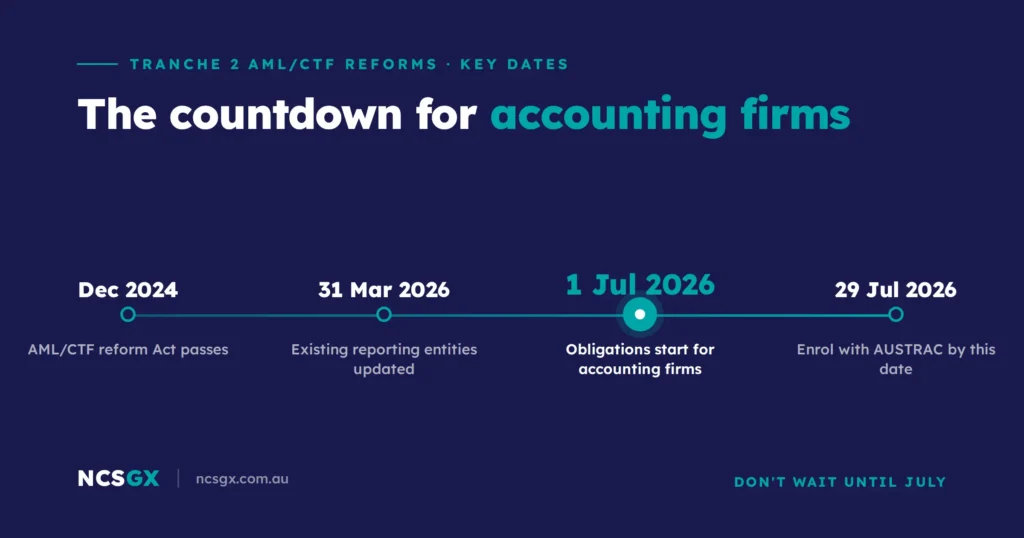
The timeline is staged, and the dates for accounting firms are firm. Here’s what’s locked in:
Date | What happens |
10 December 2024 | AML/CTF Amendment Act receives Royal Assent |
31 March 2025 | Updated “tipping off” offence commences |
31 March 2026 | Changes to obligations for existing reporting entities and virtual asset service providers |
1 July 2026 | AML/CTF obligations commence for Tranche 2 entities, including accounting firms |
29 July 2026 | Newly regulated firms must be enrolled with AUSTRAC by this date |
The two dates that matter most for your firm are 1 July 2026, when your obligations begin, and 29 July 2026, the deadline to complete your AUSTRAC enrolment. With 1 July only weeks away, the time to build your program is now, not in July.
What your firm will need to do: your AML/CTF obligations
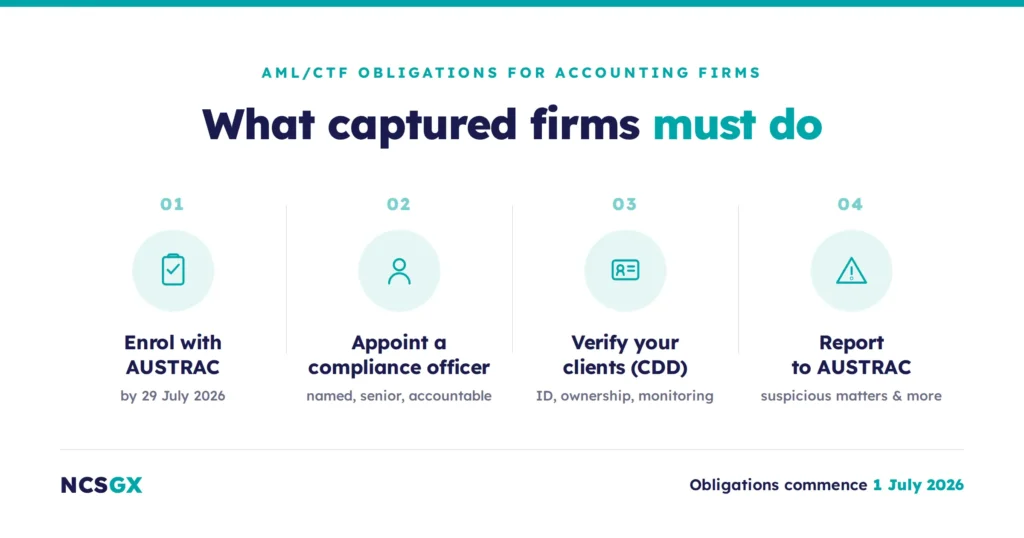
Once you’re captured, the AML/CTF obligations for accounting firms fall into a few core areas. None of them are optional.
Enroll (and where relevant, register) with AUSTRAC. AUSTRAC enrolment for accountants is the entry point. You’ll provide details about your firm, the designated services you offer, and the person responsible for compliance. Enrolment must be completed by 29 July 2026.
Appoint an AML/CTF Compliance Officer. This is a named individual at a senior level who is accountable for your firm’s compliance. In a small practice, that’s often a partner.
Conduct a money laundering and terrorism financing risk assessment. You need to understand where your firm is exposed, which clients, services and delivery channels carry higher risk, before you can manage it.
Build and maintain an AML/CTF program. Your AML/CTF program is the documented set of policies, procedures and controls that turn your risk assessment into day-to-day practice. It covers how you verify clients, monitor activity, train staff and keep records.
Carry out customer due diligence (CDD). This means knowing who your client actually is, verifying identity, understanding beneficial ownership, and applying enhanced checks for higher-risk clients such as politically exposed persons (PEPs). It also means ongoing monitoring, not just a one-off check at onboarding.
Meet your reporting obligations. This includes:
- Suspicious matter reporting: lodging a Suspicious Matter Report (SMR) with AUSTRAC when you form a reasonable suspicion about a client or transaction
- Threshold Transaction Reports (TTRs) for cash transactions of $10,000 or more
- Annual compliance reports to AUSTRAC
Keep records. Identity records, transaction records and your AML/CTF program documentation generally need to be retained for seven years.
How to start preparing now
You don’t need to solve everything at once, but you do need to start. A sensible sequence:
- Work out if you’re captured. Map your services against the designated services list. If you set up entities, manage client money or provide registered office services, assume you’re in.
- Decide who owns it. Nominate your AML/CTF Compliance Officer early so someone is driving the work.
- Run a risk assessment. Look honestly at your client base and the services that carry the most exposure.
- Draft your program and CDD procedures. Build practical onboarding and verification steps your team can actually follow.
- Diarise the deadlines. AUSTRAC enrolment by 29 July 2026; obligations live from 1 July 2026.
- Train your people. Front-desk and client-facing staff need to know what to look for and when to escalate.
If that list feels heavy on top of an EOFY workload, you’re not alone and you don’t have to carry the administrative weight in-house. More on that below.
Conclusion
The AML/CTF reforms for accountants take effect on 1 July 2026, with AUSTRAC enrolment due by 29 July 2026. If your firm provides any designated service setting up entities, managing client money, acting as a registered office you’re in scope, and you’ll need a working AML/CTF program before the deadline, not after it. The firms that start now will treat this as a manageable process; the ones that wait until July will treat it as a scramble.
The good news is that none of this needs to derail your EOFY workload. With the right preparation and the right back-office support, your firm can meet its new obligations cleanly and keep doing what it does best. If you’d like to talk through where your firm stands and what to prioritise first, reach out to the NCSGX team. We’re happy to help you map a clear path to 1 July.
How NCSGX can help
The Tranche 2 reforms add a real compliance layer on top of the work your firm is already doing, and they land in the middle of your busiest period. NCSGX supports Australian accounting firms with the back-office capacity to absorb that load without hiring in a hurry.
We help firms with the operational side of AML/CTF readiness: structuring and maintaining client due diligence workflows, organising and retaining records to meet seven-year requirements, supporting ongoing monitoring, and freeing your senior people to own the parts that must stay in-house. Paired with our accounting and bookkeeping support, outsourced back-office services and compliance and reporting support, it means your firm can meet the 1 July 2026 deadline with its workflow intact rather than overloaded.
Frequently Asked Questions (FAQ)
1. Do bookkeepers need to comply with the AML/CTF reforms?
Generally, no, not for standard bookkeeping. Recording transactions, reconciling accounts and preparing BAS are not designated services on their own. A bookkeeper would only be captured if they started providing a designated service, such as managing client money or helping set up a company or trust.
2. Do I need to enrol with AUSTRAC if I only prepare tax returns?
If your firm genuinely provides only tax return preparation and similar compliance work, you likely won’t be captured and won’t need to enrol. The catch is that very few firms stop there. The moment you incorporate a company, establish a trust, act as a registered office or hold client funds, AUSTRAC enrolment for accountants applies.
3. What happens if my firm doesn't comply?
Non-compliance carries civil and, in serious cases, criminal penalties and AUSTRAC has a track record of substantial enforcement action against reporting entities. Beyond penalties, there’s reputational and licensing risk. The reforms are not being introduced as a box-ticking exercise; AUSTRAC expects genuine, risk-based compliance.
4. Can AML/CTF obligations be outsourced?
The accountability can’t be outsourced your firm remains legally responsible, and your AML/CTF Compliance Officer role stays in-house. But the operational heavy lifting absolutely can be supported externally: customer due diligence and identity verification, ongoing monitoring, record-keeping, drafting and maintaining your AML/CTF program, and preparing reporting. This is where the right back-office partner takes the burden off your team.