
 USA
USA
 Canada
 Australia
Introduction
Buying new equipment, technology, or other business assets can be a significant expense for a small business. The instant asset write-off eligibility 2026 rules can make those investments easier to manage by allowing eligible businesses to claim an immediate deduction for qualifying assets costing less than $20,000.
For Australian businesses, NCSGX Australia provides finance and accounting support that can help businesses maintain accurate records, organise financial information and support compliance processes.
The $20,000 instant asset write-off is now permanent from 1 July 2026, giving eligible small businesses greater certainty when planning asset purchases. However, the rules still contain conditions around business size, asset type, business use, and when the asset is first used or installed, ready for use.
What Is the Instant Asset Write-Off in 2026?
The instant asset write-off allows eligible small businesses to claim an immediate deduction for the business-use portion of an eligible depreciating asset in the income year the asset is first used, or installed ready for use, for a taxable purpose.
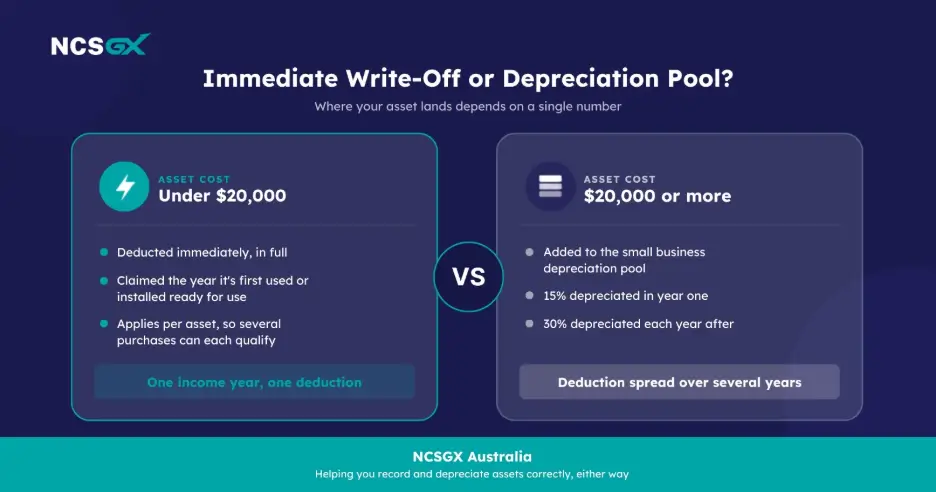
From 1 July 2026, the $20,000 threshold is permanent. The legislation applies to the threshold on a per-asset basis, meaning an eligible business can claim multiple assets during the same financial year, provided each qualifying asset costs less than $20,000.
This can help businesses that purchase items such as computers, tools, office equipment and machinery manage the tax deduction in the year the investment is made rather than depreciating the asset over several years.
The write-off is a tax deduction, not a cash refund. The actual tax benefit depends on the business’s taxable income and circumstances.
Who Is Eligible for the Instant Asset Write-Off in 2026?
The who qualifies for instant asset write off question starts with the business’s aggregated turnover.
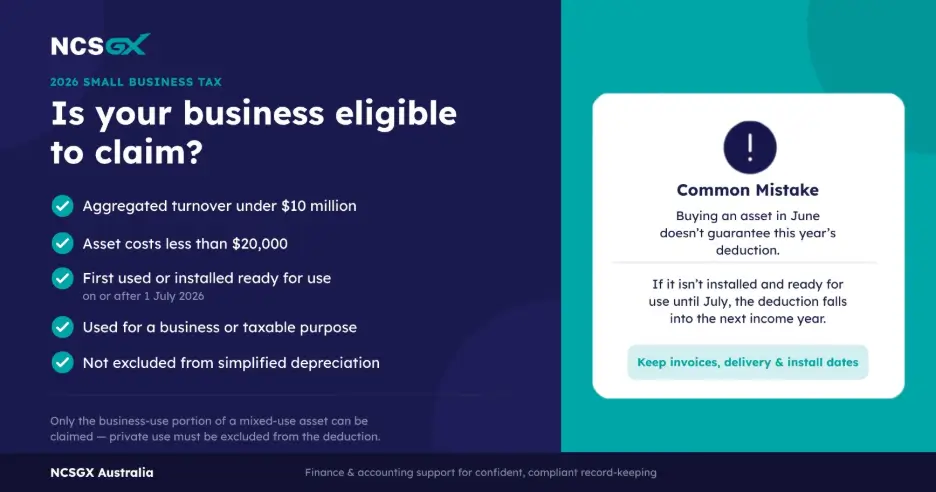
For 2026–27, the permanent $20,000 measure applies to small business entities with aggregated annual turnover of less than $10 million that use the simplified depreciation rules.
When determining aggregated turnover, businesses need to consider not only their own turnover but also relevant connected entities and affiliates.
Other conditions also apply. Generally, the asset must:
- Be an eligible depreciating asset.
- Cost less than $20,000.
- Be first used, or installed ready for use, for a taxable purpose on or after 1 July 2026.
- Be used for business or another taxable purpose.
- Not excluded from the simplified depreciation rules.
The instant asset writes off rules 2026 therefore requires more than simply purchasing an asset for under $20,000.
What Is the $20,000 Instant Asset Write-Off Limit?
The $20,000 threshold applies to each individual asset, rather than to the total amount a business can spend during the year.
For example, if an eligible business purchases:
- A computer for $4,000
- Office equipment for $7,500
- Tools for $3,500
- Business machinery for $12,000
Each asset may potentially qualify because each individual asset costs less than $20,000.
There is no general annual limit that restricts a business to one $20,000 asset. The legislation specifically maintains the per-asset approach.
However, an asset costing $20,000 or more does not qualify for immediate deduction under the threshold. Instead, it may need to be allocated to the small business simplified depreciation pool and depreciated under the applicable rules.
What Assets Qualify for the Instant Asset Write-Off?
The eligible assets for instant asset to write off are generally depreciating assets used in carrying on a business or for another taxable purpose.
Depending on the business, examples can include:
- Computers and business technology
- Printers and office equipment
- Tools and equipment
- Machinery
- Furniture and fixtures
- Certain business vehicles
- Other qualifying depreciating assets
Both new and second-hand assets can potentially qualify if they meet the relevant requirements.
The asset must also be first used or installed ready for use for a taxable purpose in the relevant income year. Simply purchasing an asset before the end of the financial year does not necessarily mean the deduction can be claimed for that year.
For example, if a business orders equipment in June but it is not installed and ready for use until July, the relevant income year may be the following financial year.
Businesses should therefore keep evidence showing the purchase date, installation or delivery date and when the asset was brought into use.
What Assets Are Not Eligible for Instant Asset Write-Off?
Not every business purchase automatically qualifies.
The simplified depreciation rules contain exclusions, and special rules can apply to certain assets. Passenger vehicles, for example, can be affected by the car limit, which can restrict the amount that can be depreciated.
Other exclusions may apply depending on the nature and use of the asset.
Private use also matters. A business can generally claim only the portion of an eligible asset that is used for business or another taxable purpose.
For example, if a qualifying computer costing $10,000 is used 80% for business and 20% privately, the deductible business portion would generally be $8,000 rather than the full $10,000.
This is why businesses should assess both the type of asset and its actual use before claiming the deduction.
How Does the Instant Asset Write-Off Work for Small Businesses?
The instant asset write-off forms part of the simplified depreciation rules for eligible small businesses.
Where an asset meets the $20,000 threshold and other conditions, the eligible business-use portion can generally be deducted immediately in the relevant income year.
If an asset costs $20,000 or more, it generally moves into the small business depreciation pool rather than receiving the immediate write-off. Under the current rules, qualifying assets added to the pool are generally depreciated at 15% in the first income year and 30% in later years.
This creates an important distinction:
Asset below $20,000: potentially deducted immediately.
Asset $20,000 or more: generally dealt with through the small business depreciation pool.
The threshold therefore needs to be considered before a business finalises its asset of purchase and tax treatment.
How to Claim the Instant Asset Write-Off in Your Tax Return
Claiming the deduction requires appropriate records and correct tax treatment.
Businesses should retain documents such as:
- Supplier invoices and receipts
- Asset descriptions
- Purchase dates
- Installation or ready-for-use dates
- Evidence of business-use percentage
- Financing or lease documentation where relevant
- GST records
- Depreciation records
The cost used for the threshold can also depend on the business’s GST position. Businesses registered for GST and entitled to claim a GST credit generally calculate the asset cost differently from businesses that cannot claim the GST credit.
The asset should then be correctly recorded in the accounting and depreciation records and included in the relevant tax return.
Because an incorrect asset classification can affect the deduction, businesses should review their records before lodging.
Instant Asset Write-Off vs Depreciation: What Is the Difference?
The main difference is when the deduction is recognised.
With the instant asset write-off, an eligible asset costing less than $20,000 can potentially be deducted immediately in the relevant income year.
Under normal depreciation, the cost of an asset is generally spread over its effective life or dealt with under the applicable depreciation rules.
For small businesses using simplified depreciation, assets that do not qualify for the instant write-off may generally be placed into the small business pool.
The choice is therefore not simply about getting a larger deduction. Businesses should consider cash flow, taxable income, business use, and the longer-term tax position before making significant asset purchases.
Common Mistakes Businesses Make When Claiming Asset Write-Offs
Some of the most common mistakes include:
1. Assuming every asset under $20,000 qualifies
The asset must meet the eligibility requirements and must not be excluded.
2. Using the purchase price without considering GST
The relevant cost treatment depends on the business’s GST circumstances.
3. Ignoring private use
Only the taxable-purpose portion can generally be claimed.
4. Using the threshold against the business-use portion
The ATO’s rules require the entire asset cost to be considered when determining whether the asset is below the threshold.
5. Buying the asset but not having it ready for use
The timing of when an asset is first used or installed ready for use matters.
6. Assuming vehicles are treated like ordinary equipment
Passenger vehicles can be subject to additional depreciation limits.
7. Failing to maintain supporting records
Invoices, dates and business-use evidence should be retained to support the deduction.
How NCSGX Can Help
NCSGX Australia supports businesses with finance and accounting operations that require accurate records, structured processes and reliable financial information.
Our support can help businesses with:
- Bookkeeping and transaction processing
- Asset and financial record management
- Reconciliations and accounting support
- BAS and GST-related processes
- Financial reporting
- Month-end and year-end support
- Documentation and workflow management
Through finance and accounting outsourcing support, businesses can strengthen their underlying financial processes and maintain better visibility over transactions and records. NCSGX does not provide regulated tax advice directly; tax advice and final tax positions should be handled by appropriately authorised professionals.
Conclusion
The instant asset write off eligibility 2026 rules give eligible Australian small businesses greater certainty, with the $20,000 threshold now permanently applying from 1 July 2026. Businesses with aggregated turnover below $10 million can potentially immediately deduct eligible assets costing less than $20,000, with the threshold applying separately to each asset.
However, eligibility depends on more than the asset’s price. Businesses need to consider the type of asset, business use, GST treatment, ready-for-use date, vehicle restrictions, and record-keeping requirements.
If you need support with your finance operations and accounting processes, contact NCSGX Australia to discuss how our outsourced finance and accounting support can help your business maintain accurate and organised financial records.
Frequently Asked Questions (FAQ)
1. Is the instant asset write-off available in 2026?
Yes. The $20,000 instant asset write-off has been made permanent from 1 July 2026 for eligible small businesses with aggregated turnover of less than $10 million.
2. What is the maximum instant asset write-off amount for small businesses?
The threshold is $20,000 per asset, but the asset must cost less than $20,000 to qualify. Assets costing $20,000 or more are generally dealt with under the small business depreciation pool rules.
3. Can small businesses claim multiple assets under the instant asset write-off?
Yes. The $20,000 threshold applies on a per-asset basis, so an eligible business can potentially claim multiple qualifying assets during the same income year.
4. Does a vehicle qualify for instant asset write-off?
A vehicle may qualify if it meets the relevant requirements, but passenger vehicles can be subject to a separate car limit. The business-use portion and vehicle classification also need to be considered.
5. What records are needed to claim the deduction?
Businesses should retain invoices, receipts, asset details, purchase information, ready-for-use dates, GST records and evidence supporting the business-use percentage. These records help substantiate the deduction and support accurate tax reporting.