

 USA
USA
 Canada
 Australia

Payday Super 2026 starts on 1 July, and it’s the biggest change to superannuation compliance in decades. From that date, employers must pay super at the same time as wages, not once a quarter. At NCSGX, we work with accounting firms and BAS agents across Australia who are already reviewing payroll processes ahead of this deadline. If your payroll, cash flow, and reporting aren’t ready, the ATO’s new penalty regime won’t wait for you to catch up.
Here’s exactly what’s changing and what to fix before the deadline.
What Is Payday Super 2026?
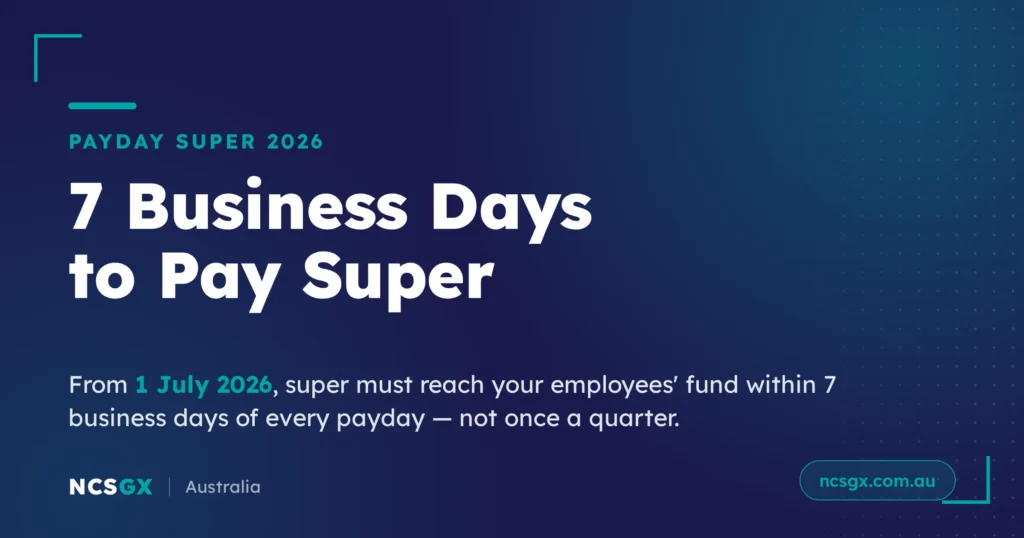
Payday Super is a legislated change requiring employers to pay superannuation guarantee contributions on the same day as wages, rather than by the current quarterly due dates. The ATO’s Payday Super guidance sets out the full detail, but here’s what matters most for employers.
From 1 July 2026:
- Super must be paid every payday, whether you run weekly, fortnightly, or monthly pay cycles
- Contributions must actually land in the employee’s super fund account within 7 business days of payday
- The old 28-day-after-quarter-end deadline is gone
This isn’t a minor tweak to due dates. It’s a structural shift in how often money leaves your business account, and how tightly your payroll and super processes need to work together.
What Actually Changes for Employers?
The table below compares the current system with what applies from 1 July 2026.
| Area | Current Rules | New Rules from 1 July 2026 |
| Payment frequency | Quarterly (4 times a year) | Every payday |
| Payment timing | Up to 28 days after quarter end | Within 7 business days of payday |
| Earnings base | Ordinary Time Earnings (OTE) | Qualifying earnings (broader) |
| SBSCH | Available to eligible small businesses | Closed from 1 July 2026 |
| Late payment charge | SGC not tax deductible | SGC is tax deductible |
| Reporting | Checked quarterly | Matched against STP each pay run |
Every one of these rows touches a different part of your business payroll software, cash flow, HR data, and compliance reporting. Fixing one without the others won’t get you compliant.
Payroll Systems Need to Be Ready for Payday Super
Your payroll software needs to calculate, process, and remit super automatically at every pay run, not batch it up for later. If you’re still relying on manual super calculations, spreadsheets, or a system that only reports quarterly, that setup won’t survive the 7-day window. If you’d rather have this handled for you, our outsourced payroll and bookkeeping services are built around exactly this kind of compliance shift.
Before 1 July 2026, check that your payroll system:
- Calculates super automatically as part of each pay run
- Integrates with a SuperStream compliant clearing house or fund payment gateway
- Can process real-time or near real-time payments, not just batch transfers that take days to clear
A clearing house that takes three to five days to process payments leaves you almost no buffer inside a 7-business-day deadline.
Qualifying Earnings Need to Be Calculated Correctly
Under the current system, super guarantee is calculated on Ordinary Time Earnings (OTE). From 1 July 2026, the ATO moves to a broader measure called qualifying earnings, explained in detail in the ATO’s guide to qualifying earnings.
Qualifying earnings generally include OTE plus amounts like salary sacrifice contributions and certain commissions. That means the earnings base you’re calculating super on gets wider and if your payroll settings still default to the old OTE definition, you’ll underpay super without realising it.
This is a configuration issue, not just a policy one. Payroll systems need their super calculation rules updated to reflect qualifying earnings before the first payday in July 2026.
STP Reporting Must Match the New Super Process
Single Touch Payroll (STP) reporting and super payments will need to line up far more closely than they do now. Where the ATO currently reconciles super obligations on a quarterly cycle, payday super means STP data effectively confirms compliance every pay run.
That means:
- Your STP reporting needs to reflect the correct qualifying earnings figure each pay run
- Discrepancies between STP data and actual super payments become visible to the ATO much sooner
- Errors that used to get quietly corrected before quarter-end now show up in near real time
If your STP and super payment processes run through disconnected systems, this is the year to bring them together.
Cash Flow Planning Will Need to Change
Quarterly super gave employers an informal cash flow buffer: three months of accrued super sitting in the business before it had to go out the door. That buffer disappears under Payday Super. Independent modelling from Employment Hero estimates the average business could need over $124,000 in additional working capital to meet the new payday super requirements.
From 1 July 2026, super leaves your account every pay cycle instead of once a quarter. For a business running weekly payroll, that’s a meaningful shift in short-term liquidity, not just an administrative change.
Start reviewing this now:
- Model your cash flow assuming super leaves the account weekly or fortnightly, not quarterly
- Build super into your regular pay-run budgeting rather than treating it as a periodic bill
- Talk to your bookkeeper or accountant about working capital if the shift is significant for your business
The ATO Small Business Superannuation Clearing House Closure
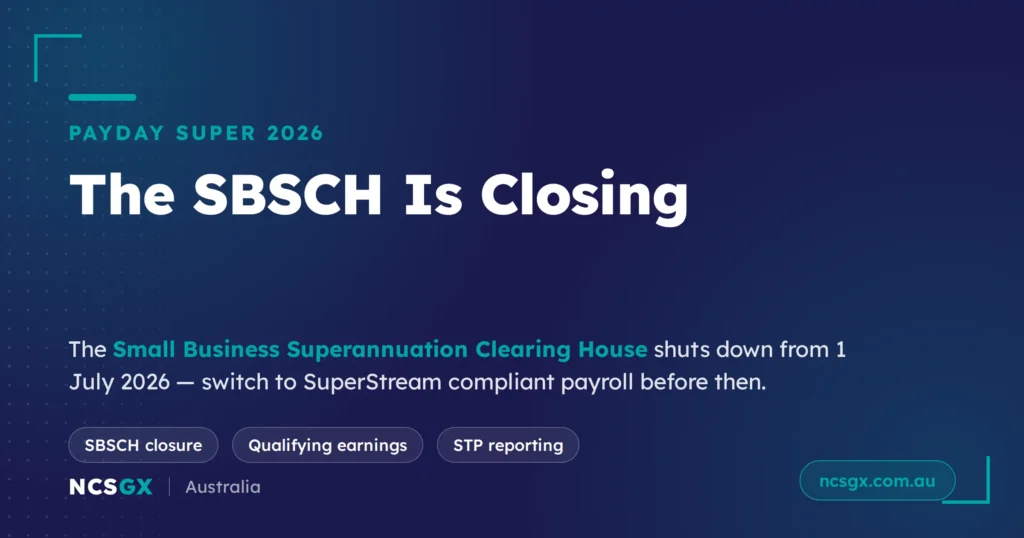
The Small Business Superannuation Clearing House (SBSCH), the free ATO service many small businesses use to pay all employee super in one transaction, is closing as part of the Payday Super reforms.
If your business currently uses SBSCH, you’ll need to move to a commercial clearing house or a payroll system with built-in SuperStream compliant payment processing before 1 July 2026. Leaving this until the last few weeks is risky: migrating super payment methods takes time to set up, test, and confirm with your existing employees’ funds.
Employee Onboarding and Fund Details Need Better Controls
Incorrect employee fund details cause bounced super payments and under the new 7-day deadline, there’s far less room to chase down and re-process an error before you’re technically late.
Tighten these controls before go-live:
- Verify Tax File Numbers and superannuation fund details at onboarding, not after a payment fails
- Check for stapled super funds through ATO Online Services when a new employee doesn’t nominate a fund
- Keep employee super details current whenever fund or bank details change
What Happens If an Employer Pays Late?
Missing the 7-business-day window triggers the Superannuation Guarantee Charge (SGC). Under the new rules, the SGC generally includes:
- Interest calculated from the date super was due
- An administrative uplift that can add a significant percentage on top of the shortfall
- The SGC amount itself becomes tax deductible, unlike the current non-deductible penalty though avoiding it altogether is still far cheaper than paying it
There’s effectively no grace period. Being late by a single day still triggers the charge, and the ATO has far greater visibility into individual pay runs than it did under quarterly reporting.
Payday Super Readiness Checklist for Employers
Use this as a working checklist between now and 1 July 2026:
- Confirm your payroll software calculates and pays super automatically each pay run
- Update super calculation settings from OTE to qualifying earnings
- Migrate away from the SBSCH to a SuperStream compliant alternative
- Test that your clearing house or fund payment gateway settles within 7 business days
- Align STP reporting with your actual super payment data
- Verify all employee TFNs, stapled funds, and bank details
- Rebuild your cash flow forecast around weekly or fortnightly super outflows
- Set a calendar reminder well before 1 July 2026, not on the day
Common Employer Mistakes to Avoid
- Assuming “sent” is the same as “received.” The ATO measures whether super has landed in the employee’s fund within 7 business days not whether you initiated the payment.
- Leaving the SBSCH switch until the last minute. Migrating payment methods and testing them takes longer than most employers expect.
- Forgetting to update the earnings base. Payroll systems left on the old OTE setting will underpay super under qualifying earnings rules.
- Treating this as a payroll-only project. Cash flow, HR onboarding, and compliance reporting all need to change together.
- Not testing before go-live. Run at least one full pay cycle through your updated process before 1 July 2026 to confirm timing and accuracy.
Conclusion
Payday Super isn’t a due-date change you can leave until June. It touches payroll configuration, cash flow, employee data, and STP reporting all at once, and each of those needs testing before 1 July 2026, not after. Employers who start now, updating payroll settings, migrating off the SBSCH, and rebuilding their cash flow forecast, will move into the new system without disruption. Those who wait will be reconciling errors and chasing the ATO’s clock at the same time.
If you’re unsure where your business or your clients stand against this checklist, connect with NCSGX and we’ll help you map out exactly what needs to change before 1 July 2026.
How NCSGX Can Help
Payday Super touches payroll processing, bookkeeping, and compliance reporting all at once, which is exactly where outsourcing removes the risk. NCSGX Australia supports accounting firms, BAS agents, and CPA practices with payroll processing, bookkeeping, and BAS/IAS compliance support built around current ATO requirements, so your practice and your clients are ready well before 1 July 2026.
If you’re reviewing payroll and super processes ahead of Payday Super, get in touch with our team and we’ll walk you through what needs to change for your practice or your clients.
Frequently Asked Questions (FAQ)
1. When does Payday Super 2026 start?
Payday Super starts on 1 July 2026. From that date, employers must pay super at the same time as wages rather than quarterly.
2. Do employers still pay super quarterly after Payday Super starts?
No. Quarterly super payments end under the new rules. Super must be paid every payday, aligned with your business’s regular pay cycle.
3. How quickly must super reach the employee's fund?
Within 7 business days of payday. This excludes Saturdays, Sundays, and public holidays that apply across a whole state or territory.
4. What happens if super is paid late?
Late payments trigger the Superannuation Guarantee Charge (SGC), which includes interest and an administrative uplift. Unlike the current penalty, the new SGC is tax-deductible, but avoiding it is still far cheaper.
5. Does Payday Super apply to small businesses?
Yes. Payday Super applies to all Australian employers, regardless of size, including small businesses currently using the SBSCH.
6. What should SBSCH users do before 1 July 2026?
Migrate to a SuperStream compliant payroll system or commercial clearing house well before the deadline, and test that payments settle within the 7-business-day window before relying on it for real pay runs.