

 USA
USA
 Canada
 Australia

The wealth management industry is at a turning point. AI in wealth management has moved past pilot projects and proof-of-concept demos into the everyday workflows of advisers, paraplanners, and licensee groups across Australia. From portfolio rebalancing to client onboarding, from Statement of Advice drafting to compliance monitoring, artificial intelligence is reshaping how advice practices run quietly, but decisively.
For Australian advisers navigating the Delivering Better Financial Outcomes (DBFO) reforms and rising client expectations, the question isn’t whether to adopt AI. It’s how to do so responsibly while keeping Best Interests Duty, client trust, and ASIC’s expectations front and centre. At NCSGX, we work with advice practices grappling with exactly this question and the patterns of what’s working, and what isn’t, are becoming clear.
Why AI matters for wealth management right now
Three forces have collided to push AI into mainstream advice practice:
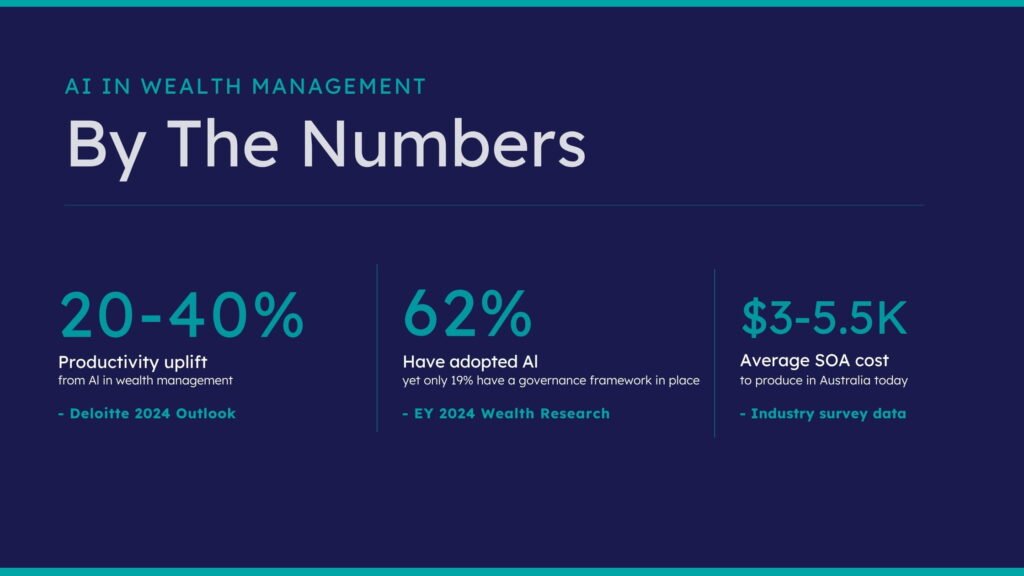
- Cost pressure: The average cost to produce a comprehensive SOA in Australia sits between $3,000 and $5,500, with most of that cost tied up in adviser and paraplanner time.
- Client expectation: Clients who use AI in other parts of their lives expect the same fluency from their adviser: real-time portfolio insights, scenario modelling on demand, and faster turnaround on questions.
- Talent shortage: The Financial Adviser Standards regime has tightened the supply of qualified advisers. AI helps existing teams do more, without compromising quality.
Deloitte’s 2024 wealth management outlook estimated that AI could lift productivity in the sector by 20% to 40% over the next five years. That’s a figure no practice principal can comfortably ignore when fee margins are compressing.
How AI is reshaping the adviser’s workflow
AI for financial advisors isn’t replacing the relationship. It’s removing the friction around it. The areas where Australian practices are seeing the biggest shifts:
Research and modelling: Machine learning models scan thousands of managed funds, ETFs, and direct equities against a client’s risk profile and goals in seconds, surfacing options an adviser might otherwise miss.
Client onboarding and KYC: AI-driven identity verification, AML/CTF checks, and fact-find automation cut onboarding times from days to hours.
SOA and ROA drafting: Generative tools can draft Statement of Advice frameworks from a populated fact-find, leaving the adviser to refine strategy, judgement, and the basis of advice, the work that genuinely requires a human.
Ongoing service evidence. Natural language processing tools log adviser-client interactions automatically, building the audit trail that’s now non-negotiable for [outsourced paraplanning] workflows and post-Hayne ongoing service obligations.
Generative AI in wealth management: Beyond the marketing
Generative AI in wealth management gets a lot of airtime, but the practical use cases are narrower than the hype suggests. Where it actually works today:
- Summarising long client emails or meeting transcripts into action points
- Drafting initial versions of SOA strategy sections (still requiring full adviser review)
- Producing client-facing explainers, translating technical strategy into plain English
- Generating scenario narratives for retirement and TTR modelling
Where it still falls short: anything requiring real-time market data without explicit integration, calculations involving complex super or tax rules, and any output that lands in front of a client without adviser review. ASIC’s Information Sheet 282 makes it clear that the licensee remains accountable for the advice, not the model.
AI portfolio optimization in practice
AI portfolio optimization moves well beyond the traditional mean-variance toolkit. Modern systems combine several layers:
| Capability | What it does | Why it matters |
|---|---|---|
| Dynamic rebalancing | Triggers based on drift, tax events, and market signals | Reduces tax drag and behavioural error |
| Tax-aware optimisation | Models CGT impact before recommending sales | Critical for high-balance clients near retirement |
| Real-time risk profiling | Updates client risk capacity as circumstances change | Surfaces issues before the next review meeting |
| ESG and values screening | Filters portfolios against stated client preferences | Increasingly expected, not optional |
For most Australian practices, the win isn’t replacing the model portfolio entirely. It’s using AI as a layer that flags opportunities and risks the adviser would otherwise miss and documenting that supervision in a way that holds up under audit.
Personalized investment advice: The new client expectation
Personalized investment advice used to mean a tailored asset allocation. Today, clients expect more. They want scenario-based modelling for life decisions, behavioural insights about their own spending patterns, and goal-based reporting tied to their milestones, not the calendar quarter.
AI enables this at scale. Where a single adviser might once have delivered deep personalisation to 50 high-touch clients, AI tools extend that level of attention across a book of 200 or more without diluting the human relationship that still drives retention.
The risks every adviser needs to manage
AI adoption isn’t risk-free. The practical risks Australian advice practices should plan for:
- Privacy Act and CDR obligations. Any AI tool processing client data must comply with the Australian Privacy Principles, and with Consumer Data Right rules where relevant.
- Best Interests Duty. Section 961B of the Corporations Act still applies. An AI recommendation that hasn’t been validated by a human adviser doesn’t pass the safe harbour steps.
- Algorithmic bias. Models trained on historical data may underserve specific client cohorts. ASIC has flagged this as a supervisory priority.
- Explainability. If you can’t explain why the AI made a recommendation, you can’t defend it in an AFCA complaint.
EY’s 2024 wealth management research found that 62% of wealth managers globally had adopted some form of AI, but only 19% had a formal AI governance framework in place a gap that regulators are moving to close.
Wealth management outsourcing in the AI era
Wealth management outsourcing has evolved alongside AI. The most effective Australian practices aren’t choosing between “outsource the back office” and “implement AI tools.” They’re combining the two. An outsourced paraplanning team using AI-assisted drafting can produce a compliant SOA in a fraction of the time, with consistent quality, while the adviser stays focused on the conversations only, they can have.Many Australian advice firms are now combining outsourced paraplanning workflows with AI-enabled compliance systems to improve turnaround times without compromising review standards.
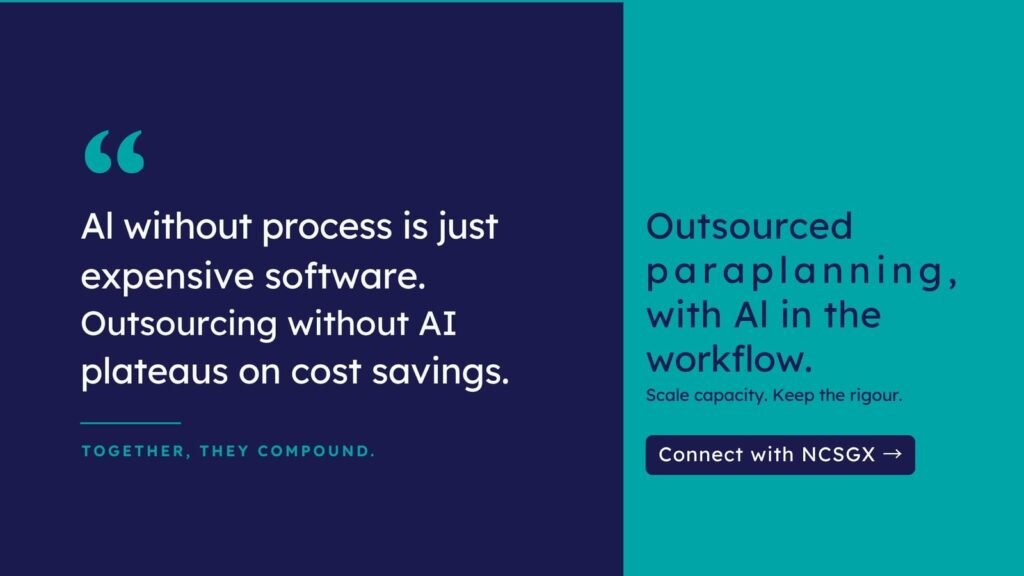
The combination matters. AI without processing is just expensive software. Outsourcing without AI plateaus on cost savings. Together, they compound and that’s where Australian practices are starting to find real operating leverage.
Conclusion
AI in wealth management is no longer optional reading for Australian advice practices, it’s actively reshaping cost structures, client expectations, and compliance workflows. The practices pulling ahead are the ones combining AI-assisted tools with experienced human review, not choosing between them. The risk isn’t moving too fast; it’s building the wrong stack without the governance to defend it. Connect with NCSGX to talk through how outsourced paraplanning and AI-supported workflows can give your practice the capacity to grow without losing the rigour your clients and your licensee expect.
How NCSGX can help
NCSGX supports Australian financial advisers, paraplanners, and licensee groups with outsourced paraplanning and back-office services that combine AI-assisted workflows with experienced human review. From SOA and ROA drafting to strategy research, modelling, and compliance support, we help practices scale capacity without scaling overhead.
If you’re working out how to bring AI into your advice process or want a second pair of eyes on the workflows, you’ve already built our team can walk you through what’s working in practices like yours, and where the common stumbling points sit.
Frequently Asked Questions (FAQ)
1. Is AI replacing financial advisers in Australia?
No. AI is automating the supporting tasks, such as research, drafting, and monitoring, that take time away from the advice of conversation. The adviser-client relationship, strategy judgement, and Best Interests Duty accountability remain firmly human.
2. How does ASIC view AI use in financial advice?
ASIC’s Information Sheet 282 sets out the current expectations: licensees remain accountable, governance must be documented, and AI use must be disclosed where it materially affects the advice.
3. Can generative AI write a compliant SOA?
It can draft sections. It cannot produce a compliant SOA without adviser review, validation of the strategy, and the basis-of-advice work that satisfies section 961B of the Corporations Act.
4. Does wealth management outsourcing reduce compliance risk?
Used well, yes. Outsourcing to a specialist team that knows ASIC’s expectations adds a layer of review. The licensee remains accountable, but the documented workflow strengthens the audit trail.
5. What should advisers do first when introducing AI to their practice?
Start with the supporting workflows research, drafting, and file notes, not the advice itself. Document where AI is used, validate every output, and build the governance framework before scaling.