

 USA
USA
 Canada
 Australia

The Division 296 super tax is now law. It passed Parliament in March 2026, took effect from 1 July 2026, and applies an additional tax on the earnings linked to large superannuation balances. If your total super balance is near or above $3 million, the 2026–27 year is when this starts to matter, and it is the right time to review how your fund is set up.
A quick note before we go further: NCSGX administers SMSFs, we never advise. What follows is general information to help you frame the right questions with your accountant or licensed adviser. It is not tax or financial advice, and nothing here should be acted on without speaking to your own professional.
What Division 296 Super Tax Means for SMSF Trustees
Division 296 adds an extra layer of tax on top of the standard 15% rate that already applies to super fund earnings. It targets the proportion of a member’s earnings that relates to the part of their balance above the thresholds, not the whole balance, and not the whole fund.
Two points changed the picture compared with the original 2023 draft, and both are good news for SMSF trustees. The final law taxes realised earnings only, so paper or unrealised gains are no longer caught. The thresholds are also indexed, so they rise over time rather than staying fixed.
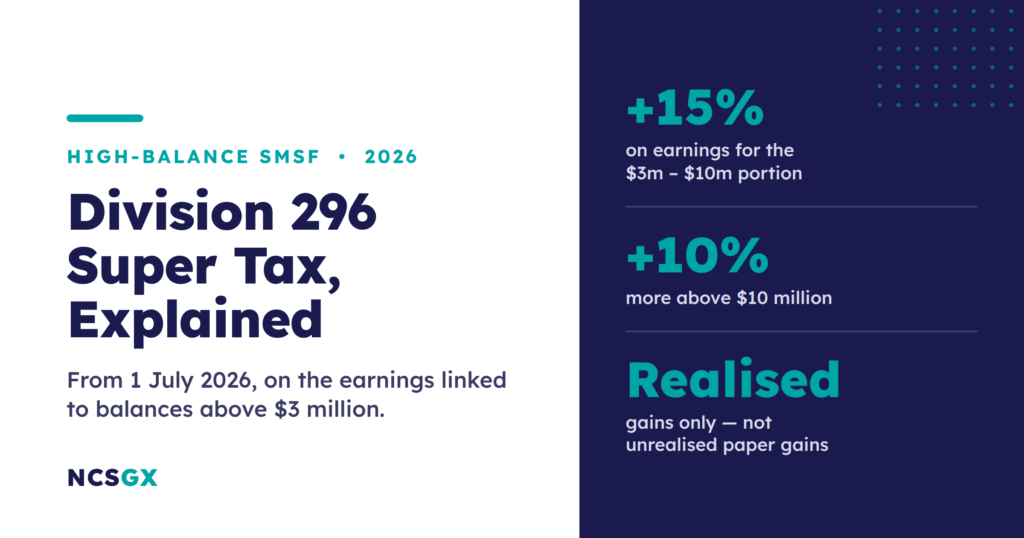
| Portion of total super balance | Additional Division 296 tax | Approx. effective rate on those earnings |
|---|---|---|
| Up to $3 million | None | 15% (standard) or 0% in retirement phase |
| $3 million to $10 million | +15% | Up to ~30% |
| Above $10 million | +10% more | Up to ~40% |
The $3 million threshold is indexed in $150,000 increments and the $10 million threshold in $500,000 increments.
Who May Be Affected by Division 296
Division 296 applies to individuals whose total super balance (TSB) is above $3 million, measured across every super account they hold, not just their SMSF. Roughly 1 in 200 Australians are expected to be affected, so this is a small group, but a high balance SMSF is one of the most common places to find balances of this size.
If you are a member of a fund where one or both members are approaching $3 million, this is worth a look now rather than after 30 June. Even members who sit just under the threshold should keep an eye on growth.
Key Dates and 2026 Review Timing
Among the SMSF changes 2026 brought in, the dates matter as much as the rates:
- 1 July 2026 – Division 296 commences.
- 30 June each year – your TSB is measured against the thresholds.
- Year ending 30 June 2027 – the first assessment period, based on realised earnings.
- Ongoing – the ATO is expected to release further guidance and reporting detail.
There is no rush to make irreversible moves, but there is real value in understanding your position before the first measurement period closes.
Review Total Super Balances Across All Funds
Because Division 296 works on a per-member TSB across all funds, the first review is simply getting a clear, consolidated picture. Add up every super account each member holds, including SMSF, retail and industry funds.
This is administration, not advice, and it is exactly the kind of consolidated reporting an SMSF administrator can help pull together so you and your adviser are working from accurate, current figures.
Review Income, Realised Gains and Asset Mix
Because the tax is based on SMSF realised gains and realised income rather than unrealised movements, the timing and source of your earnings now matter more. A fund weighted toward income, or one that regularly realises gains, has a different profile to one holding long-term assets it does not intend to sell.
Reviewing your asset mix and recent realisation patterns gives your adviser the data to model the likely impact. NCSGX can prepare that underlying data, your adviser interprets it.
Check Liquidity Before Any Tax Liability Arises
SMSF liquidity is one of the most practical issues here. Where a Division 296 liability arises, the member can choose to pay it personally or elect to have the fund release the funds. Either way, cash needs to be available.
If most of the fund’s value sits in property or unlisted assets, a future liability could land at an awkward time. Mapping your cash position against possible liabilities now is a sensible part of any SMSF tax planning conversation.
Review SMSF Property and Borrowing Arrangements
Property is where the realised-only approach really shows. An increase in the market value of a property the fund still holds is not taxed under Division 296. A gain is only brought into the calculation when the asset is actually sold and the gain is realised.
If your fund holds property, especially under a limited recourse borrowing arrangement (LRBA), review how a future sale would interact with both the loan and any Division 296 exposure. This is one to walk through with your adviser before any decision.
Review Estate Planning and Death Benefit Arrangements
High balances and SMSF estate planning go hand in hand. Death benefits, reversionary pensions and binding death benefit nominations can all interact with a member’s balance and the way earnings are measured.
Now is a good time to confirm your nominations are current and valid, and that your intended structure still does what you want it to. Your adviser and estate planning lawyer should lead this, with documentation support from your administrator.
Review Documentation Before Making Decisions
Good decisions rest on clean records. Before anyone models a strategy, confirm the foundations are in order, which is also central to your SMSF trustee obligations:
- Current, signed trust deed
- A documented and up-to-date investment strategy
- Recent, supportable asset valuations
- Trustee minutes for past decisions
Keeping this documentation tidy is core SMSF administration, and it works hand in hand with your SMSF annual return checklist to make any later advice faster and more reliable.
What Trustees Should Not Do Without Advice
This is the most important section. Headlines about a “super tax over 3 million” have prompted some trustees to consider selling assets, restructuring or pulling money out before commencement. Do not act on any of that without licensed advice.
Selling assets to realise gains early, winding back contributions, or moving money out of super can each trigger consequences that outweigh the Division 296 saving, and some cannot be reversed. The right sequence is data first, advice second, action last.
Division 296 Super Tax Review Checklist
Use this as a prompt for the conversation with your adviser:
- Confirm each member’s total super balance across all funds.
- Identify members at, near or above the $3 million threshold.
- Review the fund’s income and realised gains profile.
- Assess liquidity against any possible future liability.
- Review property holdings and any LRBA.
- Confirm death benefit nominations and estate plans are current.
- Check the trust deed, investment strategy and valuations are up to date.
- Book time with your accountant or adviser before 30 June.
Conclusion
Division 296 affects a small number of high-balance members, but for those members, the details matter. The regime is now law, it taxes realised earnings rather than paper gains, the thresholds are indexed, and the first measurement year is already underway. The trustees who handle this well will be the ones who get their numbers and documents in order early, then let their adviser do the modelling.
If you would like your SMSF data review-ready before 30 June, speak with our SMSF administration team.
How NCSGX Can Help
NCSGX provides SMSF administration and back-office support to trustees and the accounting firms that serve them. We administer, we never advise.
For Division 296, that means we can help you get organised: consolidated balance reporting across funds, accurate realised income and gains data, asset and liquidity summaries, and clean, audit-ready documentation. We prepare the information your adviser needs to model your position and make confident decisions.
If you would like your SMSF data review-ready before 30 June, talk to our SMSF team.
Add Your Heading Text Here (FAQ)
1. What is Division 296 super tax?
Division 296 is an additional tax on the earnings linked to large superannuation balances. It adds 15% on earnings attributable to the portion of a member’s total super balance between $3 million and $10 million, and a further 10% above $10 million, on top of the standard 15% fund tax. It applies from 1 July 2026 and taxes realised earnings only.
2. Does Division 296 apply to SMSFs?
Yes. Division 296 applies to all superannuation, including SMSFs, retail funds and industry funds. It is based on a member’s total balance across every fund, so SMSF members with large balances are commonly affected.
3. Who is affected by the $3 million super tax?
Individuals whose total super balance across all funds is above $3 million. Around 1 in 200 Australians are expected to be affected. The threshold is indexed, so it rises over time.
4. Does Division 296 apply per member or per SMSF?
This is a decision for your licensed adviser, not something to act on from general information. Because the final law taxes realised gains only, selling to crystallise gains early can have the opposite effect to what you intend. Speak to your accountant or adviser before making any change.
5. Should trustees sell assets before 1 July 2026?
This is a decision for your licensed adviser, not something to act on from general information. Because the final law taxes realised gains only, selling to crystallise gains early can have the opposite effect to what you intend. Speak to your accountant or adviser before making any change.
6. How can SMSF trustees prepare for Division 296?
Get your numbers and documents in order. Confirm each member’s total super balance, review your income, realised gains, liquidity and property holdings, check your estate planning, and make sure your deed, investment strategy and valuations are current. Then take that information to your adviser.