

 USA
USA
 Canada
 Australia

How Mortgage Loan Processing Works in Australia
Mortgage loan processing is the structured work that takes a home-loan application from initial documents to settlement. For Australian mortgage brokers, it requires accurate information, lender-specific checks, and clear communication at every stage. NCSGX Australia helps brokerages manage this operational work with a disciplined approach to document review, application packaging, lender coordination, and file visibility.
A well-run process does more than move paperwork. It helps brokers spend more time with clients, reduces preventable lender queries, and gives borrowers a clearer view of what happens next.
What Mortgage Loan Processing Involves in Australia
The mortgage broker process usually moves through seven connected stages:
- Collecting borrower and property details
- Reviewing and verifying documents
- Preparing and lodging the application
- Completing lender credit and serviceability checks
- Obtaining a property valuation
- Meeting approval conditions
- Signing documents and coordinating settlement
Each lender has its own credit policy, evidence requirements, and processing timeframes. That is why an accurate file at the beginning is one of the strongest ways to avoid delays later.
For brokerages managing rising application volumes, dedicated mortgage broker support can bring more consistency to these stages without changing the client relationship.
Step 1: Submitting Your Home Loan Application
The application begins with a complete picture of the borrower’s circumstances. This includes their loan purpose, requested amount, deposit or equity, employment, income, expenses, assets, liabilities, and property information.
The broker reviews suitable lending options and prepares the application for the selected lender. Before lodgment, every figure should be checked against the supporting evidence. Names, dates, account balances, income amounts, and declared liabilities should be consistent across the file.
A clean submission gives the lender assessor a clearer starting point. It also reduces the risk of repeated document requests that can slow the application.
Home Loan Document Checklist Australia
The required documents depend on the lender and the borrower’s situation. However, a typical home loan document checklist in Australia may include:
- Identification: Passport, driver license, Medicare card, or other accepted identification
- Income evidence: Recent pay slips, income statements, employment details, tax returns, or Notices of Assessment
- Self-employed documents: Personal and business tax returns, financial statements, and current business records
- Assets: Savings statements, investments, superannuation, and details of other properties
- Liabilities: Credit cards, personal loans, car finance, HELP debt, and existing mortgages
- Living expenses: Household bills, childcare, education, insurance, subscriptions, and discretionary spending
- Property documents: Signed contract of sale, deposit evidence, and for construction loans, plans and building contracts
Borrowers with casual, commission-based, rental, or self-employed income may need to provide further evidence. It is important to check the selected lender’s current policy rather than relying on a generic checklist alone.
NCSGX’s lender-ready loan application packaging support helps brokers organise documents and identify gaps before submission.
Home Loan Assessment Process Australia
Once the application is lodged, the lender assesses its credit policy. This stage is designed to confirm whether the borrower can reasonably meet the loan repayments and whether the property is acceptable for security.
The lender may review:
- Identity and income verification
- Employment history and income stability
- Credit history and existing commitments
- Declared living expenses
- Deposit, genuine savings, or available equity
- Loan-to-value ratio (LVR)
- Serviceability using the lender’s assessment rate
- The type and location of the property
The assessor may ask for clearer, newer, or additional documents. Fast and complete responses help preserve momentum. Brokers should also keep borrowers informed about outstanding actions, especially when a purchase contract has a finance deadline.
Property Valuation for Home Loan Australia
A property valuation helps the lender decide what value it will use for its security assessment. It is not always the same as the purchase price or a real estate agent’s appraisal.
Depending on the property and lender policy, the valuation may be completed through an automated model, desktop assessment, or physical inspection. The outcome can affect the LVR and the amount the lender is prepared to advance.
If the valuation is lower than expected, the borrower may need to contribute more funds, reduce the loan amount, reconsider the purchase price, or discuss another lender-acceptable strategy with their broker.
A low valuation does not necessarily mean the property is overpriced. It means the lender has reached a different view of its security value.
Conditional Approval vs Unconditional Approval Home Loan
Conditional approval means the lender is prepared to move forward if specified requirements are met. Conditions can include an acceptable valuation, updated pay slips, evidence of deposit funds, clarification of an existing debt, or a signed contract of sale.
Unconditional approval, often called formal approval, means the lender has completed its required credit assessment and approved the loan. It is a significant milestone, but it does not mean the transaction has settled.
Borrowers should avoid making major financial changes after approval. Taking on a new loan, increasing credit-card limits, changing jobs, or making large purchases can affect the lender’s final checks and may create avoidable risk.
Home Loan Settlement Process Australia
Settlement is the final legal and financial stage of a property purchase. The lender, buyer’s conveyancer or solicitor, and seller’s representative coordinate the transfer of funds and ownership.
Before settlement, the borrower will generally need to:
- Sign and return loan documents
- Provide any remaining contribution or settlement funds
- Arrange insurance where required
- Complete a final property inspection
- Confirm settlement arrangements with their conveyancer or solicitor
On settlement day, the purchase funds are transferred, the mortgage is registered, and ownership passes to the buyer. The buyer can then collect the keys once the settlement is confirmed.
For an independent consumer overview of the home-loan journey, borrowers can refer to ASIC’s Moneysmart home-loan guidance.
How Long Does Mortgage Processing Take in Australia?
Stage | Indicative timing |
| File preparation and submission | 1–3 business days |
| Lender assessment and valuation | 2–10 business days |
| Meeting conditions to formal approval | 2–10 business days |
| Purchase settlement period | Usually 30–90 calendar days |
These timeframes are general guides, not service guarantees. Lender queues, valuation of access, borrower circumstances, and contract conditions can all influence the outcome.
Common Reasons Mortgage Loan Processing Gets Delayed
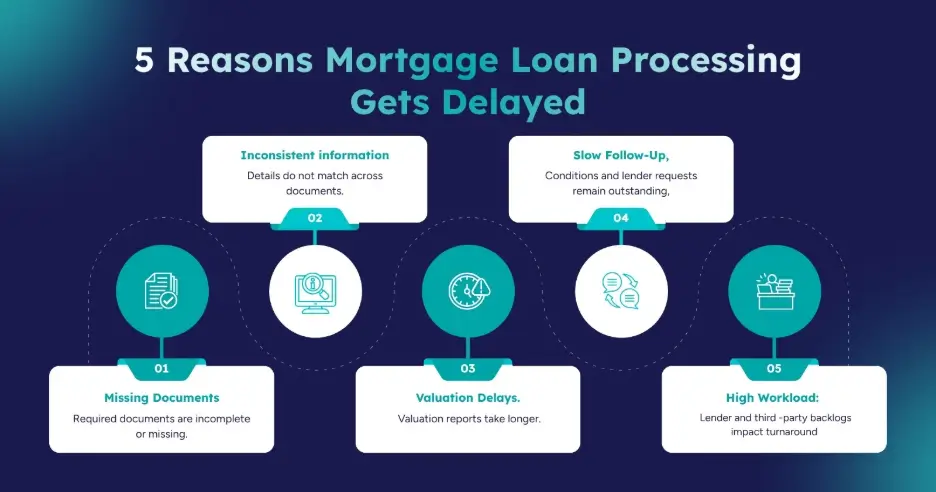
A clear checklist, early quality review and proactive status updates can reduce avoidable rework, although no process can remove lender or third-party dependencies.
Conclusion
Mortgage loan processing in Australia involves multiple moving parts, from collecting borrower documents and completing lender checks to managing valuations, approval conditions, and settlement. When each stage is managed with accurate information and clear ownership, brokerages can reduce unnecessary rework and give borrowers a more confident experience.
A disciplined process also helps brokers maintain visibility across their pipeline, respond to lender requests promptly, and keep applications moving towards approval. The result is a more reliable workflow for the brokerage and clearer communication for every client.
How NCSGX Supports Mortgage Loan Processing
NCSGX helps mortgage brokerages manage the operational work behind each loan application. Our structured support covers document collection and validation, application packaging, CRM updates, lender submission tracking, condition management, and settlement coordination.
By working within a brokerage established systems and processes, NCSGX helps maintain consistency across the loan lifecycle. This can reduce administrative pressure, improve file visibility, and allow brokers to dedicate more time to client relationships and business development.
NCSGX provides operational support rather than credit advice. Brokers remain responsible for understanding client needs, recommending the lending strategy, and managing the client relationship, while NCSGX supports the disciplined execution required to keep files progressing.
Frequently Asked Questions (FAQ)
1. What documents do I need for mortgage loan processing in Australia?
Most applicants need identification, proof of income, bank statements, details of assets, liabilities, living expenses, and property documents. Self-employed, investor, construction, and variable-income applications may require additional evidence.
2. What’s the difference between conditional and unconditional home loan approval?
Conditional approval means the lender still needs specific requirements to be met. Unconditional or formal approval means the lender has completed its assessment and approved the loan, although settlement documents and legal steps still need to be completed.
3. How long does mortgage loan processing take in Australia?
A straightforward application may reach formal approval within one to three weeks. Complex income structures, missing documents, lender workloads, valuations, and additional conditions can extend the timeframe.
4. What happens during the home loan assessment process?
The lender checks the borrower’s identity, income, expenses, assets, liabilities, credit history, serviceability, deposit or equity, and the property offered as security.
5. What happens if my property’s valuation comes lower than expected?
The lender may use the lower valuation to calculate the LVR. The borrower may need a larger contribution, a lower loan amount, a revised purchase arrangement, or another lending strategy.
6. What causes delays in mortgage loan processing?
Frequent causes include incomplete documents, inconsistent figures, complex income, valuation issues, lender backlogs, financial changes after application, and unresolved legal or settlement requirements.