

 USA
USA
 Canada
 Australia

Introduction
The TPAR due date for the 2025–26 financial year is 28 August 2026. Businesses and government entities that meet the TPAR reporting requirements must lodge their Taxable Payments Annual Report by this date. TPARs must now be lodged electronically; paper lodgements are no longer accepted.
For Australian businesses, this means checking not only whether a TPAR is required, but also whether the contractor records and digital lodgement process are ready. NCSGX supports Australian businesses with practical finance and tax compliance processes, helping teams stay on top of recurring reporting obligations.
When Is the TPAR Due in 2026?
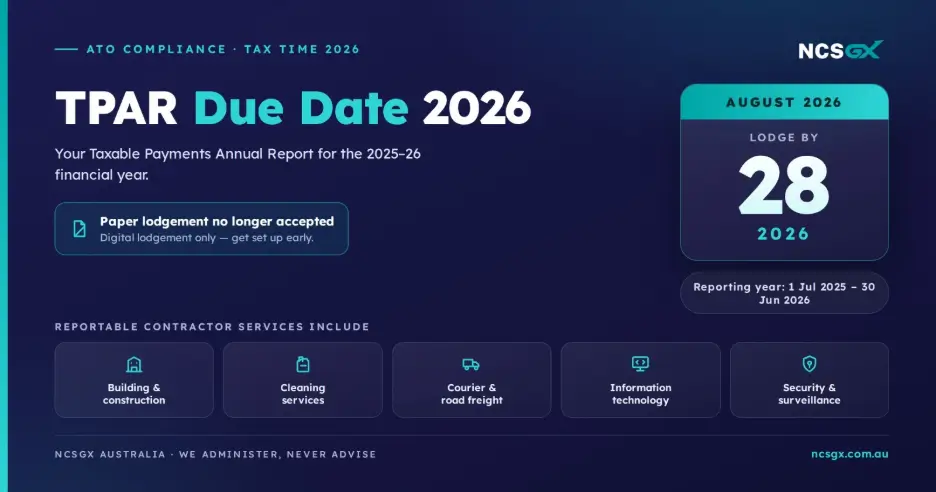
The TPAR due date 2026 is 28 August 2026.
The report covers payments made to eligible contractors between 1 July 2025 and 30 June 2026. If your business is required to report, the TPAR needs to be lodged by the deadline.
The requirement generally applies where a business or government entity pays contractors for services in certain industries. These include:
- Building and construction
- Cleaning services
- Courier and road freight
- Information technology
- Security, investigation and surveillance
Businesses operating across multiple activities should also check whether a significant part of their income comes from a TPAR-reportable service.
The TPAR gives the ATO information about payments made to contractors, which can then be used to compare contractor income against information reported in their tax returns.
The ATO provides a detailed guide to TPAR obligations and reporting requirements for businesses that need to determine whether they must lodge.
If you’re preparing your year-end records at the same time, keeping your broader finance and accounting processes organised can make these annual reporting requirements considerably easier.
Why Paper TPAR No Longer Works
One of the biggest changes businesses need to be aware of is the end of paper TPAR lodgement.
The ATO has confirmed that paper TPAR forms are no longer accepted. Reports now need to be submitted electronically through an approved channel.
This may sound like a small administrative change, but it matters if your business has historically relied on paper forms or manual processes.
Digital reporting means businesses should make sure they can access the appropriate online service or have compatible accounting software, or a registered tax practitioner ready to lodge on their behalf.
The ATO’s taxable payments reporting system information confirms that TPAR reporting is an electronic process and that the report is due by 28 August each year.
The change also makes it more important to avoid leaving the report until the deadline. If there is an issue with your records, software, or access to the relevant ATO service, there is less room for a last-minute workaround.
Who Needs to Lodge
Not every business that uses contractors automatically needs to lodge a TPAR.
The key question is whether your business paid contractors for services that fall within a TPAR-reportable industry during the financial year.
For example, a construction company paying subcontractors for building work may have a TPAR obligation. Similarly, businesses paying contractors for cleaning, IT, courier or security services may need to report those payments.
Before lodging, review:
- The nature of your business activities
- The services provided by your contractors
- Contractor payments made during 2025–26
- ABNs and identifying details recorded for contractors
- Whether any payments fall outside the TPAR reporting requirements
It is also worth remembering that employees are not contractors simply because they are paid through a different arrangement. The classification of the worker and the nature of the engagement matter.
If you’re uncertain about the obligation, check the ATO’s guidance before assuming that a TPAR is or isn’t required.
Accepted Digital Lodgement Methods
With TPAR online lodgement now the standard approach, businesses have several ways to submit their report.
Depending on the business and circumstances, electronic lodgement can be completed through:
- ATO online services for business
- ATO online services for individuals and sole traders
- Standard Business Reporting (SBR)-enabled software
- A registered tax or BAS practitioner
The ATO’s electronic reporting specifications also support TPAR reporting through approved digital channels.
If your accounting software supports the required reporting functionality, it can be useful to prepare the information directly from your existing contractor records. This reduces the need to manually recreate figures at the end of the financial year.
For businesses using an accountant or tax professional, it is sensible to confirm early that the practitioner has everything required to prepare and submit the report.
Compliance Checklist Before You Lodge
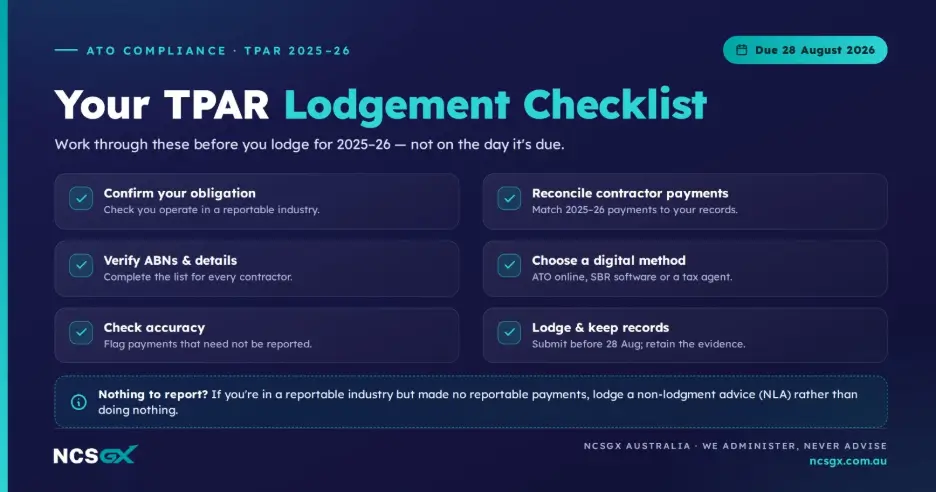
Before you lodge TPAR with the ATO, take a few minutes to work through the following checks.
- Confirm that your business operates in a TPAR-reportable industry.
- Confirm whether contractor payments were made during 2025–26.
- Review the contractor list for completeness.
- Confirm each contractor’s ABN and business details.
- Reconcile contractor payments against your accounting records.
- Check that reported amounts are accurate.
- Identify payments that may not need to be reported.
- Confirm your digital lodgement method.
- Check access to the relevant ATO online service or software.
- Lodge before 28 August 2026.
- Keep evidence of the lodgement and supporting records.
A simple reconciliation before submission can prevent avoidable problems. Differences between your accounts, contractor records and TPAR figures can create unnecessary follow-up work later.
This is where a structured tax compliance process for Australian businesses can make a difference.
What If You Have Nothing to Report?
What happens if you operated in a TPAR-reportable industry but did not make any reportable contractor payments during the year?
You should not simply ignore the obligation.
Where a business is not required to lodge a TPAR for the financial year, the appropriate step may be to submit a TPAR non-lodgment advice (NLA).
The ATO provides guidance on when a non-lodgment advice may be appropriate, including situations where a business does not have reportable contractor payments.
This is particularly important for businesses whose circumstances have changed. For example, you may have previously lodged TPARs but did not make any relevant contractor payments during 2025–26.
Rather than assuming that no report means no action, check your current obligation and submit the appropriate advice where required.
Penalties for Missing the Deadline
Missing the TPAR deadline can create an unnecessary compliance issue.
The ATO can apply penalties where a required report is not lodged on time. Incorrect or incomplete reporting can also create problems, particularly where contractor information or payment amounts do not match the business’s records.
The best approach is therefore straightforward: don’t treat 28 August as the day you start preparing the report.
Aim to have your contractor records reconciled before the deadline so there is time to resolve missing ABNs, incorrect payment totals or questions about whether particular payments should be reported.
If you realise that you have missed the deadline, act promptly rather than waiting for the ATO to contact you. The appropriate response can depend on your circumstances.
Conclusion: Get the Digital Process Right Before 28 August
The TPAR due date 2026 is straightforward: 28 August 2026 for the 2025–26 reporting year.
The bigger change is how businesses lodge. With TPAR paper lodgement stopped, businesses that still rely on manual or paper-based processes need to move to an electronic method.
For most businesses, the practical priority is not simply remembering the date. It is making sure contractor records are complete, payments have been reconciled and the digital lodgement method is ready well before the deadline.
A short review now can save a much more stressful compliance exercise later.
If your business has multiple contractors or recurring compliance obligations, putting a repeatable review and lodgement process in place can make future reporting much easier. If you need support reviewing your finance, accounting or compliance processes, you can contact the NCSGX Australia team to discuss your requirements.
How Can NCSGX Help?
NCSGX can help Australian businesses manage the administrative and reporting work that sits around their tax and compliance obligations. Instead of leaving contractor records, reconciliations and reporting until the deadline, businesses can use a structured process to keep these tasks organised throughout the year.
For TPAR preparation, this can include:
- Reviewing contractor records and payment information
- Checking that relevant contractor details are complete and up to date
- Supporting reconciliation of contractor payments with accounting records
- Identifying information that may need further review before lodgement
- Helping maintain consistent finance and compliance processes
- Supporting businesses with recurring reporting and accounting administration
The benefit is not simply getting a TPAR lodged on time. A well-organised process can reduce last-minute corrections, missing information and the administrative pressure that often comes with annual compliance deadlines.
Frequently Asked Questions (FAQ)
1. Is TPAR fully digital now?
Yes. Paper TPAR lodgements are no longer accepted. Businesses must use an electronic lodgement method, such as the relevant ATO online service, SBR-enabled software or a registered tax or BAS practitioner.
2. When is the TPAR due in 2026?
The TPAR for the 2025–26 financial year is due on 28 August 2026.
3. Who needs to lodge a TPAR?
Businesses and government entities that pay contractors for services in specified industries may need to lodge. Common examples include building and construction, cleaning, courier and road freight, IT, and security-related services.
4. What happens if I miss the TPAR deadline?
If you are required to lodge and miss the deadline, the ATO may apply penalties. If you realise the report is late, it is generally better to address the outstanding lodgement promptly rather than wait for further ATO action.
5. What if I don't have anything to report this year?
If your business does not have any reportable payments for the relevant financial year, you may need to submit a non-lodgment advice rather than a TPAR. Check the ATO requirements for your circumstances before taking no action.
6. Can sole traders or small businesses lodge TPAR themselves?
Yes. Eligible sole traders and small businesses can use the relevant ATO online service where available. They can also use supported accounting software or engage a registered tax or BAS practitioner to handle the lodgement.