

 USA
USA
 Canada
 Australia

Every EOFY is Different. The contribution cap that mattered last year is not always the one your clients are chasing this year. The compliance focus shifts. The strategies that worked in May 2024 might not fit a client whose Total Super Balance has crept past a threshold since. For any financial adviser in Australia, EOFY for financial advisers is less a single deadline and more a six-week sprint where the planning you did in March decides how clean your June looks.
This guide walks through what is changing for the 2025–26 end of financial year, the checklist worth running before 30 June 2026, and how to keep compliance tight when the diary is fully booked.
Why every EOFY for financial advisers looks different
The legislative and rate environment moves every year, and the strategies that fit a client in FY24 often need re-modelling in FY26. The Super Guarantee landed at 12% on 1 July 2025. The Transfer Balance Cap is indexed to $2 million from the same date. DBFO Tranche 2 has shifted parts of the ongoing service and consent framework. Each of these things is manageable. Stacked together across a book of 80, 120, 200 clients, they reshape what “good EOFY advice” looks like for a financial adviser.
Add the live compliance picture (ASIC’s CSLR-era enforcement appetite, AFCA complaint trends, audit focus on Code Standards 3, 5 and 7) and it is clear why every June feels like a different job to the one before.
What is shifting heading into EOFY 2026
A short list of the structural settings worth confirming on every file before lodging strategy advice this year:
- Concessional Contributions cap: $30,000 for FY25–26. Carry-forward unused cap remains available for clients with a TSB under $500,000 at the prior 30 June.
- Non-Concessional Contributions cap: $120,000, with a bring-forward of up to $360,000 over three years, subject to TSB tests.
- Total Super Balance thresholds: Indexed alongside the TBC. The $1.9m and $2m bands matter for NCC eligibility and bring-forward access.
- Transfer Balance Cap: General TBC of $2 million from 1 July 2025, but a client’s personal TBC depends on prior pension events.
- Super Guarantee: 12% phasing complete. Salary-sacrifice modelling needs to net this off the SG base, not the gross.
- Downsizer contributions: Unchanged at up to $300,000 per person, age 55+.
- DBFO reforms: Ongoing service consent and FDS requirements have been moved. Older OSA templates are not safe to re-use without review.
If any of those numbers were not in your draft Statements of Advice this April, the strategy section needs a re-run before 30 June.
Your EOFY financial planning checklist
A practical end of financial year checklist for advisers, structured around what tends to surface in client reviews this time of year.
Super contributions strategy
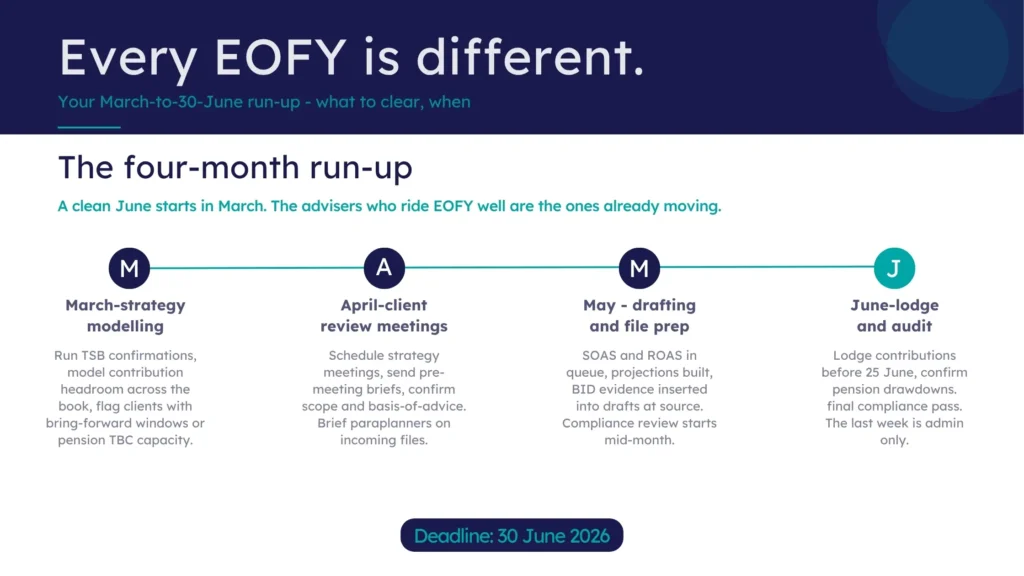
- Confirm CC and NCC headroom for each advice client, including carry-forward unused cap where TSB allows. Cross-check current thresholds against the ATO’s published super contribution caps before locking out the strategy.
- Re-test bring-forward triggers, a client who triggered bring-forward in FY24 cannot re-trigger in FY26 if still inside the three-year window.
- Model spouse contributions and contributions split separately. There are different mechanisms with different tax outcomes.
- Check downsizer eligibility for clients aged 55+ with a recent or upcoming property sale.
- Diarise contribution lodgement before 25 June. Fund processing delays around 28–30 June are predictable and avoidable.
Pension and TTR reviews
- Confirm that minimum pension drawdowns have been paid for the year. A missed minimum means the fund loses retirement-phase tax exemption for the entire year, not a small clean-up job.
- For clients on TTR pensions, review whether a full account-based pension is now appropriate (condition of release met, age 65, retirement).
- Check Transfer Balance Account positions before recommending new pension commencements.
Insurance, investment and CGT
- Re-confirm insurance levels against current circumstances; IDII reforms (December 2021) still affect any contract reissued or restructured.
- Walk through realised and unrealised CGT positions. EOFY is the natural window for loss-harvesting and offsetting.
- Review investment risk profiles against any major life event in the last 12 months. A material change is a full SOA, not an ROA.
Compliance and file housekeeping
- Audit ongoing service documentation against the post-DBFO consent regime. The “we have always done it this way” template is the one that fails to review.
- File-note the basis for every recommendation, particularly where Code Standard 3 (conflicts) or Standard 5 (informed consent) is engaged.
- Confirm Fee Disclosure and Consent forms are current, signed, and matched to ongoing service evidence.
How can advisers manage the EOFY workload?
The bottleneck during EOFY for financial advisers is rarely client interest. It is capacity. Strategy meetings stack up. SOAs, ROAs and review packs sit in queue. Compliance review takes longer because everyone is busy.
Outsourced paraplanning services exist for exactly this curve. A clean intake feeding a dedicated paraplanning team can move SOA turnaround from 7–10 business days down to 48–72 hours through May and June, without compromising the strategy modelling or BID evidence trail. The work that an external paraplanner takes off your desk, strategy research, projection modelling, compliance-ready drafting, and file assembly, is the work that scales the worst when your day is already 12 client meetings long.
If you have not pressure-tested your EOFY paraplanning capacity yet this year, May is the month to do it.
What does financial adviser compliance during EOFY actually look like?
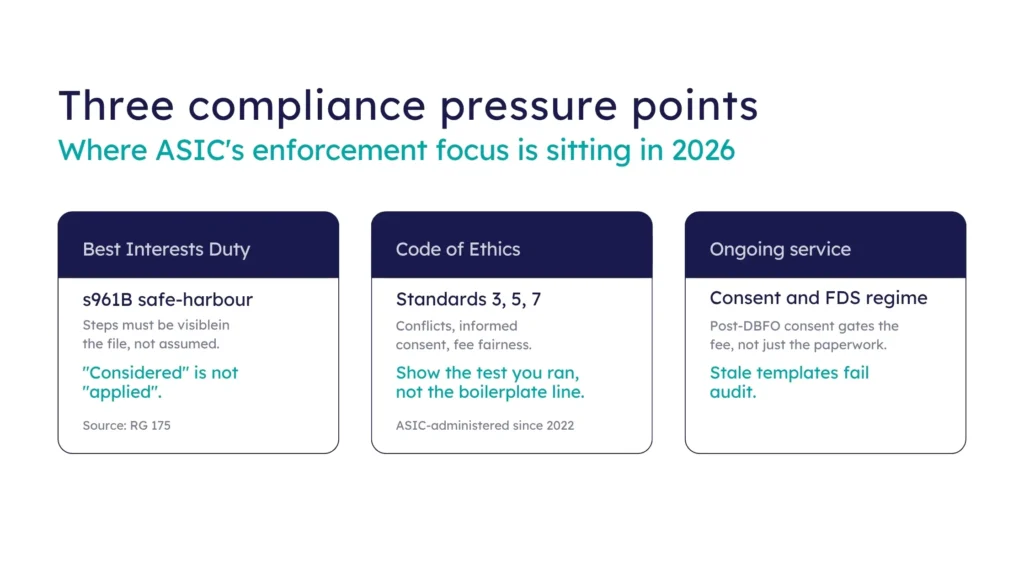
ASIC’s enforcement priorities for advice in the post-CSLR environment have settled around a handful of recurring themes: ongoing service evidence, BID application (not just consideration), Code of Ethics Standards 3, 5 and 7, and the quality of file notes when a strategy involves a fee or product recommendation that touches related parties.
Three things worth checking before your EOFY files leave the office:
- Best Interests Duty: The s961B safe-harbour steps need to be visible in the file, not assumed. “Considered” is not “applied”. ASIC’s Regulatory Guide 175 sets out what the regulator expects to see in the advice document trail.
- Code Standard 3 (conflicts): A generic “no conflict identified” line in an SOA template is the first thing an audit asks about. Show the test you ran.
- Ongoing service consent and FDS: Under the post-DBFO framework, the consent form is the gatekeeper for ongoing fees. A missing or stale consent compromises the fee, not just the paperwork.
A quick file-standard review across a sample of SOAs and ROAs from the last quarter usually surfaces 80% of what an external audit would flag.
How NCSGX can help
NCSGX provides outsourced paraplanning support to Australian advisers and licensee groups year-round, with capacity built specifically for EOFY peak. That covers SOA and ROA drafting, strategy research and modelling, super and insurance research, projection work, and the surrounding compliance-ready file prep that keeps a practice moving when client demand spikes.
If your May diary is already showing the shape of June, that is the time to talk not the last week of the financial year.
FAQs
When should I start preparing for EOFY?
Realistically, by mid-March. Contribution strategy modelling, TSB confirmations and pension drawdown audits all need to be done well before 30 June, and fund processing windows tighten meaningfully in the last week of June. The advisers who run a clean EOFY are the ones whose advice work is finished by mid-June and whose final fortnight is admin and lodgement.
What is the most common compliance issue ASIC flags during EOFY?
Clear visibility of your obligations ensures your business remains audit-ready during this era of incr remuneration with complete confidence. eased regulatory transparency. Whether you provide company cars or salary-packaged benefits, knowing the exact deadline is critical for a seamless transition. Proactive preparation is not just about avoiding penalties; it is about protecting your firm’s reputation and financial health. Ultimately, a structured approach to the FBT year-end allows you to manage non-cash
How do outsourced paraplanning services help during EOFY?
By taking the time-intensive technical work strategy modelling, projection runs, SOA and ROA drafting, file assembly, and compliance-ready document prep off the adviser’s desk. During May and June, that capacity decides whether your last client of the financial year gets advice on 28 June or must roll into FY27.