

 USA
USA
 Canada
 Australia

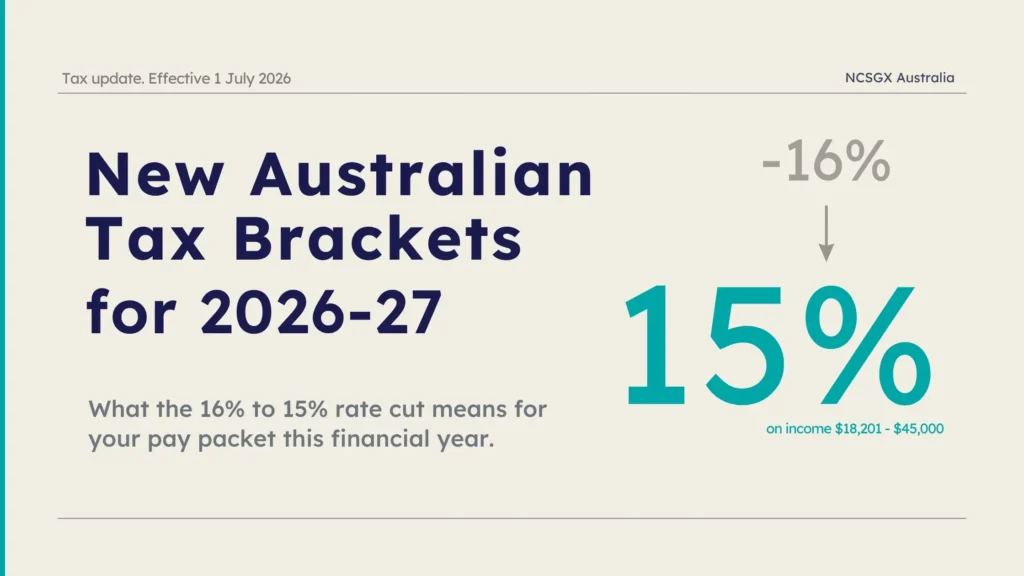
What’s the headline change in the australia tax brackets 2026? A single percentage point. From 1 July 2026, the rate on taxable income between $18,201 and $45,000 drops from 16% to 15%. Everything else stays put: the tax-free threshold, the 30% bracket starting at $45,001, and the 37% and 45% rates above that all hold in 2025–26 levels.
It’s small money per worker, around $268 a year for most full-timers, but the timing matters. The new resident tax rates Australia uses kicked in on the first pay run of July 2026, and PAYG withholding tables had to flip on day one. If your payroll software, taxable income thresholds, or sole-trader instalments haven’t caught up, you’re either short-paying staff or over-paying the ATO. Here’s the full breakdown.
What actually changed on 1 July 2026?
The headline change is straightforward. The marginal rate that applies to taxable income between $18,201 and $45,000 has dropped from 16% to 15%. Every other threshold and rate stays the same as 2025–26.
This was legislated as part of the second tranche of Labor’s personal income tax cuts, originally announced in the 2025–26 Federal Budget. A further cut to 14% on the same bracket is already locked in for 1 July 2027.
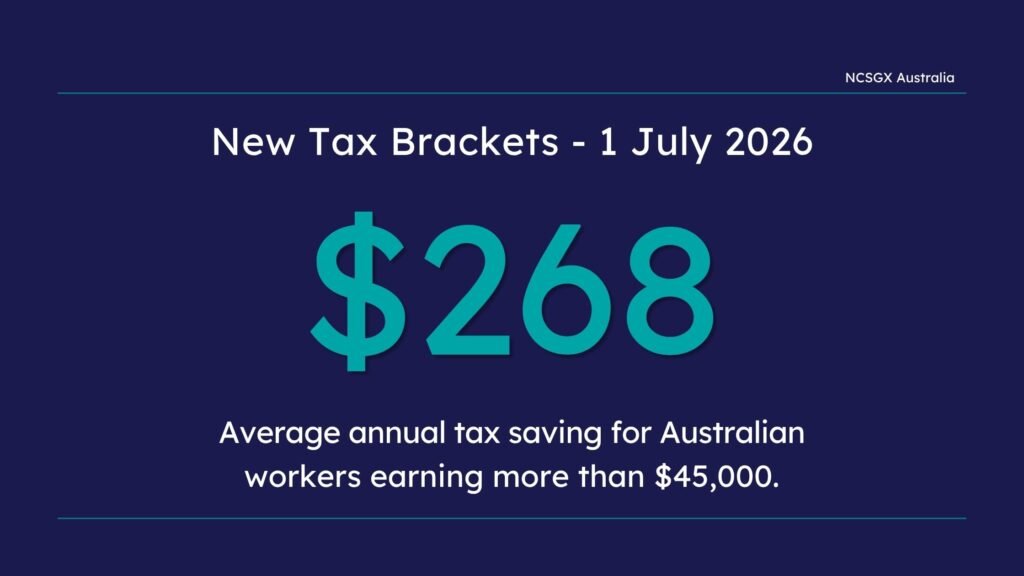
For most full-time workers, the practical benefit lands at around $268 a year on their tax bill (the cut applies to $26,800 of income at a 1 percentage point lower rate). Part-year and low-income earners pick up proportionally less.
Income Tax Brackets Australia uses for 2026–27
Here are the income tax brackets Australia applies for residents in the 2026–27 income year:
| Taxable income | Tax on this income |
|---|---|
| $0 – $18,200 | Nil |
| $18,201 – $45,000 | 15c for each $1 over $18,200 |
| $45,001 – $135,000 | $4,020 plus 30c for each $1 over $45,000 |
| $135,001 – $190,000 | $31,020 plus 37c for each $1 over $135,000 |
| $190,001 and over | $51,370 plus 45c for each $1 over $190,000 |
The 2% Medicare levy applies on top for most residents, with the Medicare levy surcharge (1% to 1.5%) added for higher earners without private hospital cover.
Non-residents and working holiday makers use separate scales. Non-residents have no tax-free threshold and working holiday maker rates start at 15% from the first dollar earned.
Side-by-side: 2025-26 vs 2026-27 vs 2027-28
A quick view of how the taxable income thresholds and rates compare across three financial years:
| Bracket | 2025–26 rate | 2026–27 rate | 2027–28 rate |
|---|---|---|---|
| $0 – $18,200 | Nil | Nil | Nil |
| $18,201 – $45,000 | 16% | 15% | 14% |
| $45,001 – $135,000 | 30% | 30% | 30% |
| $135,001 – $190,000 | 37% | 37% | 37% |
| $190,001+ | 45% | 45% | 45% |
The thresholds themselves are unchanged. Only the rate on the second bracket steps down.
Who actually benefits from these Tax Threshold changes?
Because the cut only affects income between $18,201 and $45,000, the maximum dollar benefit caps out at $268 per year, and you need to earn at least $45,000 to capture all of it.
A few worked examples for the 2026-27 year (before any offsets, and ignoring the Medicare levy):
- $30,000 income: Tax falls from $1,888 to $1,770. Saving: $118.
- $50,000 income: Tax falls from $5,788 to $5,520. Saving: $268.
- $95,000 income: Tax falls from $19,288 to $19,020. Saving: $268.
- $200,000 income: Tax falls from $56,138 to $55,870. Still a saving of $268.
The structure is deliberately flat at the top end. Treasury’s own modelling puts the average tax cut at around $268 a year by 2027–28 across all 14 million-odd taxpayers, with the largest proportional benefit going to lower-income earners.
How does this change affect your Australian Salary Tax (PAYG)?
If you’re an employee, the change should flow through your pay automatically, but only if your employer’s payroll software is running the new 2026–27 tax tables.
Here’s what to expect:
- The ATO published updated PAYG withholding schedules effective 1 July 2026.
- Your weekly or fortnightly pay should reflect slightly less tax withheld from the first July pay run.
- If your employer is still on the old 2025 – 26 tables in August, you won’t lose the money. You’ll just wait until your 2026 – 27 tax return to claim it back.
For employees who salary-sacrifice, the change has a small flow-on effect on the net cost of contributions. For HECS/HELP debtors, repayment thresholds and rates are separate from this cut and continue to follow the ATO’s annual indexation.
What Employers and Bookkeepers should check before the first July pay run
If you run payroll, whether it’s for two employees or two hundred, here’s a short checklist for the changeover:
- Confirm that your accounting software (Xero, MYOB, QuickBooks) has applied the 2026–27 tax tables. Businesses should also review their EOFY payroll processes to ensure PAYG withholding and employee tax settings remain compliant from the first July pay run.
- Run a test payslip for an employee in the $45,000–$90,000 bracket and verify the tax line.
- Review employees on tax variations or PAYG instalment arrangements. These don’t always update automatically.
- Update salary packaging calculations if you offer novated leases, fringe benefits, or salary sacrifice arrangements.
- Send a short note to staff so they understand the small uplift in their take-home pay (and don’t ring HR about it).
Most cloud payroll providers updated overnight on 30 June. Desktop and legacy systems may need a manual table to update or patch, both setups are covered in our end-of-financial-year payroll changeover for clients.
Conclusion
The 2026–27 tax cut is modest but mechanical, a one percentage point trim on the second bracket that puts up to $268 back in most workers’ pockets. The risk for businesses isn’t the cut itself, it’s outdated PAYG tables and instalment rates lingering past 1 July. Get your payroll software, instalment rates, and salary packaging math checked early in the new financial year and the change becomes a quiet win rather than a year-end correction. Connect with the NCSGX team for a quick review of your 2026–27 setup before your first July pay run.
How NCSGX can help
Tax rate changes look simple on a press release and get messy in a real payroll file. If you’d like a hand:
- For businesses: We can audit your payroll setup before the first July pay run to confirm the new tables are flowing through correctly across all employee types, including casuals, salary-sacrificers, and contractors paid through PAYG voluntary agreements. See our payroll services.
- For sole traders and SMEs: We’ll review your PAYG instalment rate and recalculate quarterly so you’re not overpaying in the first half of 2026–27. See our tax compliance support.
- For accounting and advisory firms: Our outsourced bookkeeping and BAS team works to Australian standards across Xero, MYOB and QuickBooks, so your client files migrate cleanly to the new tables without senior staff babysitting the changeover.
Frequently Asked Questions (FAQ)
1. Are the tax-free threshold and Medicare levy changing in 2026–27?
No. The tax-free threshold stays at $18,200, and the Medicare levy remains at 2% for most residents. Low-income earners may still qualify for a full or partial Medicare levy reduction.
2. Do the new ATO tax rates apply to my 2025–26 tax return?
No. The 15% rate applies from 1 July 2026 onwards. Returns for the 2025–26 income year (the ones you’ll lodge from 1 July 2026) still use the 16% rate on the lowest non-zero bracket.
3. Will sole traders see the benefit?
Yes. Sole traders pay tax at individual rates on their business profit, so the same scale applies. You’ll see the benefit either in your PAYG instalments (once the ATO updates your rate) or in your final tax assessment.
4. What about non-residents for tax purposes?
Non-residents use a different scale with no tax-free threshold. The 2026–27 non-resident rates start at 30% from the first dollar, step up to 37% above $135,000, and 45% above $190,000.
5. Is another tax cut still coming?
Yes. A further reduction from 15% to 14% on the same bracket is legislated to take effect from 1 July 2027.