
 USA
USA
 Canada
 Australia


The way businesses think about their processes has shifted more in the last three years than in the decade before. What used to be a question of “how do we document and improve our workflows?” has quietly become “how do we make sense, learn, and almost run themselves?” That shift sits at the heart of the BPM trends 2026 conversation, and it’s one we see play out every week across NCSGX’s global client base.
Business Process Management is no longer the back-office discipline it once was. It’s the layer where strategy, technology, and day-to-day operations meet, and the lines between BPM, process mining, and intelligent automation are blurring fast. For leaders deciding where to place their bets next year, six shifts stand out.
1. Process Mining Turns Predictive, Not Just Descriptive
For years, process mining did one thing well: it showed you what was actually happening inside your systems versus what you thought was happening. Useful, but mostly backward-looking.
The new generation of tools goes further. They flag bottlenecks before they form and recommend specific fixes inside the flow itself. According to Gartner’s research on process mining, the market continues to grow at a double-digit clip driven largely by leaders who want forward-looking insights rather than autopsies.
What this looks like in practice:
- Predictive variant analysis that highlights risky cases in real time
- Prescriptive nudges baked into the workflow (“approve now to hit SLA”)
- Tighter coupling between mining tools and the systems doing the work
For finance teams, that means catching exception invoices earlier. For the supply chain, it means knowing which orders will miss their promise dates before they do.
2. Hyperautomation Moves From Buzzword to Operating Model
Hyperautomation isn’t a single technology. It’s a strategy that stitches together RPA, AI, machine learning, low-code, and process intelligence to automate as much of an end-to-end process as possible.
What’s changed is maturity. Three years ago, hyper automation services were mostly pilots held together with bots and dashboards. Today, they look more like coordinated ecosystems where bots, humans, and AI agents work hand in hand with each other based on real-time context.
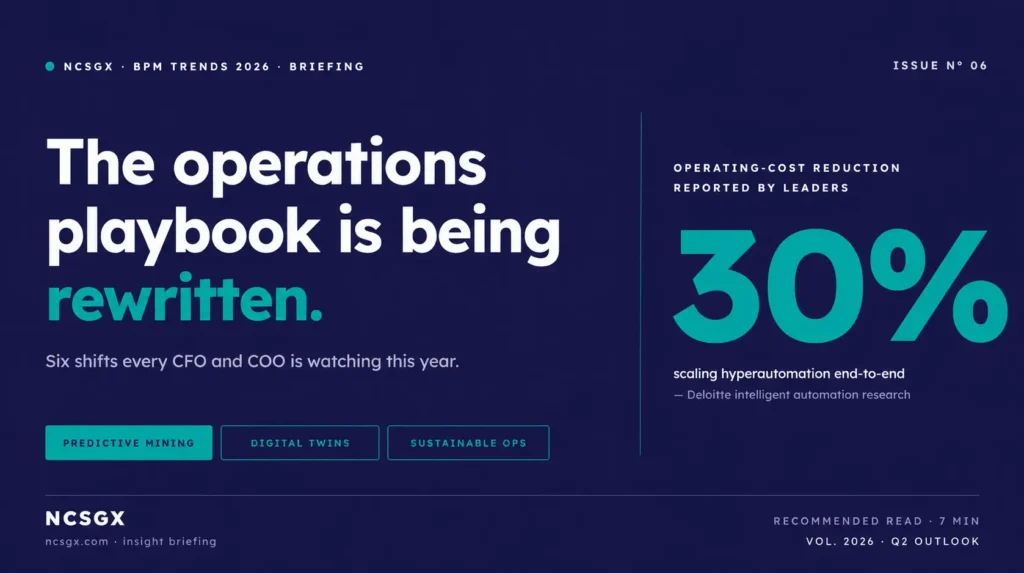
Deloitte’s intelligent automation research has consistently put cost reductions in the 20–30% range for organisations that scale these programs properly. The catch: you can’t bolt it on. The companies getting real returns are redesigning their processes first, then automating not the other way around. If you’re early on the journey, our business process automation services team can help sequence the work so the wins land in the right order.
3. Agentic AI Steps Into the Workflow
The most interesting development in BPM right now isn’t another platform. It’s a different kind of worker. Agentic AI autonomous systems that can perceive, reason, and act across multiple applications are starting to take on real process work.
Picture an AI agent that doesn’t just answer a query. It opens the ticket, pulls the customer record from the CRM, runs a credit check, drafts a response, and routes the case for human approval only if it crosses a threshold. No human stitching steps together.
This raises fresh questions around governance, audit trails, and accountability. The sensible approach is to start small: low-risk, high-volume processes such as supplier onboarding, AP matching, or internal IT requests. Build trust there before turning agents loose on customer-facing decisions.
4. Low-Code and No-Code Put BPM in More Hands
For most of BPM’s history, building a workflow meant filing a ticket with IT and waiting weeks. Low-code and no-code platforms have flipped that. Business analysts, operations managers, and line-of-business staff can now design, test, and deploy processes themselves.
This democratisation is one of the more underrated BPM trends 2026 has on offer. It changes how organisations innovate:
- Faster iteration on internal processes
- Lighter load on IT for routine workflows
- Greater ownership by the people who run the process
The risk is process sprawl, dozens of half-built workflows nobody governs. That’s why composable architecture and a clear citizen-developer framework are becoming the standard. The platforms give freedom; the framework keeps order.
5. Digital Twins of the Organisation Sharpen Process Intelligence
Manufacturing has used digital twins for years. The idea is now moving into the back office. A Digital Twin of an Organisation (DTO) is a live, virtual model of how your business runs its processes, dependencies, resources, and decisions.
Why does this matter? Because process intelligence has historically been retrospective. A DTO lets you simulate changes before you commit to them. Thinking about reorganising your customer service teams? Run the twin, model the impact on resolution time and cost-to-serve, then decide.
Industry analysts including Forrester have flagged DTOs as one of the more disruptive ideas heading into the next planning cycle. For mid-sized firms, the practical entry point is starting with a single high-value process quote-to-cash, hire-to-retire rather than trying to model the whole organisation at once.
6. Sustainability and Compliance Reshape Process Design
The third force pulling BPM forward isn’t technology at all. It’s pressure regulatory, environmental, and reputational. ESG reporting, data-protection rules, and customer expectations around ethical sourcing all flow back into how processes are designed and monitored.
In 2026, BPM automation isn’t judged only by cost saved or hours reclaimed. It’s also measured by:
- Carbon footprint of digital and physical workflows
- Auditability of every automated decision
- Data privacy compliance across regions
- Ethical checkpoints in AI-driven steps
Process intelligence platforms are starting to surface these metrics alongside efficiency KPIs. Organisations that bake compliance and sustainability into process design rather than retrofitting later will move faster when the next wave of regulation lands.
Conclusion
Step back from the individual trends and a single pattern emerges: processes are moving from static to dynamic. From documents and SOPs to living systems that sense, learn, and adapt. The organisations that treat BPM as a one-off project will struggle. Those that build it as a continuous capability, supported by process mining, hyperautomation services, and the right people, will pull ahead.
The good news is you don’t have to chase every trend at once. Pick one painful, high-volume process. Measure it. Improve it. Then expand. Most of the BPM success stories worth studying started exactly that way. That’s also the path NCSGX clients through small, measurable wins first, then the bigger structural changes once the foundations are in place.
How NCSGX Can Help
NCSGX works with finance, advisory, and operations teams to design and run modern process operations without the cost and risk of building everything in-house. Our work spans:
- Process discovery and mapping to surface what’s really happening across your workflows
- Business process automation services that combine RPA, AI, and human review where it matters
- Outsourced finance and accounting and back-office processing so your team can focus on higher-value work
- Ongoing process intelligence reporting to keep improvements measurable quarter after quarter
Whether you’re piloting your first automation or scaling a hyperautomation program across multiple regions, our team can help you move faster with less risk. Get in touch with us to start the conversation.
Frequently Asked Questions (FAQ)
1. What's the difference between BPM and process intelligence?
BPM is the broader discipline of designing, executing, and improving how work gets done. Process intelligence is the data layer on top, it tells you how those processes are actually performing, where they break down, and what to fix next.
2. Will AI replace traditional BPM tools?
Not entirely. AI is making BPM tools smarter by adding prediction, automation, and natural-language interfaces. But the underlying need to design, govern, and improve processes isn’t going away. If anything, it’s becoming more important as more decisions get automated.
3. Where should a mid-sized business start with BPM automation?
Start with one high-volume, rule-based process that frustrates your team’s invoice processing, customer onboarding, and expense approvals. Measure it, automate the obvious steps, and use what you learn to fund the next project.
4. How do hyperautomation services differ from RPA?
RPA automates individual tasks, usually rule-based and screen-driven. Hyperautomation combines RPA with AI, process mining, low-code, and analytics to automate end-to-end workflows and to keep improving them over time.
5. Is process mining only worth it for large enterprises?
No. Mid-sized firms often see faster returns because their processes are less tangled. The drop in entry cost over the last two years has put process mining within reach of organisations that wouldn’t have considered it before.

Aayushi Shah
Aayushi Shah is a Chartered Accountant with over 6 years of experience in Canadian accounting and currently serves as the Chief Branding Officer at NCS Global. She specializes in outsourced services including tax preparation, payroll, financial reporting, and business consulting for Canadian CPAs and businesses. With strong expertise in Canadian tax laws and tools like QuickBooks, Sage, and Xero, she helps streamline financial operations and reduce costs. Aayushi has supported over 50 CPA firms in cutting operating expenses by 50–70% and is known for delivering scalable, client-focused solutions. Outside of work, she enjoys typography and scrapbooking, bringing creativity into her professional approach.
All Posts