

 USA
USA
 Canada
 Australia


Managing indirect tax across jurisdictions sounds like a single discipline. In practice, dozens of them are stacked on top of each other, each with its own rates, rules, thresholds, and filing formats. A business that sells in three countries is really complying with three tax systems, three regulators and three calendars. Add a fourth market, and the complexity does not grow in a straight line, it compounds.
This guide, drawn from how NCSGX helps growing businesses stay compliant across multiple markets, walks through what triggers your obligations, where the process tends to break, and how to scale compliance without scaling headcount at the same rate.
Why does indirect tax get harder the moment you cross a border
Inside a single country, indirect tax is largely a solved problem. You know the rate, the registration rules and the filing cadence, and your finance system is set up for it.
Cross a border and almost every assumption resets. The tax might be charged at every stage of the supply chain or only at the final sale. The threshold that triggers registration changes. The invoice format that was compliant at home becomes non-compliant abroad. None of it is conceptually difficult, but the volume of small differences is what creates risk.
The danger is rarely a single large error. It is the slow accumulation of minor ones, a missed registration here, a wrong rate there, that surfaces years later as an assessment with interest and penalties attached.
VAT, GST and sales tax, the differences that affect you
The three main forms of indirect tax are often used interchangeably. They are not the same, and the VAT, GST and sales tax differences directly affect how much you collect, what you can reclaim, and where you owe.
| Factor | VAT | GST | US Sales Tax |
|---|---|---|---|
| Used in | UK, EU, 170+ countries | Australia, NZ, Canada, India, Singapore and others | United States |
| Charged | At each stage of the supply chain | At each stage of the supply chain | Only on the final sale to the consumer |
| Input credits | Yes, reclaim input VAT | Yes, input tax credits | No reclaim mechanism |
| Rate set by | National government | National government (sometimes plus state, as in Canada and India) | State and local jurisdictions |
| Obligation triggered by | Turnover threshold and place of supply | Turnover threshold | Nexus, physical or economic |
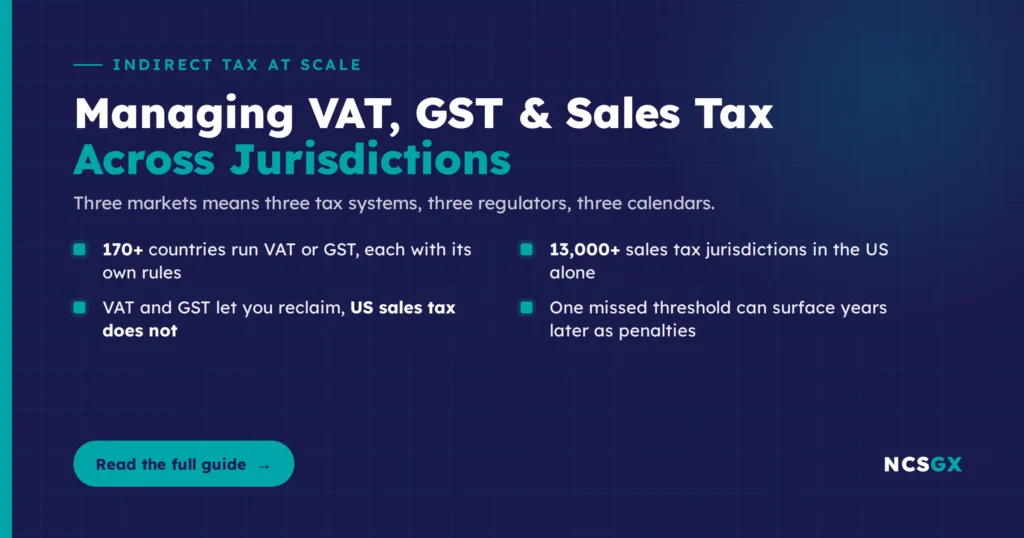
VAT and GST are mechanically similar: businesses act as collection agents and recover the tax they pay on inputs, so the real cost falls on the end consumer. The model is widespread, with more than 170 countries operating a VAT or GST system according to the OECD. US sales tax works differently. There is no input credit, it applies only at the point of final sale, and rates are set across more than 13,000 state and local jurisdictions.
Where your tax obligations are triggered
Knowing the rules matters less than knowing the moment they apply to you. Indirect tax registration thresholds are the first trigger to watch.
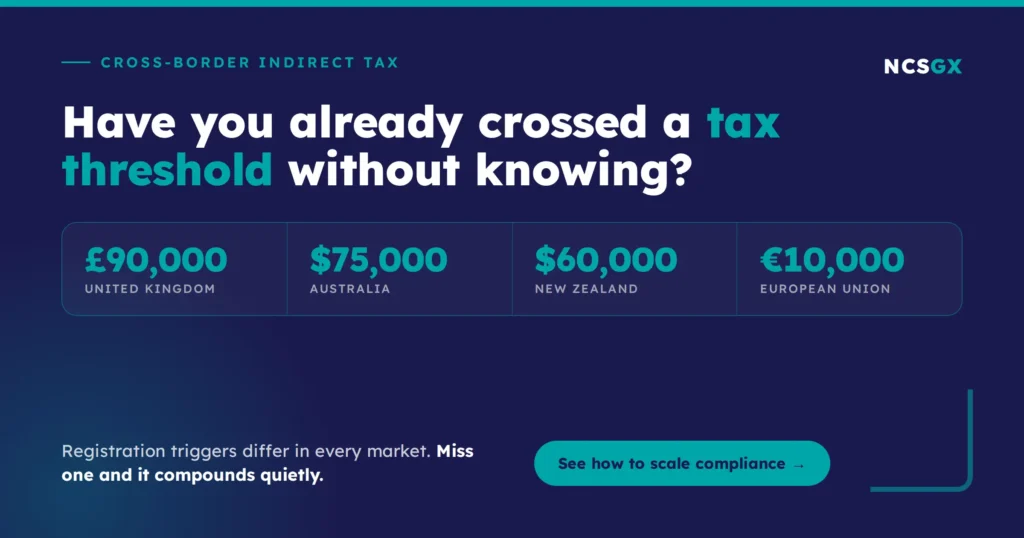
- United Kingdom: VAT registration is required once taxable turnover passes £90,000 (effective 1 April 2024).
- Australia: GST registration applies at AUD 75,000 of turnover.
- New Zealand: GST registration applies at NZD 60,000.
- European Union: a single €10,000 threshold covers cross-border B2C sales, after which you register or report through the One Stop Shop.
- United States: most states use economic nexus, commonly $100,000 in sales or 200 transactions, though the exact figures vary by state.
The US point deserves attention. Since the Supreme Court’s 2018 decision in South Dakota v. Wayfair, you no longer need a physical presence in a state to owe sales tax there. Selling enough into a state is enough to create an obligation. Thresholds also change, so treat any figure as current at the time, not permanent.
The core challenges of multi-jurisdiction indirect tax
Multi-jurisdiction VAT compliance and its sales-tax equivalent share the same failure points. Cross-border indirect tax management tends to break in a few predictable places:
- Rate and rule sprawl: Standard rates, reduced rates, zero-rates and exemptions differ by country and often by product category.
- Place-of-supply and nexus logic: Deciding where a sale is taxed is frequently harder than calculating how much.
- Inconsistent data. Your billing system, ERP and tax returns rarely agree on the numbers without manual reconciliation.
- E-invoicing and digital reporting mandates. Real-time and near-real-time reporting is expanding fast across the EU, Latin America, and Asia.
- Filing fragmentation. Different formats, frequencies, and currencies in every market.
Each of these is manageable on its own. The problem is carrying all of them at once, in spreadsheets, with no single owner.
How to build a scalable indirect tax process
A process scales when adding a new market is a configuration change, not a fire drill. That requires structure before software, and often outsourced finance and tax support to carry the load as you expand.
- Create a single source of truth. One reliable record of what you sold, where, to whom, and at what tax treatment.
- Centralise tax determination. The logic that decides the rate and place of supply should live in one place, not in each person’s head.
- Track registrations and thresholds. Monitor where you are registered and where you are approaching a threshold before you cross it.
- Build a filing calendar. Every obligation, with its format, frequency and owner.
- Reconcile revenue to returns. The total tax on your returns should tie back to your billing data, every period.
- Assign clear ownership. Someone is accountable for each jurisdiction. Shared ownership is not ownership.
Get these six right and the foundation holds whether you operate in three markets or thirty.
When to automate and what to automate first
Indirect tax automation is worth it, but only on top of a process that already works. Automating a broken process simply produces wrong answers faster. Sequence it like this:
- First, tax determination: Automated rate and rule lookup removes the highest-volume, highest-error task.
- Second, threshold monitoring: Let the system flag approach registration limits so nothing slips.
- Third, return preparation: Auto-populate returns from clean source data.
- Last, reconciliation. Automated matching between revenue and returns closes the loop and supports audits.
Start where the volume and error rate are highest. That is almost always determination and data entry, not the final filing keystroke.
Staying compliant as the rules keep moving
GST compliance for global businesses, and VAT compliance alongside it, is not a project you finish. Rates change, thresholds move, and e-invoicing mandates arrive on fixed timelines that do not wait for your roadmap.
Build a standing review cadence rather than reacting to each change as a surprise. Subscribe to updates from the regulators in every market you operate in, and assign someone to translate “the rule changed” into “here is what we change in the system.” The businesses that struggle are not the ones that missed a deadline once. They are the ones with no mechanism to catch the next change coming.
Common mistakes to avoid
- Assuming VAT, GST and sales tax behave the same way.
- Treating sales tax nexus as physical-only, years after Wayfair made that wrong.
- Discovering a registration threshold was crossed only at year-end.
- Letting spreadsheets carry logic that should live in a system.
- Never reconciling reported tax back to actual revenue.
- Ignoring e-invoicing mandates until the go-live date.
- Spreading ownership so thin that no one is truly accountable.
Conclusion
Indirect tax across jurisdictions is rarely undone by one big mistake, it is the quiet pile-up of small ones that surfaces later with penalties attached. The businesses that handle it well build a structure first, then let automation amplify it. If it has outgrown your spreadsheets and started to feel like a risk, connect with NCSGX for a review of where you are registered, where you should be, and where the gaps sit.
How NCSGX can help
NCSGX gives growing businesses the indirect tax capability of a much larger finance team, without the overhead of building one in-house. We help you map your obligations across every market, monitor registration thresholds before you cross them, prepare and reconcile returns, and put a repeatable process behind it all so adding a new jurisdiction is routine rather than risky.
If indirect tax has quietly become the messiest part of your finance function, talk to our tax and compliance team about a review of where you are registered, where you should be, and where the gaps are. You can also see how this fits alongside our broader finance and accounting services.
Frequently Asked Questions (FAQ)
1. What's the difference between VAT, GST and sales tax?
VAT and GST are essentially the same model under different names: tax is collected at each stage of the supply chain and businesses reclaim the tax they pay on inputs. US sales tax is single-stage, charged only on the final sale to the consumer, with no reclaim mechanism.
2. When do I need to register for VAT or GST in another country?
Once you cross that country’s registration threshold, or in some cases on your first taxable sale. Thresholds vary widely, from £90,000 in the UK to AUD 75,000 in Australia to a €10,000 EU-wide threshold for cross-border B2C sales. Check the rule before you enter the market, not after.
3. What is sales tax nexus and how do I know if I have it?
Nexus is the connection that obligates you to collect sales tax in a US state. It can be physical (an office, staff, inventory) or economic (exceeding a sales or transaction threshold). Since South Dakota v. Wayfair (2018), economic activity alone can create nexus, commonly at $100,000 in sales or 200 transactions per state.
4. Do I need indirect tax software, or can spreadsheets cope?
Spreadsheets cope for a single jurisdiction with low volume. Once you operate across several markets, with changing rates and reconciliation to manage, spreadsheets become the source of risk rather than control. The trigger to move is usually the third jurisdiction or the first audit, whichever comes first.

Aayushi Shah
Aayushi Shah is a Chartered Accountant with over 6 years of experience in Canadian accounting and currently serves as the Chief Branding Officer at NCS Global. She specializes in outsourced services including tax preparation, payroll, financial reporting, and business consulting for Canadian CPAs and businesses. With strong expertise in Canadian tax laws and tools like QuickBooks, Sage, and Xero, she helps streamline financial operations and reduce costs. Aayushi has supported over 50 CPA firms in cutting operating expenses by 50–70% and is known for delivering scalable, client-focused solutions. Outside of work, she enjoys typography and scrapbooking, bringing creativity into her professional approach.
All Posts