
 USA
USA
 Canada
 Australia


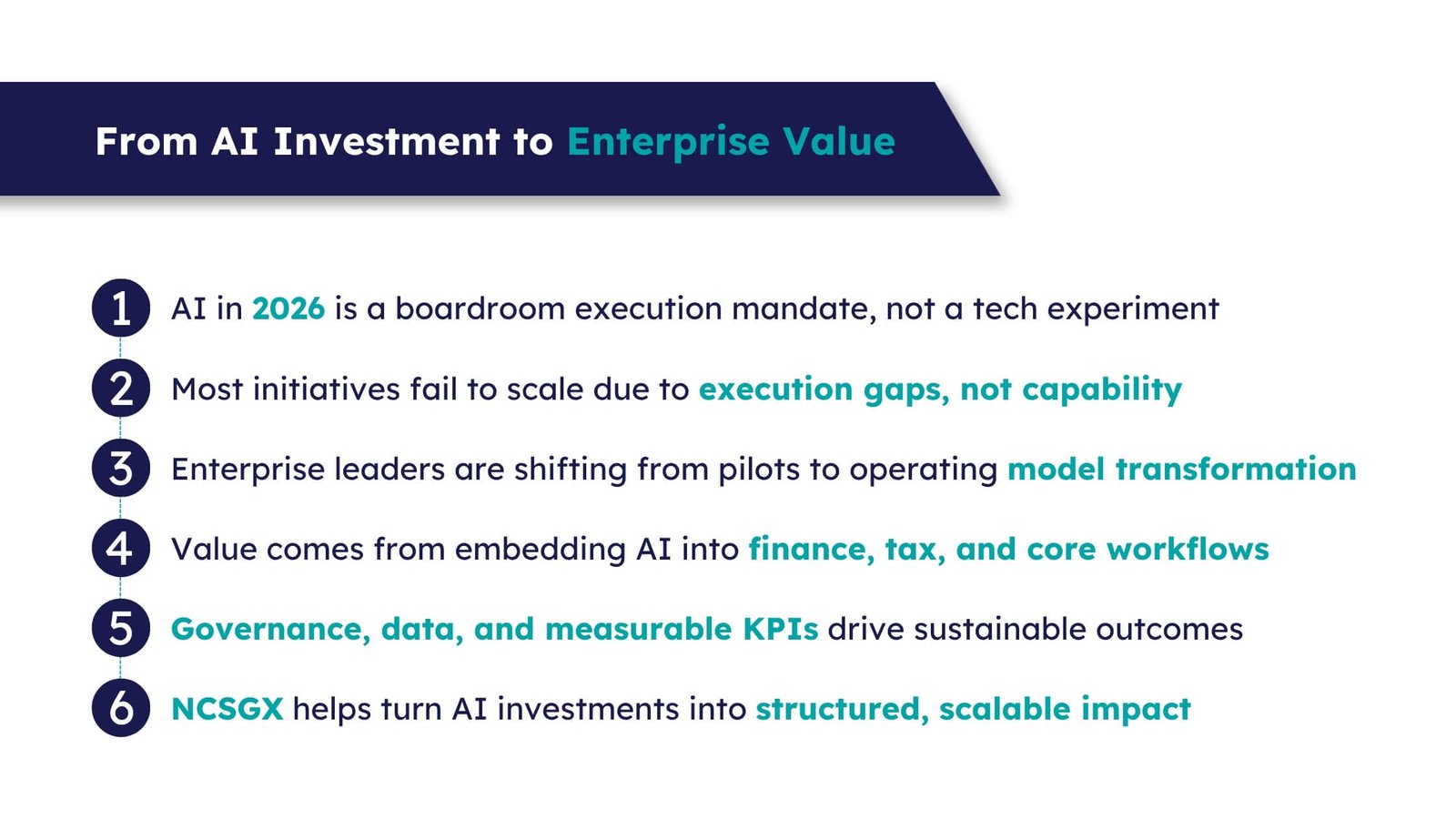
For enterprise leaders, AI digital transformation in 2026 is no longer a technology exploration exercise; it is a boardroom-level execution mandate. Organisations that moved first to experiment are now under pressure to show returns. Those who moved cautiously are being asked why they haven’t started. In both cases, the critical question is the same: how do you convert scattered AI investments into durable, measurable enterprise value and which partners, such as NCSGX, are best placed to help you do it?
Across industries, the pattern is becoming clear. Isolated pilots succeed but rarely scale. AI point solutions automate one task without reshaping the surrounding process. And technology investments deliver tools, not outcomes. The organisations separating themselves in 2026 are those that treat AI-led transformation as an operating model change, not a technology project.
The Execution Gap: Why Most AI Investments Underdeliver
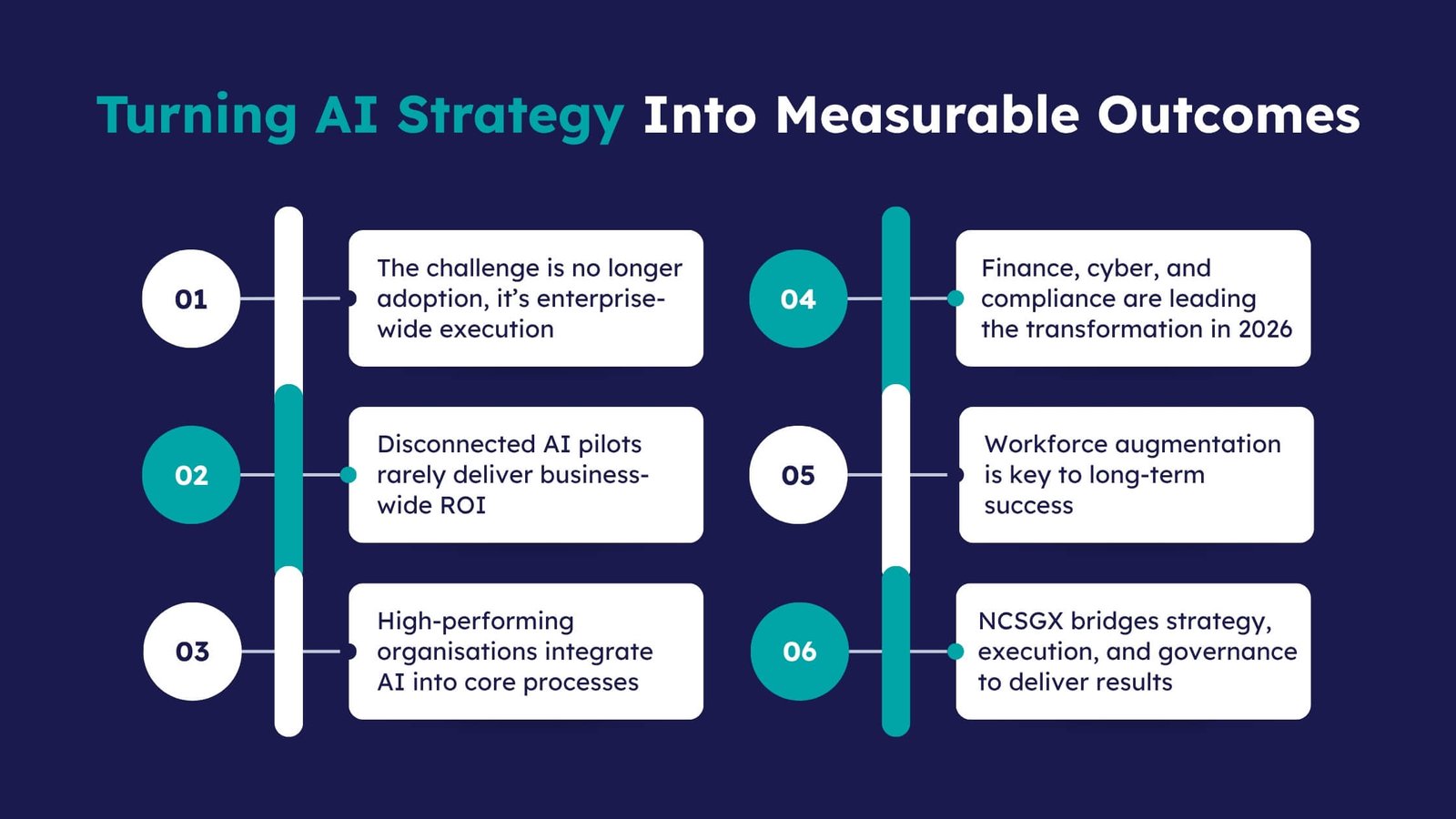
Research from Deloitte consistently shows that only a fraction of enterprise AI initiatives advances beyond the pilot phase to deliver quantifiable, business-wide ROI. The gap between promise and performance is rarely a technology failure, it is an execution failure. Common culprits include undefined success metrics, disconnected implementation teams, inadequate change management, and a tendency to deploy AI on top of broken processes rather than redesigned ones.
According to Deloitte’s State of Generative AI in the Enterprise research, organisations that achieve transformational outcomes from AI share three traits: clear executive ownership, outcome-based investment cases, and deliberate integration of AI capabilities into core business workflows, not just support functions.
The differentiator for high-performing organisations is disciplined execution: matching the right AI capability to the right process, with clear governance, measurable KPIs, and a change program that brings people along. Technology is an enabler, but execution is a competitive advantage.
Five Digital Transformation Strategies That Define 2026
Enterprise AI adoption in 2026 is being shaped by a set of converging digital transformation strategies. Understanding where the momentum is and where the risks concentrate is essential for any executive making platform and capability decisions this year.
- Agentic AI Moves into Core Processes
Generative AI has advanced from text generation to autonomous action. Agentic AI systems, those capable of planning, reasoning, and executing multi-step tasks across enterprise systems, are now entering production in finance, operations, and customer service. Leading organisations are deploying AI agents to manage accounts with payable exceptions, coordinate procurement workflows, and run first-level IT incident resolution without human intervention. The value is real, but so is the governance requirement: agent-driven processes need robust audit trails, human escalation protocols, and integration with existing risk frameworks.
- AI-Embedded Finance Operations
The CFO function is one of the highest-readiness domains for AI in business transformation. Intelligent automation applied across the record-to-report, order-to-cash, and procure-to-pay cycles delivers meaningful reductions in close cycle times, exception rates, and manual reconciliation hours. FP&A teams are deploying AI-assisted forecasting models that incorporate real-time signals, moving from backwards-looking variance analysis to forward-looking business intelligence. For finance leaders, AI is not replacing the finance function; it is reshaping it toward strategic advisory and away from transaction processing. For a deeper view of how this plays out in practice, see how NCSGX supports Finance & Accounting Operations across global organisations.
- Cyber Resilience as a Board-Level AI Priority
- Cyber Resilience as a Board-Level AI Priority
As enterprises deploy AI at scale, the threat surface expands proportionally. Attackers are leveraging AI to accelerate phishing, social engineering, and vulnerability discovery, making AI-powered cyber defence not optional but essential. The 2026 enterprise security posture requires AI-assisted threat detection, continuous compliance monitoring, and adaptive identity management running 24/7 across hybrid and cloud environments. Cybersecurity is no longer a technology problem managed by IT; it is an enterprise risk issue that belongs to the agenda of every CIO, CFO, and board audit committee. Organisations are increasingly turning to partners like NCSGX’s Managed IT & Cyber Services to operationalise this level of resilience at scale.
- Intelligent Tax and Compliance Automation
Tax functions are under mounting pressure from global regulatory complexity, from OECD Pillar Two minimum tax rules to expanding e-invoicing mandates and transfer pricing scrutiny. AI and digital automation are enabling tax departments to process data at the scale and speed of compliance now demands, improving accuracy and freeing tax professionals for higher-order planning and advisory work. Organisations that continue to manage global tax obligations through manual, spreadsheet-based processes are taking on avoidable compliance and financial risk.
- Workforce Augmentation, Not Replacement
The most effective digital transformation strategies in 2026 treat AI as a capability multiplier for the workforce, not a headcount reduction lever. Organisations investing in AI-assisted workflows alongside upskilling programs are outperforming those that deploy automation without accompanying change management. The goal is to enable skilled professionals to operate at a higher level: less time on routine tasks, more capacity for analysis, judgment, and client-facing work.
Generative AI Business Use Cases: From Pilot to Production
Across the enterprise functions NCSGX serves, generative AI business applications are advancing rapidly from controlled pilots to operationally significant deployments. The most mature use cases in 2026 share a common pattern: they address high-volume, rule-governed processes where AI can operate within a defined and auditable decision boundary.
Leading-Practice Insight: The most scalable generative AI implementations in 2026 are built on clean, governed data. Organisations that invested in master data management and ERP data quality in prior years are realising significantly faster time-to-value from AI deployments than those still resolving foundational data issues.
Key production use cases emerging across enterprise functions include:
- Finance & Accounting: AI-driven journal entry automation, anomaly detection in the general ledger, and AI-assisted management reporting narratives, reducing manual commentary effort.
- Tax Operations: Document ingestion and classification for tax provision workflows, automated data aggregation for indirect tax filings, and AI-assisted transfer pricing benchmarking analysis.
- IT & Managed Services: AI-powered service desk triage and resolution, predictive infrastructure monitoring, and automated security alert enrichment, reducing mean time to respond.
- HR & Talent: AI-assisted candidate screening, onboarding workflow automation, and intelligent knowledge management for HR service delivery.
- Procurement & Supply Chain: Intelligent purchase order matching, supplier risk scoring, and demand signal interpretation for inventory optimisation.
Your 2026 Action Plan: Three Steps to Enterprise-Scale Value
- Assess and Prioritise
Conduct a structured diagnostic of current AI initiatives, identifying which pilots are ready to scale, which processes are highest-value targets, and where data or governance gaps must be resolved first.
- Embed AI into Core Processes
Select two to three high-impact workflows for AI integration. Finance close automation, tax data processing, and IT service management are consistently the highest-readiness starting points for mid-market and enterprise organisations.
- Build for Scale with Governance
Establish accountability, data standards, and audit frameworks that allow successful programs to expand consistently across business units and geographies, preventing compliance failures that derail transformation at scale.
Conclusion
The enterprise leaders who will define 2026 are those treating AI-led digital transformation as an operating model change, one that demands executive ownership, disciplined investment cases, and a delivery partner capable of bridging strategy and execution. The technology is ready. The question is whether the governance, process design, and execution capability are equally prepared. To explore where AI can create enterprise-scale value in your organisation, contact the NCSGX team for an initial conversation.
How NCSGX Can Help
NCSGX enables enterprises to move from AI pilots to real, measurable outcomes by aligning technology with process and governance. We focus on high-impact areas like finance, tax, and operations to drive scalable transformation.
With deep expertise in execution, data, and operating models, NCSGX ensures AI adoption is structured, compliant, and outcome-driven, delivering faster value and long-term impact.