
 USA
USA
 Canada
 Australia

Introduction
Canadian businesses are rethinking how they manage their books, and AI and bookkeeping now sit at the centre of that conversation. Expert bookkeepers across the country are watching automation handle work that used to take entire mornings. The shift is real, but the story is not as simple as machines take overver. The role itself is changing, and the bookkeepers who adapt are becoming more valuable, not less.
This article looks at where the shift is heading, what it means for Canadian SMEs, and how finance leaders can prepare their teams for a smarter way of working in 2026.
Why AI Is Becoming Part of Modern Bookkeeping
Cloud accounting platforms began the shift over a decade ago. AI accelerated it. Tools that once flagged duplicates now learn from past entries, suggest categorizations, and prepare bank reconciliations in seconds. QuickBooks research has consistently shown that small business owners report saving several hours each week through automation, and many redirect that time toward planning and customer work.
Canadian firms are adopting these tools because they solve real problems. Talent shortages in the accounting profession, ongoing CRA compliance pressures, and rising client expectations are pushing firms to find efficiency wherever they can. CPA Canada has noted that technology fluency is now considered a core competency for the profession, not a bonus skill.
The result: a typical bookkeeper today spends less time entering data and more time reviewing what the system produced.
Where AI Is Adding the Most Value
- Bank feed matching and transaction categorization
- Receipt and invoice capture using OCR
- Anomaly detection in expense reporting
- Cash flow forecasting based on historical patterns
- GST/HST coding suggestions
Key Takeaways
- AI is reshaping bookkeeping workflows, not eliminating the profession.
- Routine data entry, reconciliation, and categorization are being automated first.
- Human judgment still drives compliance, advisory, and exception handling.
- Canadian SMEs that pair AI tools with skilled bookkeepers see better cash flow visibility.
- The bookkeeping skills 2026 employers want to look different from what was needed five years ago.
What AI Still Cannot Replace in Bookkeeping
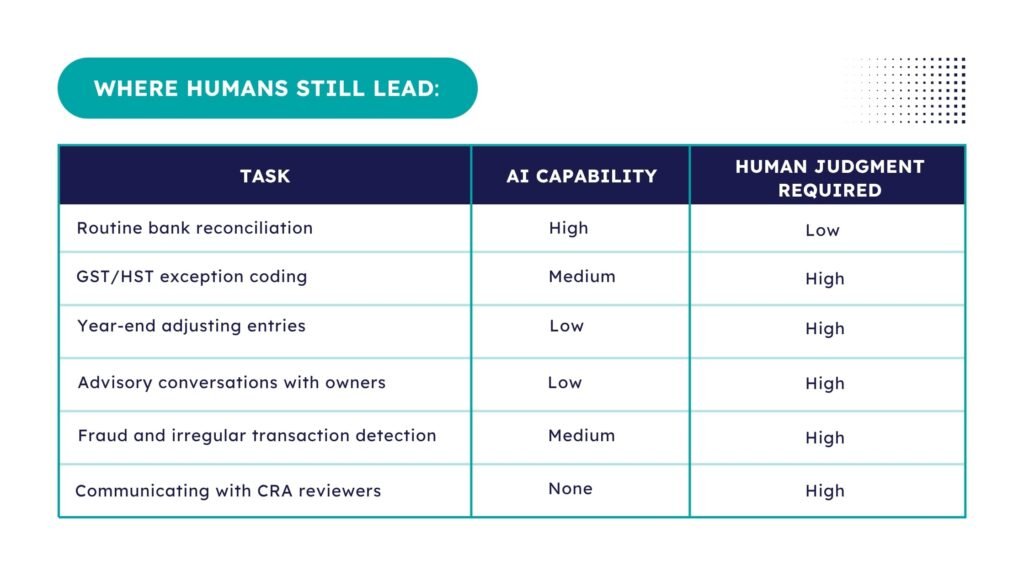
Despite the hype around AI replacing bookkeepers, the reality on the ground is different. AI handles patterns. It struggles with context.
Consider a small Toronto retailer who paid a contractor in cash with a handwritten receipt. The categorization tool flagged the entry as “uncategorized.” A bookkeeper recognized it as a one-time inventory disposal and coded it accordingly, which mattered for the year-end T2 return.
That kind of judgment cannot be trained into a model overnight. CRA compliance, audit defensibility, and advisory conversations still require human reasoning. AI provides speed; bookkeepers provide accountability.
How the Daily Work of Bookkeepers Is Changing
Five years ago, a Canadian bookkeeper might spend the first three hours of the day in data entry. Today, that time is spent reviewing automated entries, investigating exceptions, and preparing management reports the owner can actually use.
The shift is from doing the work to overseeing the work. Bookkeepers are becoming reviewers, advisors, and process owners.
A few specific changes worth noting:
- Reconciliations finish faster but require a sharper review.
- Month-end close cycles are shorter, with more emphasis on accuracy of automated postings.
- Client conversations have moved up the value chain, from “where is my receipt” to “how is my margin trending.”
- Audit trails are richer, with metadata that AI tools attach automatically.
Bookkeeping Skills 2026 Will Demand
The bookkeeping skills 2026 firms are hiring for go beyond debits and credits. Statistics Canada has reported that digital adoption among Canadian businesses continues to climb, which means bookkeepers need to be comfortable inside multiple platforms and understand how data flows between them.
Skills that matter most for the future of bookkeeping:
- Strong working knowledge of cloud accounting platforms such as QuickBooks Online, Xero, and Sage
- Comfort interpreting AI-generated reports and identifying when they are wrong
- Solid grasp of GST/HST, payroll deductions, and basic T2 preparation workflows
- Communication skills for advisory conversations with owners
- Curiosity about new tools without blindly trusting them
Bookkeepers who lean into these areas position themselves as indispensable. Those who treat AI as a threat tend to fall behind the firms embracing it.
Risks of Relying Too Heavily on AI Bookkeeping
Bookkeeping automation trends are encouraging, but over-reliance on AI carries real risks. Canadian SMEs have run into trouble more than once by trusting the tool without a human review layer.
Warning Signs Your AI Bookkeeping Setup Needs Attention
- Repeated miscategorization of vendor payments going unchallenged
- GST/HST input tax credits being missed or duplicated
- Reconciliations marked “complete” with unexplained variances
- Payroll postings that do not match T4 summaries at year-end
- Owners making decisions based on dashboards no one has verified
When these signs appear, the issue is not the AI. The issue is the absence of bookkeeping workflow automation that includes human checkpoints.
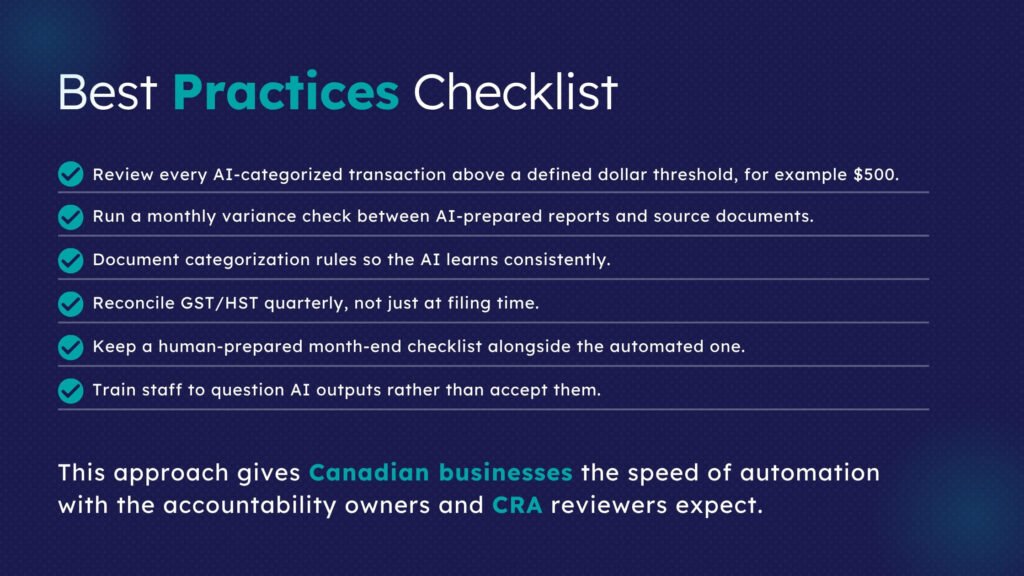
Best Practices for Combining AI and Bookkeeping
Firms that get this right share a common pattern. They treat AI as a junior assistant, not a replacement, and they build review into every workflow.
What Small Businesses Should Expect Moving Forward
Owners often ask whether AI bookkeeping is “ready” for their business. The honest answer: it is ready for routine work, not strategic work. BDC Canada research has consistently shown that small businesses benefit most when technology frees up time for decision-making rather than replacing the people who make those decisions.
Expect three things over the next two to three years:
- Lower bookkeeping costs for transactional work.
- Higher demand for advisory-style bookkeeping.
- More integrated systems include linking banking, payroll, and reporting.
The future of bookkeeping in Canada looks more like a partnership between humans and machines, with the bookkeeper acting as the quality controller and the strategic translator.
Final Thoughts
AI and bookkeeping are not opposing forces. They work best together, with automation handling volume and bookkeepers handling judgment. Canadian SMEs that build this kind of finance function gain speed without losing control. The firms succeeding in 2026 will not be the ones with the fanciest tools. They will be the ones whose people know exactly when to trust technology and when to override it.
How NCSGX Canada Can Help
NCSGX Canada supports growing businesses with finance outsourcing that combines modern AI-driven tools and experienced human review. Our team understands that automation is only as strong as the people overseeing it.
Our bookkeeping services help Canadian SMEs spend less time chasing numbers and more time running the business. Whether you are evaluating new AI tools, building a finance function from scratch, or simply need cleaner books, we can take it from here.
Ready to talk through your numbers?
Book a consultation with our team, let’s map out how AI and bookkeeping can work together for your business.
Frequently Asked Questions (FAQ)
1. Will AI replace bookkeepers completely?
No. AI handles repetitive, pattern-based work well, but it cannot replicate human judgment around compliance, exception handling, and advisory conversations. The role of bookkeepers is shifting toward review, oversight, and strategic input, which AI is not positioned to take over.
2. What bookkeeping tasks can AI automate?
AI tools can automate transaction categorization, bank reconciliations, receipt capture, recurring journal entries, and basic cash flow forecasts. They can also flag anomalies and unusual patterns for a human bookkeeper to review.
3. Why does AI bookkeeping still need human review?
AI works from patterns in past data. It often miscategorizes unusual transactions, misses the context behind a payment, or applies to the wrong tax treatment. A human bookkeeper catches these issues before they affect financial statements or CRA filings.
4. What skills should bookkeepers develop in 2026?
Bookkeepers should focus on cloud accounting fluency, GST/HST and payroll knowledge, comfort with AI-generated reports, exception handling, and advisory communication. These bookkeeping skills 2026 employers prioritize will define the strongest hires.
5. Is AI bookkeeping reliable for small businesses?
It can be paired with proper human oversight. Small businesses that rely entirely on automation tend to miss errors that compound over time. A blended model with an experienced review is the most reliable path forward.