
 USA
USA
 Canada
 Australia

Introduction
Across Canada, more small business owners are walking into their accountant’s office with the same problem: the books are months behind, transactions are uncategorized, bank balances do not match the general ledger, and tax filing season feels like a fire drill. Bookkeeping cleanup is no longer a once-in-a-while task reserved for a small slice of businesses. It has become a recurring need for a growing share of Canadian SMEs, and the cost of ignoring it keeps climbing.
This article walks through why messy bookkeeping records are spreading, what a proper cleanup involves, the warning signs that your business needs one, and how to stop the same backlog from forming again next year. Know with NCSGX.
What Bookkeeping Cleanup Actually Means
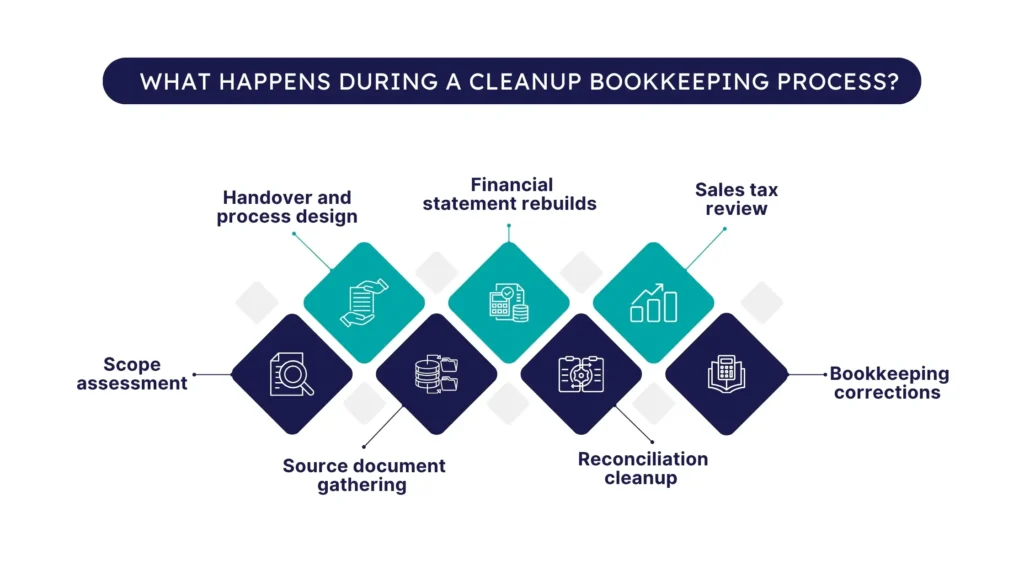
Bookkeeping cleanup is the structured process of identifying, correcting, and reconciling errors in a company’s financial records, so the books reflect what happened in the business. It is broader than catching up bookkeeping, which deals primarily with transactions that were never recorded.
A cleanup also addresses entries that were recorded, just recorded poorly. That includes:
- Transactions miscoded to the wrong account
- Duplicate or missing invoices and expenses
- Unreconciled bank, credit card, and merchant accounts
- GST/HST miscategorized, understated, or missed entirely
- Stale items in accounts payable and receivable that never cleared
- Owner contributions or draws mishandled in equity
- Loan balances that no longer tie to the lender’s statement
The end goal is a clean trial balance, accurate financial statements, and a general ledger you can rely on for real decisions.
Statistics Canada reports that small businesses with fewer than 100 employees represent roughly 98 percent of all Canadian employer businesses. Most of them operate without a dedicated controller, which means recordkeeping discipline depends on whoever has the time.
Key Takeaways
- Bookkeeping cleanup corrects inaccurate, incomplete, or outdated financial records before they create tax, cash flow, or compliance problems.
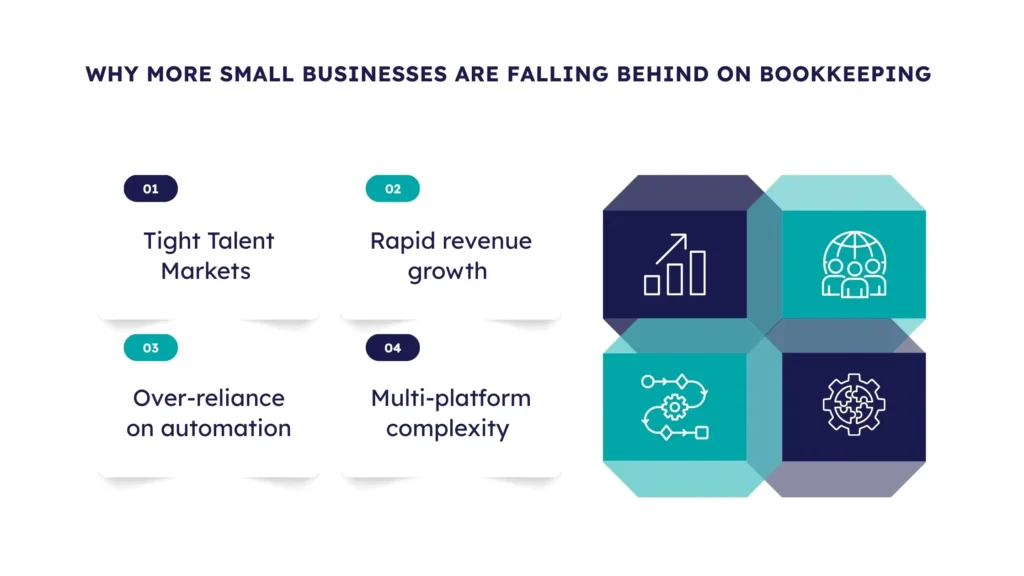
- More Canadian SMEs are falling behind because of tighter labor markets, rapid post-pandemic growth, and over-reliance on automated bank feeds without proper review.
- Common red flags include unreconciled accounts, mismatched GST/HST filings, and a general ledger no one fully understands.
- Delayed cleanup compounds quickly, turning small errors into CRA scrutiny, missed deductions, and poor financial decisions.
- A structured cleanup bookkeeping process, paired with a disciplined monthly close, prevents the problem from coming back.
What Are the Signs of a Business Needs Bookkeeping Cleanup?
Use this as a warning signs checklist. If three or more apply, the books likely need attention before the next filing deadline.
- Bank and credit card accounts have not been reconciled in more than three months.
- The opening balance in your accounting software no longer matches prior-year financials.
- GST/HST filings were estimated rather than calculated from the books.
- The AR aging report contains invoices over a year old that no one can confirm.
- Your accountant returns the file each year with a long list of journal entries to correct.
- You cannot answer a basic question like “what was our gross margin last quarter” without manualxercise.
- Payroll liabilities on the balance sheet do not tie to CRA payroll account statements.
- Owner personal expenses are mixed into business accounts with no clear separation.
These are not just bookkeeping problems. They are early signs that decisions are being made on incomplete information.
Typical Findings in a Bookkeeping Cleanup Engagement
The table below reflects patterns commonly seen across cleanup engagements for Canadian SMEs. It is not a forecast for any specific business, but it illustrates where reconciliation cleanup work usually concentrates.
| Issue Area | How Often It Appears | Typical Business Impact |
|---|---|---|
| Unreconciled bank or credit card accounts | Very common | Inaccurate cash position, missed expenses |
| GST/HST coding errors | Common | Over or underpayment to CRA, audit risk |
| Duplicate transactions from bank feeds | Very common | Overstated expenses, inflated tax deductions |
| Misclassified payroll items | Common | Incorrect T4 reporting, CPP/EI mismatches |
| Stale AR and AP balances | Common | Distorted working capital metrics |
| Shareholder loan account drift | Common in owner-managed firms | CRA exposure on deemed taxable benefits |
Why Delayed Cleanup Creates Bigger Financial Problems
The cost of waiting is rarely just the bookkeeper’s hourly rate. Compounding starts almost immediately.
Mini case example. Consider a Calgary-based contracting business with about $3.2 million in annual revenue. The owner postponed cleanup for two years while focused on operations. When the team finally engaged a finance partner, the cleanup uncovered $47,000 in unclaimed input tax credits, a $19,000 overstated revenue figure that had inflated corporate tax across two fiscal years, and a shareholder loan balance that triggered a CRA reassessment. The cleanup fee was a fraction of the recovered amounts, but the corporate tax restatement required formal amendments and several months of back-and-forth with the CRA.
The lesson is simple. Messy books rarely contain only one type of error. They contain layers, and the deeper layers usually carry bigger dollar consequences.
CPA Canada has consistently flagged accurate recordkeeping as foundational for any SME seeking financing, planning succession, or preparing for a transaction. The Canada Revenue Agency itself requires businesses to keep financial records and supporting documents for at least six years from the end of the tax year they relate to.
How Businesses Can Prevent Future Bookkeeping Backlogs
A cleanup only pays off if the same conditions do not rebuild the backlog. Businesses that pair reconciliation work with ongoing professional bookkeeping services are far more likely to maintain accurate records, cleaner month-end closes, and stronger CRA compliance over time.
- Close the books monthly: Treat the month-end close as non-negotiable, not a year-end scramble.
- Reconcile every bank, credit card, and merchant account every month: Do not let bank feed substitute for reconciliation.
- Separate roles: The person entering data should not be the only person reviewing it.
- Review the trial balance, not just the P&L: Most cleanup issues hide on the balance sheet.
- Tie payroll, GST/HST, and corporate tax accounts to CRA statements quarterly.
- Document the chart of accounts: A short internal guide prevents future miscoding.
- Outsource the close where capacity is short: A fractional finance partner often costs less than the errors an overworked in-house bookkeeper accumulates. Many Canadian SMEs are now shifting toward virtual bookkeeping models that provide ongoing reconciliation support, cloud-based reporting, and scalable financial oversight.
BDC research has long pointed out that financial management capacity is one of the strongest predictors of SME resilience. Businesses that close the books regularly tend to forecast better, secure financing faster, and recover from downturns sooner.
How NCSGX Canada Can Help
At NCSGX Canada, we work with Canadian SMEs that need their books rebuilt and kept that way. Our cleanup engagements pair targeted reconciliation cleanup with a redesigned monthly close, so the work delivers lasting value instead of a one-time fix.
What clients get:
- Scalable support that flexes with seasonal volume and growth stages, without hiring overhead.
- Compliance accuracy across GST/HST, payroll, T4 and T2 cycles, and CRA recordkeeping requirements.
- Reporting visibility through management-ready financial statements and KPI dashboards your leadership team can use.
- Cost efficiency compared to expanding an in-house team that may sit underused outside peak periods.
Our bookkeeping and finance outsourcing services cover the full close cycle, from transaction processing through reporting. If your books need a reset, book a consultation with our team and we’ll map the scope before any commitment.
Final Thoughts
Bookkeeping cleanups are no longer a niche problem. Canadian SMEs are dealing with more complex tech stacks, leaner finance teams, and tighter compliance expectations than ever. Letting messy books drift carries real costs in tax exposure, lending decisions, and operational clarity. A disciplined bookkeeping cleanup, followed by a monthly close routine, is one of the highest-return investments an owner-managed business can make this year.
Frequently Asked Questions (FAQ)
1. What is bookkeeping cleanup?
Bookkeeping cleanup is the process of correcting, reconciling, and validating a company’s financial records, so the books accurately reflect business activity. It covers miscoded entries, missed reconciliations, sales tax errors, and balance sheet account drift.
2. What causes bookkeeping backlogs?
Common causes include staff turnover, rapid revenue growth, multi-platform complexity, over-reliance on bank feed automation without review, and inconsistent month-end close routines.
3. How often should accounts be reconciled?
Bank, credit card, and merchant accounts should be reconciled at least monthly. Quarterly reconciliations against CRA payroll and GST/HST accounts add another layer of protection.
4. Why do bookkeeping records become inaccurate?
Records typically drift due to manual coding errors, duplicate entries from connected feeds, miscategorized sales tax, unrecorded owner transactions, and poorly documented chart of accounts changes.
5. What is the difference between cleanup and catch-up bookkeeping?
Catch up bookkeeping focuses on recording transactions that were never entered. Bookkeeping cleanup goes further, correcting transactions that were entered incorrectly and reconciling balances so the financial statements can be trusted.