

 USA
USA
 Canada
 Australia


Cyber risk management is no longer a problem you can hand to the IT department and forget about. For the finance and operations teams NCSGX works with every day, a single breach can freeze payment runs, expose client financial data, trigger regulatory penalties, and stall the close. The teams that move money and keep the business running are exactly the teams attackers want inside.
That reality is changing who owns the problem. Strong cyber risk management now sits at the intersection of technology, finance, and operations, because the consequences of getting it wrong land squarely on the balance sheet and the income statement.
This guide explains how to align your IT risk frameworks with operational risk, build cyber governance that finance and ops can actually own, and turn a vague sense of exposure into a managed, measurable programme.
What Is Cyber Risk Management, and Why Does It Matter for Finance?
Cyber risk management is the discipline of identifying, assessing, treating, and monitoring the threats to your systems and data, then deciding how much of that risk you accept, transfer, or reduce. It is not a one-off project. It is an ongoing cycle that should run as routinely as your monthly reporting.
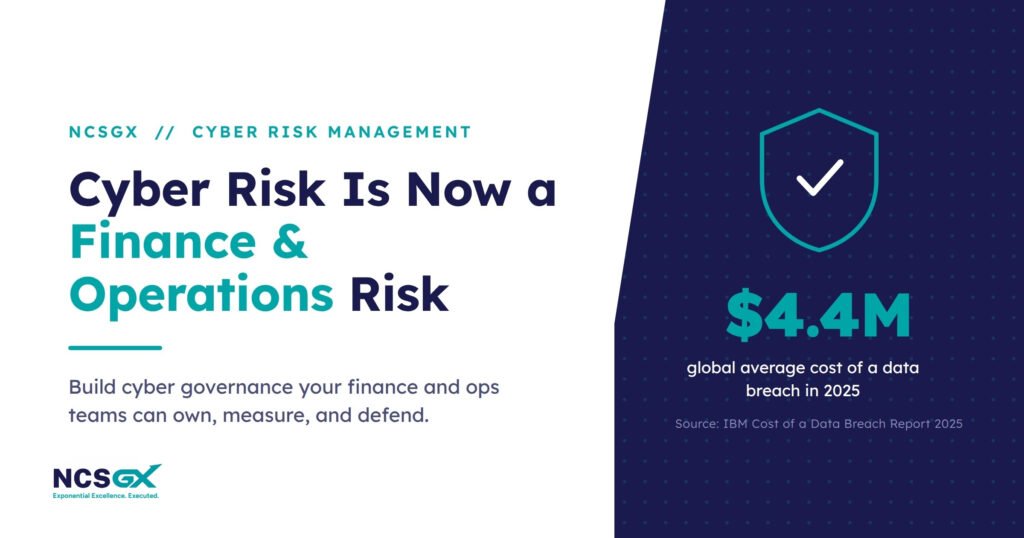
For finance leaders, the case is straightforward. According to IBM’s Cost of a Data Breach Report 2025, the global average cost of a data breach fell to USD 4.4 million, a 9% drop on the prior year, largely because organisations detected and contained incidents faster. The lesson is not that breaches are getting cheaper. It is that the firms investing in detection, response, and governance are paying far less than those that are not.
Financial functions are a high-value target because of what they hold: bank details, payment approvals, payroll data, supplier records, and tax information. When those controls fail, the loss is rarely just technical. It is fraud, business interruption, fines, and reputational damage that takes years to repair.
Where Cyber Risk and Operational Risk Meet
Many organisations still treat cyber risk and operational risk as separate worlds with separate owners. That gap is where most failures happen.
Cyber risk is the chance that a threat to your information systems causes harm. Operational risk is the broader category of loss arising from failed internal processes, people, systems, or external events. A ransomware attack that halts invoicing is a cyber event, but the inability to bill customers for a fortnight is pure operational risk with a direct revenue hit.
When these are managed in isolation, three things tend to go wrong:
- Blind spots between teams: IT tracks vulnerabilities, finance tracks fraud, and nobody owns the scenario that connects them.
- Duplicated or conflicting controls: Two functions solve the same problem twice, or assume the other has it covered.
- Reporting that leadership cannot use: Technical risk registers and financial risk registers never reconcile into a single view.
Treating cyber risk as a sub-category of operational risk fixes this. It puts both under one governance umbrella and forces the question every board should ask: if this system fails, what does it cost us, and who is accountable?
How Do You Align IT Risk Management With Operational Risk?
Alignment starts with a shared language. IT risk management uses recognised standards to structure controls, while operational risk uses impact and likelihood ratings to prioritise. The two connect when every cyber control maps to a business consequence.
A practical way to bridge them is to adopt established risk frameworks and map their functions to operational outcomes. The table below shows how the most widely used frameworks line up.
| Framework | What it covers | How it supports finance and operations |
| NIST Cybersecurity Framework 2.0 | Govern, Identify, Protect, Detect, Respond, Recover | The new Govern function ties cyber decisions to enterprise risk and accountability |
| ISO/IEC 27001 | Information security management system (ISMS) | Provides certifiable controls clients and auditors recognise |
| Three lines of defence | Operational ownership, risk oversight, independent assurance | Clarifies who owns, who monitors, and who tests each control |
Using a common framework means a finance leader and a technology lead can sit in the same meeting and talk about the same risk in terms both understand. It also makes vendor and outsourcing reviews far simpler, because you can ask partners which framework they align to and check the evidence.
Building Cyber Governance That Finance and Ops Can Own
Cyber governance is the set of policies, roles, and decision rights that determine how cyber risk is managed and who is answerable for it. Without it, security spending becomes reactive and impossible to defend at budget time.
Good cyber governance for finance and operations teams usually includes:
- Clear ownership: A named risk owner for every critical financial system, not a shared inbox.
- Defined risk appetite: A written statement of how much risk the organisation will tolerate, signed off at board level.
- Regular reporting: A concise dashboard that shows top risks, control status, and incidents in language that leadership can act on.
- Incident response planning: A tested plan covering who decides, who communicates, and how operations continue during an outage.
- Third-party oversight: A consistent process for assessing the security of vendors, software providers, and outsourcing partners.
The aim is to make cyber risk a standing agenda item, not a fire drill. When governance is embedded, the finance team can quantify exposure, justify investment, and demonstrate due diligence to clients, regulators, and insurers.
Practical Steps to Strengthen Your Cyber Risk Frameworks
You do not need a large security team to make meaningful progress. A focused programme built on proven risk frameworks delivers most of the protection for a fraction of the effort. Start here:
- Map your critical data and processes: List where financial data lives and which processes would stop the business if disrupted.
- Run a control gap assessment: Compare your current controls against NIST CSF 2.0 or ISO/IEC 27001 and record the gaps.
- Prioritise by business impact: Treat the risks with the highest operational and financial consequence first, not the ones that are easiest to fix.
- Strengthen the basics: multi-factor authentication, least-privilege access, patching, encrypted backups, and staff awareness training stop the majority of attacks.
- Test your response: Run a tabletop exercise on a payment-fraud or ransomware scenario, so the plan works under pressure, not just on paper.
- Review your partners: Confirm that anyone handling your financial data, including outsourced finance and accounting providers, meets your control standards and can prove it.
Reviewed quarterly and reported in plain language, these steps turn cyber risk management from an abstract worry into a programme leadership can measure and defend.
Conclusion
Cyber risk is now an operational and financial risk, and it deserves the same rigour you apply to cash flow or compliance. By aligning IT risk management with operational risk, adopting recognised risk frameworks, and embedding cyber governance that finance and operations teams genuinely own, you protect both your data and your ability to keep trading.
The organisations containing breaches fastest, and paying the least, are the ones that prepared before they were tested. The work you do now determines which side of that statistic you land on. If you want a finance and operations partner whose controls stand up to your auditors, clients, and insurers, contact us to talk through how NCSGX can help.
How NCSGX Can Help
NCSGX manages sensitive financial data for clients every day, so cyber risk and operational resilience are built into how we work, not added afterwards. When you partner with us, you extend your finance function without weakening your control environment.
Our teams operate to recognised security standards, with documented access controls, governed processes, and clear accountability for the data we handle. That means you gain capacity in outsourced finance and accounting and bookkeeping and back-office support while strengthening, not stretching, your cyber governance.
If you want a finance and operations partner whose controls stand up to your auditors, clients, and insurers, get in touch with our team to talk through how we work and how we protect what matters most.
Frequently Asked Questions (FAQ)
1. What is the difference between cyber risk and operational risk?
Cyber risk is the threat of harm to your information systems and data. Operational risk is the wider category of loss from failed processes, people, systems, or external events. Cyber risk is best managed as a part of operational risk so that technical threats are always tied to business impact.
2. Which cyber risk framework should finance teams use?
NIST Cybersecurity Framework 2.0 and ISO/IEC 27001 are the two most widely recognised. NIST is flexible and outcome-focused, while ISO 27001 offers a certifiable standard that clients and auditors trust. Many organisations use NIST to structure their programme and ISO 27001 to demonstrate it.
3. Who should own cyber risk management in an organisation?
Cyber risk should have shared ownership. Technology teams manage the controls, but finance and operations leaders must own the business consequences, set the risk appetite, and report to the board. The three lines of defence model helps clarify who owns, who oversees, and who independently tests each control.
4. How often should we review our cyber risk frameworks?
At a minimum, review your risk register and controls quarterly, and run an incident response exercise at least once a year. Reassess immediately after any major change, such as a new system, a merger, or onboarding a new third-party provider.

Rajesh Undhad
Rajesh Undhad, AVP of Information Technology at NCSGX, has 12+ years of experience in IT security, infrastructure, and compliance. He oversees the company's IT ecosystem across all international operations, ensuring data security, privacy, and resilience, with expertise in ISO 27001, network security, and global data protection.
All Posts