

 USA
USA
 Canada
 Australia


The pressure on Australian finance teams has shifted. Reporting deadlines have not moved, but what regulators, boards, and auditors expect inside those deadlines has. Climate disclosures now sit alongside the half-year accounts. ASIC publishes surveillance findings every quarter. Boards want forecasts that will hold up after the close, not three weeks later.
That is the gap data driven finance record to report is filling. A modern record to report process is no longer a sequence of spreadsheets and email chains. It is a connected, analytics-led workflow that closes the books faster, surfaces errors before the auditor finds them, and turns the same data into management insight without a second handover.
NCSGX works with Australian finance teams making exactly this shift across mid-market and SME ledgers, and the same patterns keep showing up. Here is how it works in practice, and what to put in place before your next FY closes.
What is the record to report process?
R2R, short for record to report, is the end-to-end process of capturing financial transactions, recording them correctly, reconciling balances, consolidating across entities, and producing financial reports for internal and external use.
The traditional cycle has six stages:
- Transaction capture (AP, AR, payroll, treasury)
- Journal entries and accruals
- Reconciliations (bank, intercompany, balance sheet)
- Consolidation across entities and ledgers
- Close and lock-down of the period
- Reporting: statutory, management, and tax
Each stage produces data for the next stage, depending on it. Each stage is also where errors compound when the work is manual.
Why is 2026 a turning point for the record to report process?
Three changes are happening at once for Australian finance functions.
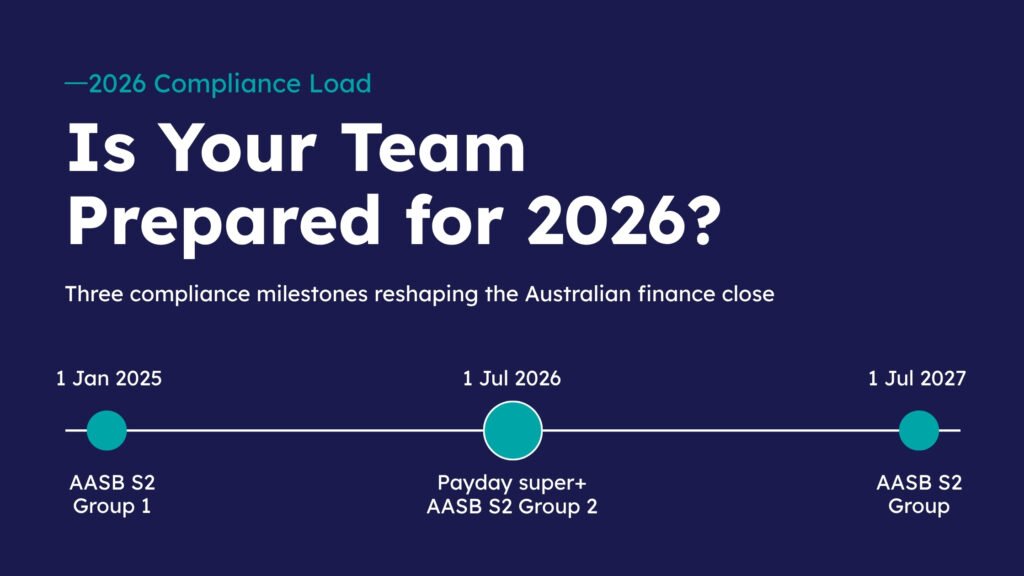
First, climate-related financial disclosures under AASB S2 are now phased in. Group 1 entities, broadly the largest, are reporting from financial years starting 1 January 2025. Group 2 follows from 1 July 2026, Group 3 from 1 July 2027. That work sits on top of the financial close, not next to it, and the disclosures must reconcile the financial statements.
Second, payday super starts 1 July 2026. Super guarantee must be paid within seven days of payday, which collapses any tolerance for slow payroll-to-GL reconciliations.
Third, ASIC’s financial reporting surveillance has moved from sampling to active pursuit. Recent focus areas include impairment, provisions, and the consistency between climate disclosures and financial statements. Inconsistencies are now a finding, not a footnote.
A spreadsheet-led close cannot carry that load reliably. Finance data analytics and record to report automation are how mid-market and large Australian businesses are absorbing it.
How does finance data analytics transform the close?
Analytics in R2R is not a dashboard at the end. It is built into each stage of the process.
- Anomaly detection on the GL: Algorithms flag journals that sit outside the normal range for the account, period, or preparer. Auditors are already running these tests on your data. Running them first is cheaper.
- Reconciliation prioritisation: Instead of reviewing every reconciliation equally, analytics surfaces the ones that have aged, moved unexpectedly, or breached a tolerance.
- Trend analysis on accruals: Variance against the same month last year, against budget, against rolling forecast, all visible before the management report is written.
- Faster root cause: When a number looks wrong, drilling from the consolidated report to the source transaction takes seconds, not a Monday morning.
The point is not technology. The point is that the finance and accounting team stops being a clerical bottleneck and starts being a control function.
What does record to report automation actually do?
Close automation tools replace the repetitive, rules-based work that historically filled the first ten working days of a month.
The high-value targets are usually:
- Automated bank and credit card reconciliations
- Rule-driven journal posting (depreciation, accruals, recurring allocations)
- Intercompany matching and elimination
- Task management showing who owns what, where it sits, and what is blocking it
- Disclosure management for statutory reports
APQC benchmarks put the median monthly close at around 6.4 business days, with top performers closing in under 5. The gap between median and top quartile is almost entirely automation and process discipline, not headcount.
For an Australian SME or mid-market group, the practical first step is rarely a full ERP rebuild. It is usually fixing the two or three reconciliations that consume the most time, then layering automation around them.
Close automation and audit-ready compliance
Auditors have changed how they work. The Big Four and mid-tier audit teams are now running full-population data tests on Australian client ledgers, not just samples. Weak controls show faster, and unusual journals get queried at fieldwork rather than at sign-off.
Close automation reduces audit risk in three ways:
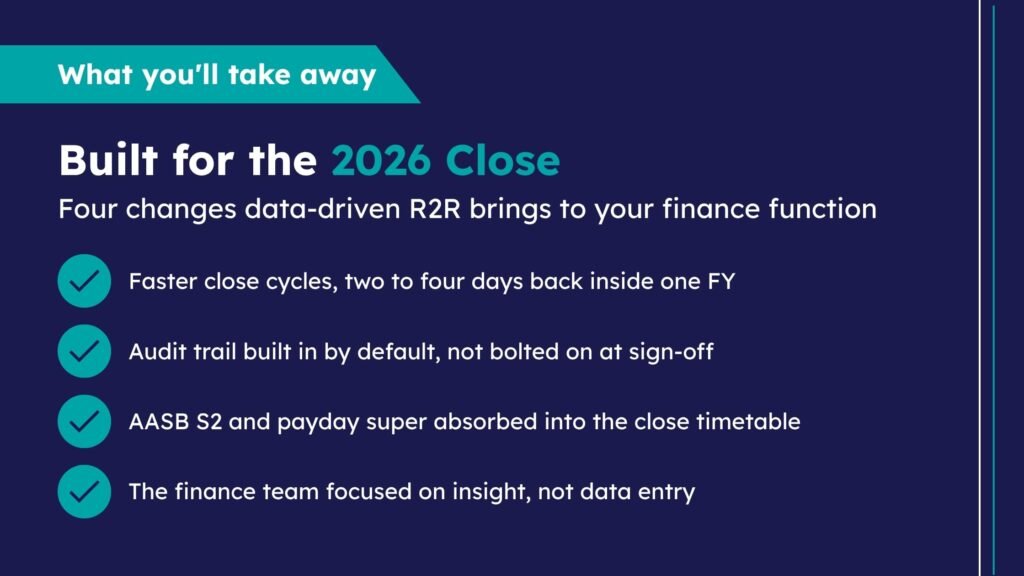
- Audit trail by default: Every change, approval, and reversal is logged with a user, timestamp, and reason. No more “we think someone did it in March.”
- Segregation of duties: Preparers and reviewers are enforced by the system, not by a process document sitting on the share drive.
- Consistency across periods: Reconciliation templates, journal narratives, and supporting evidence look the same every month. Auditors finish faster, and management letters get shorter.
For ASIC-regulated entities, this is increasingly the baseline expectation. For everyone else, it is what keeps the next finance hire focused on insight rather than data entry.
A practical roadmap for Australian finance teams
If your close still runs on spreadsheets and goodwill, you do not need to rebuild everything at once. A workable sequence:
- Map the close. Every task, owner, dependency, and average time.
- Pick the three slowest tasks. Usually bank rec, intercompany, and accruals.
- Automate those first. Measure cycle time before and after.
- Layer analytics on the cleaned data. Anomaly flags, variance reports, rolling forecasts.
- Bring sustainability data into the same timetable as the financial close, ready for AASB S2.
Most Australian mid-market groups see the close drop by two to four working days inside a single FY once the first three steps are done.
Conclusion
Data-driven R2R is not a software story. It is a discipline that lets a finance team meet the 2026 compliance load, including AASB S2 disclosures, payday super, and ASIC surveillance, without losing the management insight side of the job. The teams getting it right are the ones that started with two reconciliations, not a full transformation programme.
If your monthly close still takes ten working days, or your auditor keeps raising the same management points, that is the brief to fix. Get in touch with NCSGX and we will walk through your current close, identify the two or three biggest time-sinks, and map out what a cleaner R2R workflow looks like in your existing systems.
How NCSGX can help
NCSGX works with Australian businesses, accounting firms, and finance teams to design and run modernised R2R processes. That includes:
- Bookkeeping and reconciliation support that feeds a clean general ledger
- Outsourced management reporting so, the close produces decision-ready data, not just statutory output
- Back-office accounting and BAS support to free internal teams for higher-value work
- Process review and documentation so your close is repeatable, auditable, and not dependent on one person
We work inside your existing systems including Xero, MYOB, NetSuite, and QuickBooks Online, and bring the data discipline rather than a software pitch.
Frequently Asked Questions (FAQ)
1. What is the difference between record to report and order to cash?
R2R covers accounting, closing, and reporting. Order to cash (O2C) covers customer-side transactions from quote to collection. R2R consumes O2C data downstream.
2. Is it recorded to report automation only for large enterprises?
No. SMEs benefit faster in some ways because the automation pays back inside one quarter. The starting point is usually bank reconciliation and recurring journals.
3. Does finance data analytics replace the auditor?
It does not replace the audit. It changes what the auditor finds. Anomalies you would have explained at fieldwork are now resolved before the auditor arrives.
4. How long does it take to implement close automation?
For a single-entity Australian SME, eight to twelve weeks for the main process. For a multi-entity group, three to six months depending on consolidation complexity.
5. What changes for finance teams under AASB S2?
Climate-related disclosures must be consistent with the financial statements, prepared on the same timetable, and supported by evidence the auditor can test. The close timetable effectively expands to include sustainability data.
