
 USA
USA
 Canada
 Australia

Introduction
One of the most common questions business owners ask is that is outsourced bookkeeping safe when sensitive financial records are involved? Sharing bank statements, payroll records, tax documents, and access to accounting software with an external provider can feel risky, especially for small businesses that have never outsourced before.
The good news is that modern bookkeeping firms can be very secure when proper safeguards are in place. Many professional providers use encrypted systems, secure document portals, multi-factor authentication, and documented confidentiality procedures. The real issue is not whether outsourcing is inherently unsafe; it is whether the provider follows strong bookkeeping data security practices and whether the business performs adequate due diligence before sharing access. Many of these safeguards align with the FTC Safeguards Rule, which outlines security expectations for businesses that handle sensitive financial information. At NCSGX, we believe that secure financial management should be a core part of every outsourcing relationship.
Is Outsourced Bookkeeping Safe for Your Business Data?
Yes, outsourced bookkeeping can be safe for your business data when the provider follows strong security practices, and your company performs proper due diligence before sharing financial information. Professional bookkeeping firms typically use encrypted systems, secure document portals, multi-factor authentication, and role-based access controls to protect sensitive records such as bank statements, payroll data, tax documents, and cloud accounting information. The safety of outsourcing depends less on the fact that the work is performed externally and more on whether the provider has documented security policies, confidentiality agreements, and clear procedures for data retention, deletion, and access management.
What Data Does an Outsourced Bookkeeper Usually Access?
A bookkeeping provider typically needs access to the financial records required to maintain accurate books and prepare reports.
Common examples include:
- Bank statements and transaction data
- Credit card statements
- Payroll and employee information
- GST/HST or sales tax records
- Accounts payable and receivable records
- Cloud accounting access such as QuickBooks or Xero
- Supporting documents for tax filings
For businesses that outsource Bookkeeping services, Payroll Support, or Financial Reporting, it is important to understand exactly what information will be accessed and how it will be protected.
Key Takeaways
- Outsourced bookkeepers often need access to bank transactions, payroll records, tax documents, and cloud accounting systems.
- Strong outsourced bookkeeping security depends on encryption, secure portals, multi-factor authentication, and role-based access controls.
- Businesses should verify security policies, confidentiality agreements, and data retention procedures before sharing financial information.
- Avoid sending sensitive documents through unsecured email whenever possible.
- Regular access reviews and secure offboarding procedures significantly reduce outsourced bookkeeping risks.
Is Outsourced Bookkeeping Safe in Practice?
For most small and medium-sized businesses, the answer is often yes. Reputable bookkeeping firms generally invest more in security infrastructure than many small businesses can justify on their own.
A professional provider may use:
- Encrypted cloud platforms
- Secure client portals
- Multi-factor authentication
- Access logging and monitoring
- Regular security training for staff
That does not mean all providers are equally secure. Accounting data security depends heavily on the firm’s internal controls, technology choices, and employee practices.
The Main Data Security Risks in Outsourced Bookkeeping
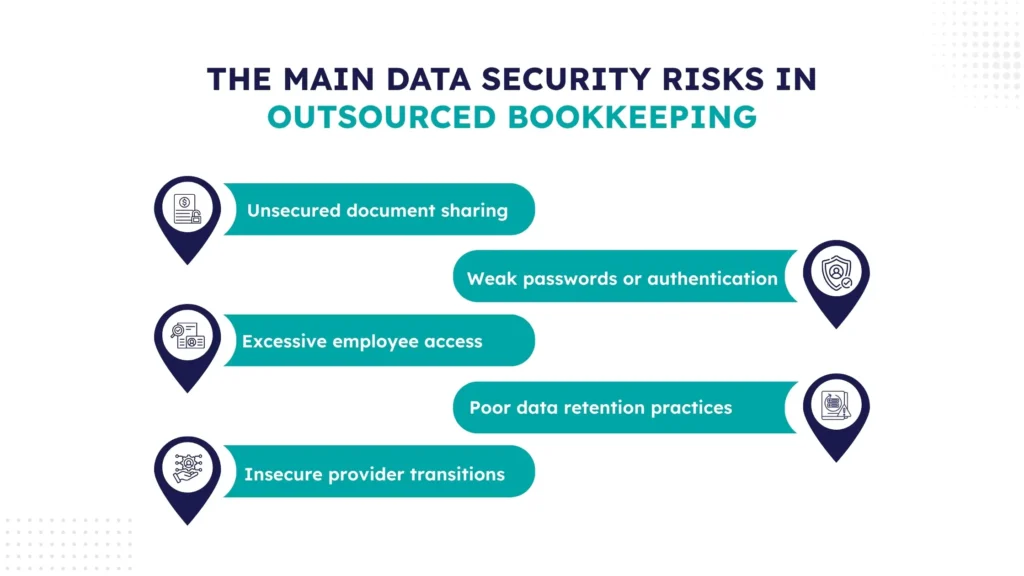
Understanding the risks helps you evaluate providers more effectively.
Unsecured document sharing
Sending financial records through regular email can expose sensitive information if the email account is compromised.
Weak passwords or authentication
Without multi-factor authentication, stolen passwords can provide unauthorized access to accounting systems.
Excessive employee access
Some firms give too many staff members access to client records, increasing exposure.
Poor data retention practices
If old records are not securely deleted, they may remain accessible long after they are needed.
Insecure provider transitions
When changing providers, accounts and file-sharing permissions may not be revoked properly.
What Security Measures Should a Bookkeeping Provider Have?
Ask potential providers about their specific controls. At a minimum, look for:
Essential Security Controls
Encryption for data in transit and at rest
Secure client document portal
Multi-factor authentication
Role-based access controls
Written confidentiality agreements
These security controls are consistent with recommendations in IRS Publication 4557, which provides guidance on safeguarding taxpayers and financial data for businesses that handle sensitive records.
What Should You Check Before Sharing Financial Data?
Before granting access, ask the provider:
- How is client data encrypted?
- Do you use a secure document portal?
- Is multi-factor authentication mandatory for staff?
- Who will have access to my records?
- How long do you retain client data?
- What is your data deletion process?
- What happens if a security incident occurs?
- How do you handle secure offboarding when a client leaves?
These questions help evaluate both bookkeeping data protection and operational maturity.
Red Flags That Outsourced Bookkeeping May Not Be Safe
Be cautious if a provider:
- Requests documents through personal email accounts
- Refuses to discuss security procedures
- Does not use multi-factor authentication
- Cannot explain who has access to your data
- Has no written confidentiality agreement
- Offers unusually low pricing without clear processes
- Cannot describe how client data is deleted after termination
These are often indicators of elevated outsourced bookkeeping risks.
What Should Be Included in a Secure Bookkeeping Agreement?
A well-written agreement should cover more than fees and deliverables.
Important clauses include:
- Confidentiality obligations
- Data ownership
- Permitted uses of client information
- Security standards and controls
- Breach notification requirements
- Data retention and deletion policies
Strong contracts support both accounting data security and legal accountability.
How Small Businesses Can Reduce Risk When Outsourcing Bookkeeping
You do not need a large IT department to improve security.
Practical Risk Reduction Steps
For small businesses
- Use dedicated business bank accounts.
- Enable multi-factor authentication on all financial systems.
- Share documents through secure portals instead of email attachments.
- Review user access permissions quarterly.
- Remove access immediately when employees or providers leave.
- Maintain your own backup copies of key financial records.
For example, if you switch bookkeeping firms, ensure the previous provider’s QuickBooks or Xero access is revoked before the new provider is added.
Additional cybersecurity best practices for U.S. small businesses are available through CISA’s Small Business Cybersecurity Guidance, which covers secure authentication, data protection, and incident response planning.
When Outsourced Bookkeeping Is Not a Good Idea
Outsourcing may not be appropriate when:
- Your business operates under highly specialized regulatory requirements that the provider does not understand.
- You cannot verify the provider’s security controls.
- The provider uses outdated software or unsupported systems.
- You are unwilling to establish clear access and approval procedures.
In these situations, the security and operational risks may outweigh the benefits.
So, Is Outsourced Bookkeeping Safe?
Yes, outsourced bookkeeping can be safe when the provider uses strong security practices, and the business performs proper due diligence.
The biggest factor is choosing a reputable provider with documented security controls. Encryption, secure portals, multi-factor authentication, role-based access, confidentiality agreements, and clear data retention policies are all signs that a firm takes bookkeeping data security seriously.
No solution is completely risk-free, but a well-managed outsourcing relationship can often provide stronger protection than informal, manual processes used by many small businesses.
Conclusion
So, is outsourced bookkeeping safe? Yes, outsourced bookkeeping can be safe when the provider uses strong security practices, and the business performs proper due diligence before sharing financial information. The most important factor is choosing a reputable provider with documented safeguards such as encryption, secure document sharing, multi-factor authentication, confidentiality agreements, and clear data management procedures.
At NCSGX, we are committed to secure, accurate, and reliable bookkeeping support for growing businesses. Contact us to learn how we can help protect your financial data while supporting your business growth.
How NCSGX Can Help
At NCSGX, we understand that financial information is one of your business’s most sensitive assets. Our bookkeeping processes are designed with security in mind, including secure document sharing, controlled system access, confidentiality procedures, and documented handling of client records. Whether you need ongoing Bookkeeping, Payroll support, or Financial Reporting Assistance, we can help you establish a secure and efficient bookkeeping workflow while maintaining strong protection for your financial data.
Frequently Asked Questions (FAQ)
1. Is outsourced bookkeeping safe for small businesses?
Yes, it can be safe for small businesses when the provider follows established security practices such as encryption, secure portals, multi-factor authentication, and confidentiality agreements. The key is verifying those controls before granting access.
2. Should I give my bookkeeper my bank login?
In most cases, it is better to provide limited or read-only access through your bank’s authorized user features rather than sharing your personal login credentials. This improves bookkeeping data protection and makes access easier to revoke later.
3. Can an outsourced bookkeeper steal financial data?
Any person with access to financial records could potentially misuse data, which is why screening, contracts, access controls, and monitoring are important. Reputable firms reduce this risk through internal controls, background checks, and documented security procedures. .
4. Is it safe to give access to QuickBooks or Xero?
Generally, yes. Cloud accounting platforms such as QuickBooks and Xero support user-level permissions and multi-factor authentication. Grant only the level of access required for the bookkeeper’s work.
5. What is the safest way to share documents with a bookkeeper?
The safest method is a secure client portal that uses encryption and access controls. Avoid sending sensitive payroll, tax, or banking documents through unsecured email whenever possible.
6. What should I do before switching to bookkeeping providers?
Review all system access, download copies of key records, confirm data ownership, and ensure the outgoing provider’s permissions are revoked. A documented offboarding process is an important part of reducing outsourced bookkeeping risks.

Rahul Sharma
Rahul Sharma is a Chartered Accountant with over 7+ years of experience in global accounting, bookkeeping, tax preparation, financial reporting, and compliance. At NCSGX, he leads accounting outsourcing operations, manages client engagements, and drives process improvements for international businesses. Through his writing, Rahul shares practical insights on accounting, outsourcing, taxation, and business finance, helping firms and professionals make informed financial and operational decisions.
All Posts