
 USA
USA
 Canada
 Australia

Introduction
A CPA firm can have good clients and a strong team and still feel stretched. The problem often starts with small things. A file is waiting for review. A client sends documents late. A senior accountant gets pulled into work that someone else could have handled. Before long, the same few people are carrying too much of the workload.
For U.S. accounting firms, the CPA firm talent shortage is making this harder to manage. The answer is not always hiring more people. Firms also need to look at how work moves through the team and where time gets lost. NCSGX USA Supports CPA and accounting firms with defined bookkeeping and accounting support when additional capacity is needed.
Key Takeaways
- The talent shortage is becoming a capacity problem, not just a hiring problem.
- Too much routine work can pull experienced accountants away from the work that needs their judgment.
- The busy season exposes weak points in a firm’s workflow and review process.
- Better workflows, technology, and cross-training can create more capacity before another hire is needed.
- Defined external support can help keep routine work moving while senior professionals stay focused on higher-value work.
CPA Firm Talent Shortage in 2026: How Firms Can Protect Client Capacity
A CPA firm can have a healthy client base, good technology, and a capable team and still feel stretched.
The problem may not be that the firm has too few employees. It may be that too much of the firm’s work is landing on the people with the least available capacity.
Reconciliation needs attention. A bookkeeping file needs cleanup. A client has not provided supporting documents. A manager has a growing review queue. Before long, routine production work is moving upward to senior accountants and partners.
That is where the CPA firm talent shortage becomes more than a hiring issue.
It becomes a capacity and delivery issue.
The latest 2026 AICPA PCPS CPA Firm Top Issues Survey reflects that shift. Hiring experienced staff is the No. 1 current issue for firms with 11–30 professionals, while managing staff workload and capacity ranks No. 3 for that group. At larger firms, technology adoption, workflow, leadership, and staff capacity also remain important concerns.
For CPA firms, the question is becoming less about simply finding more people and more about how to make the best use of the experienced people already on the team.
What the 2026 CPA Firm Landscape Looks Like
The accounting profession is not facing a simple story of “there are no accountants.”
The U.S. Bureau of Labor Statistics projects employment for accountants and auditors to grow 5% from 2025 to 2035, with approximately 115,300 openings per year on average. BLS also notes that longer hours are common during periods such as tax season.
The more useful question for a CPA firm is:
Do we have enough experienced capacity when our clients need it?
That distinction matters.
A firm may be able to hire junior professionals but still have difficulty finding experienced reviewers. It may have enough staff but lack people who can independently handle complex files. Or it may have a strong team whose time is increasingly consumed by routine production work.
The 2026 AICPA survey reflects this more nuanced picture. Firms are dealing with experienced staff hiring, workload and capacity, technology adoption, workflow, cybersecurity, and changing client expectations at the same time.
That combination creates a different kind of challenge.
The issue is not only a headcount. It is how capacity moves through the firm.
Where CPA Firm Capacity Gets Lost
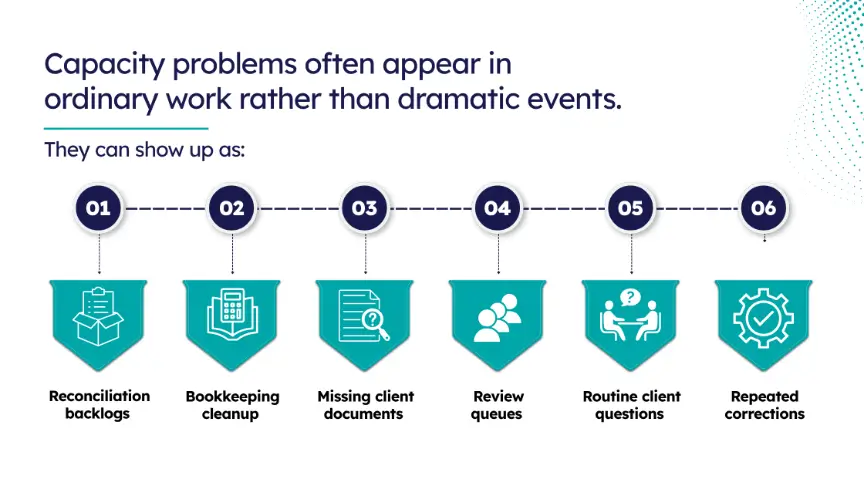
For firms looking to reduce the amount of routine bookkeeping work handled internally, NCSGX’s bookkeeping support is one option to consider.
Individually, these tasks may not seem significant.
Collectively, they can take hours away from experienced professionals.
That matters because senior accountants and partners perform work that cannot always be delegated.
They handle complex accounting questions. They review files. They communicate with clients. They provide advice. They make decisions.
When those professionals spend too much time clearing routine production work, the firm loses capacity where it matters most.
AI Is Changing the Work, Not Eliminating Judgment
Technology and artificial intelligence are another major part of the 2026 CPA firm conversation.
The AICPA’s 2026 survey identifies technology and AI change management as the leading issue in terms of anticipated impact over the next five years across CPA firms.
That does not mean technology eliminates the need for accounting professionals.
Instead, it changes where their time can create the most value.
Automation can help with repetitive processes. Technology can improve information flow. AI can assist with certain tasks.
But firms still need people who can:
- Review information
- Identify exceptions
- Understand the client context
- Apply professional judgment
- Communicate with clients
- Handle complex issues
That makes workflow design even more important.
For a practical look at what AI bookkeeping tools can and cannot handle, see NCSGX’s What AI Bookkeeping Tools Actually Automate in 2026.
The firms that benefit most from technology will not necessarily be those with the most tools. They will be the ones that know how technology, people, and processes work together.
What CPA Firms Can Do Before Hiring More People
Hiring is an important part of solving a talent gap. It is not the only answer.
- Map where work gets stuck.
- Separate production from judgment.
- Standardize recurring processes.
- Cross-train the team.
- Use technology deliberately.
- Protect senior team time.
- Consider defined external support.
The goal is not to outsource everything.
The goal is to put the right work at the right level.
For firms considering outside support, NCSGX’s Outsourced Finance & Accounting services cover areas such as bookkeeping, accounting operations, payroll and other finance support.
Capacity Cannot Come at the Expense of Security
Adding external support also means firms need to think carefully about client data protection.
The IRS states that tax professionals are required to maintain a Written Information Security Plan and include service-provider safeguards and oversight among the considerations for protecting customer information.
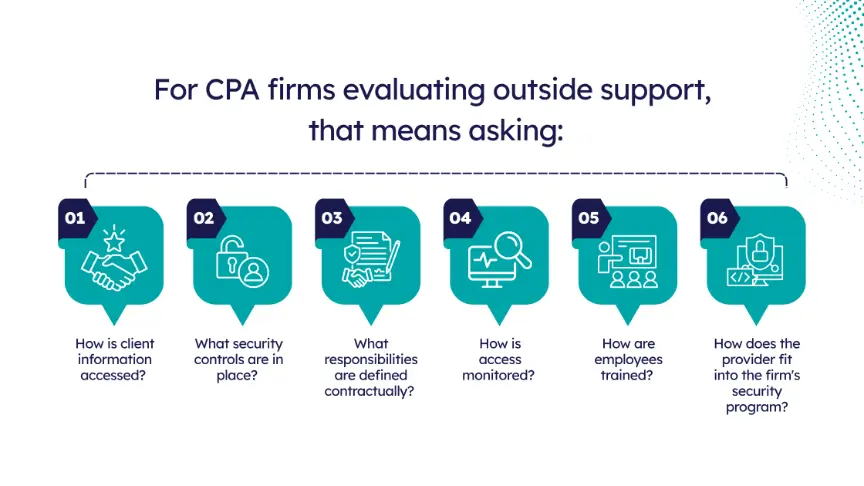
Capacity should strengthen the firm. It should not introduce avoidable risks.
Building a Stronger Delivery Layer
The strongest response to the CPA firm’s talent shortage may not be simply hiring more people.
It may be building a delivery model that makes better use of the people the firm already has.
That can mean combining:
Technology + Standardized workflows + Internal expertise + Defined support + Strong review processes
For firms that use external support, routine production work can be handled through an appropriate support layer while the firm’s professionals retain responsibility for review, client relationships, communication, and professional judgment.
Capacity Is Becoming a Strategic Advantage
The CPA firm’s talent shortage is not a problem that can be measured only by the number of open positions.
A firm can have a capable team and still struggle if too much routine work consumes experienced professionals’ time.
The firms that manage this environment well will look closely at how work moves through the organization, where bottlenecks develop, which tasks require judgment, and where additional capacity can be created.
Hiring may be part of the answer. Technology may be part of the answer. Better workflows may be part of the answer. For some firms, defined external support may also be part of the model.
Conclusion
The talent problem will not look the same in every CPA firm. What matters is knowing where the pressure starts and dealing with it before client work suffers. Better workflows, smart use of technology, and the right support can help firms make better use of the people they already have.
Your team does not have to handle every task alone. If your firm needs help with recurring bookkeeping or accounting work, NCSGX USA can work alongside your existing team. Contact us to discuss where additional support could fit.
Frequently Asked Questions (FAQ)
1. Will the accountant shortage continue beyond 2026?
There is no reliable basis for predicting exactly how the talent market will develop after 2026. BLS projects 5% employment growth for accountants and auditors from 2025 to 2035, with approximately 115,300 openings annually on average. The more relevant question for an individual CPA firm is whether it can maintain enough experienced capacity for its workload.
2. How does accountant burnout affect CPA firms?
Sustained workload pressure can make it harder for employees to maintain consistent review, client communication, and responsiveness. Firms should treat recurring overload as a capacity signal rather than waiting for it to become a larger staffing problem.
3. How does accountant burnout affect CPA firms?
Firms can combine hiring with workflow standardization, cross-training, technology adoption, workload redistribution, and defined external support where appropriate.
4. What is accounting firm capacity planning?
Accounting firm capacity planning is the process of understanding available team capacity, workload, deadlines, skills, review requirements, and workflow bottlenecks so the firm can allocate work before capacity becomes a problem.
5. Should CPA firms outsource bookkeeping?
Not necessarily. The decision depends on the firm’s workload, workflow, internal capabilities, security requirements, client expectations, and need for additional capacity. Outsourced bookkeeping can be one option for defined recurring production work.
6. What should CPA firms consider before using an external provider?
Firms should evaluate workflow fit, responsibilities, review procedures, security controls, service-provider oversight, communication, scalability, and how the arrangement fits within the firm’s overall operating model.

Rahul Sharma
Rahul Sharma is a Chartered Accountant with over 7+ years of experience in global accounting, bookkeeping, tax preparation, financial reporting, and compliance. At NCSGX, he leads accounting outsourcing operations, manages client engagements, and drives process improvements for international businesses. Through his writing, Rahul shares practical insights on accounting, outsourcing, taxation, and business finance, helping firms and professionals make informed financial and operational decisions.
All Posts