
 USA
USA
 Canada
 Australia


Introduction
Many freelancers, online sellers, and small business owners assume that receiving a Form 1099-K means they’ll owe more tax. In reality, the 1099-K reporting threshold change 2026 affects when certain payment platforms report transactions to the IRS, it does not change how much of your business income is taxable. Form 1099-K is simply an information return that helps the IRS verify the income reported on your tax return.
Whether you receive a Form 1099-K or not, you’re responsible for reporting all taxable business income. Maintaining accurate bookkeeping throughout the year helps you reconcile payment platform transactions, avoid reporting errors, and prepare tax-ready financial records. At NCSGX, we help businesses maintain organized books so they’re better prepared for tax reporting and ongoing compliance.
How the 1099-K Reporting Threshold Change Affects Your Bookkeeping in 2026
Many business owners assume a Form 1099-K means they owe tax on the full amount shown. That is not how the form works. The 1099-K reporting threshold change 2026 affects when payment platforms must report transactions to the IRS; it does not change the basic rule that taxable income must be reported accurately whether or not a form is issued. Clean bookkeeping is what keeps those numbers understandable and defensible at tax time.
A Form 1099-K is an information return, not a tax bill. Payment processors issue it to report payment activity such as sales, platform payouts, and card transactions, and the IRS can compare that reporting with what appears on your return. When books do not separately track gross sales, processing fees, refunds, chargebacks, and timing differences, the form can appear inconsistent even when the processor reported the transactions correctly. This is especially important for freelancers and online sellers, as gig worker 1099-K requirements continue to evolve alongside IRS reporting rules.
Key Takeaways
- The 2026 Form 1099-K reporting threshold determines when payment platforms must issue the form, not how much tax you owe.
- All taxable business income must be reported, even if you do not receive a Form 1099-K.
- Reconciling Form 1099-K with your accounting records helps prevent duplicate income and reporting errors.
- Recording gross payments, platform fees, refunds, and chargebacks correctly leads to more accurate financial statements.
- Monthly bookkeeping reviews reduce the risk of discrepancies before tax filing deadlines.
What the 1099-K Reporting Threshold Is Now
Form 1099-K, Payment Card and Third-Party Network Transactions, is issued to report certain payment transactions processed through payment cards and third-party settlement organizations (TPSOs), such as online marketplaces and payment apps. The form helps the IRS compare payment activity with the income reported on a business’s tax return. These rules are part of the broader third party payment reporting IRS framework that applies to payment apps, online marketplaces, and other third-party settlement organizations that process business transactions.
For the 2026 tax year, the federal reporting rules distinguish between two types of payment transactions:
- Payment card transactions (such as credit card and debit card payments processed by merchant acquiring entities) remain reportable regardless of the number of transactions or total dollar amount.
- Third-party network transactions processed through payment apps and online marketplaces are generally reportable only when both of the following conditions are met:
- Gross payments exceed $20,000 during the calendar year, and
- The recipient has more than 200 transactions.
This reflects the current federal reporting rules described in the IRS Instructions for Form 1099-K. Earlier transition thresholds that had been discussed in previous years are no longer the applicable federal standard for 2026.

Why This Threshold Change Matters Even If You Don’t Receive a 1099-K
A common misconception is that if you don’t receive a Form 1099-K, you don’t have to report the income. In reality, the IRS requires you to report all taxable business income, regardless of whether you receive an information return.
Form 1099-K is simply one way the IRS receives information about payment transactions. Understanding third party payment reporting IRS requirements helps business owners recognize that payment platform reports are designed to support income verification, not to replace accurate bookkeeping records. It is not a complete record of your business income, nor does it determine your tax liability.
For many small businesses, income comes from multiple sources, such as:
- Payment platforms
- Credit and debit card payments
- Bank transfers (ACH)
- Checks
Some of these transactions may appear on a Form 1099-K, while others may not. If you only report the amounts shown on tax forms, you could accidentally omit legitimate business income or report the same income twice.
A Practical Example
Imagine David owns a small graphic design business. During the year, he receives payments through an online marketplace, direct bank transfers from long-term clients, and mailed checks.
His payment platform issues a Form 1099-K for qualifying transactions. However, the direct bank transfers and checks are not included in that form.
If David prepares his tax return using only the Form 1099-K, he’ll underreport his actual income. On the other hand, if he records every customer payment in his accounting software and then adds the Form 1099-K amount again, he’ll overstate his revenue.
Proper bookkeeping avoids both mistakes by treating the Form 1099-K as a reconciliation tool rather than the starting point for recording income.
Common Bookkeeping Gaps the New Threshold Exposes
The 1099-K threshold bookkeeping impact extends beyond tax reporting. Whether or not you receive Form 1099-K, reconciling your payment platform reports with your accounting records can uncover bookkeeping issues that may affect your financial statements and tax reporting.
Some of the most common gaps include:
Missing Platform Income
Recording only the amount deposited into your bank account instead of the customer’s full payment can understate revenue and overlook payment processing fees. If these discrepancies have built up over several months, a Bookkeeping Cleanup can help restore accurate financial records before tax season.
Duplicate Income
Some businesses mistakenly record customer payments throughout the year and then enter the Form 1099-K amount as additional income, resulting in overstated revenue. The form should be used to verify your records, not record new income.
Refunds and Chargebacks
Refunds and chargebacks reduce the value of completed sales but may not be clearly reflected in bank deposits. Recording them separately helps explain differences between platform reports and your books.
How to Reconcile 1099-K Income With Your Books
Reconciling Form 1099-K with your bookkeeping records should be part of your regular accounting routine, not just a year-end task. Comparing your platform reports with your books throughout the year helps identify discrepancies early and makes tax preparation much easier.
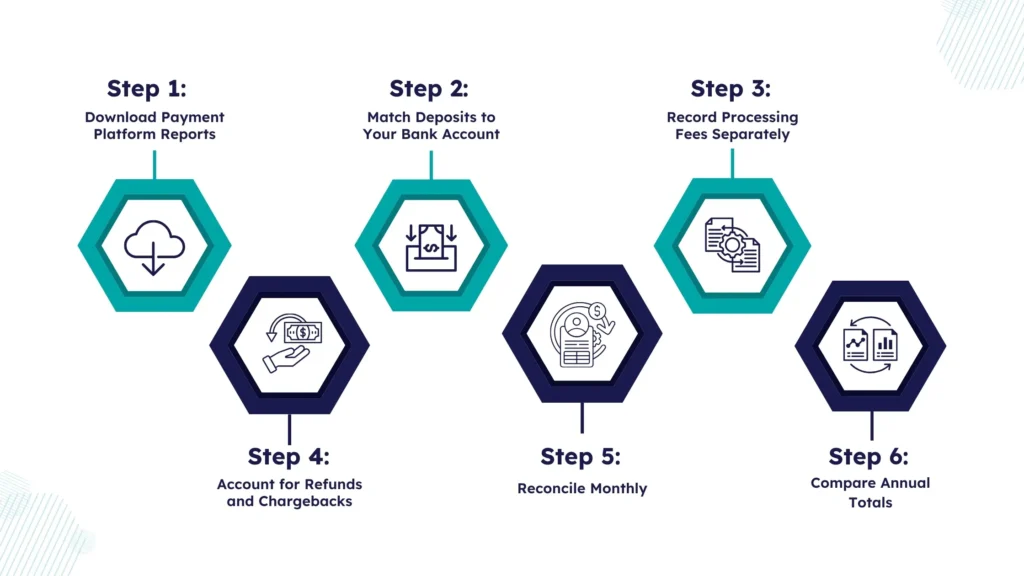
Step 1: Download Payment Platform Reports
Obtain transaction reports from each payment platform you use. These reports provide details such as gross payments, fees, refunds, and chargebacks needed for reconciliation.
Step 2: Match Deposits to Your Bank Account
Compare each platform deposit with your bank statement to ensure every payment has been recorded accurately.
Step 3: Record Processing Fees Separately
Record customer payments as gross revenue and payment processing fees as a business expense instead of reducing sales revenue.
Step 4: Account for Refunds and Chargebacks
Review refunds, cancelled transactions, and chargebacks regularly to ensure they are correctly reflected in your accounting records.
Step 5: Reconcile Monthly
Perform monthly reconciliations to identify missing or duplicate transactions before they become year-end issues.
Step 6: Compare Annual Totals
Before filing your tax return, compare your annual gross receipts with Form 1099-K and investigate any significant differences.
Setting Up Your Bookkeeping System for Ongoing Compliance
A well-organized bookkeeping system makes it easier to reconcile Form 1099-K, prepare accurate financial statements, and stay compliant with IRS reporting requirements. Following a few consistent practices throughout the year can help reduce errors and simplify tax preparation.
Perform Monthly Reconciliations
Compare your payment platform reports, bank statements, and accounting records each month to identify missing or duplicate transactions early.
Keep Platform Reports
Download and securely store transaction reports, including details of payments, refunds, processing fees, and chargebacks. These records support accurate reconciliations and tax reporting.
Reconcile Bank Accounts
Regular bank reconciliations help ensure deposits are recorded correctly and match your accounting records.
Separate Income Sources
Track income from payment platforms, online marketplaces, invoices, and other payment methods separately. This makes reconciliation more accurate and financial reporting more meaningful.
Maintain Digital Records
Keep electronic copies of invoices, bank statements, payment reports, and receipts to support your bookkeeping and tax records.
Be Consistent
Record transactions regularly instead of waiting until year-end. If your records need attention, a Bookkeeping Cleanup can help restore accurate, tax-ready books before filing season.
What to Do If Your 1099-K Doesn’t Match Your Books
Differences between Form 1099-K and your bookkeeping records are not always a sign of an error. The key is to identify the cause before preparing your tax return.
- Review Payment Platform Reports
Compare your Form 1099-K with your platform’s transaction reports to check for gross payments, refunds, sales tax, and year-end transactions.
- Check for Duplicate Entries
Review your accounting records to ensure customer payments haven’t been recorded more than once through bank imports or manual entries.
- Compare Gross Payments
Remember that Form 1099-K generally reports gross payment transactions, while bank deposits reflect net amounts after fees and adjustments.
- Verify Timing Differences
Payments processed near year-end may settle in the following month, creating temporary differences between your books and Form 1099-K.
- Contact the Payment Platform
If you believe your Form 1099-K contains incorrect information, contact the payment platform to request clarification or a corrected form. If reconciling multiple payment platforms becomes challenging, professional Bookkeeping Services can help identify discrepancies before your tax return is prepared.
Conclusion
The 1099-K reporting threshold change 2026 affects when certain payment platforms issue Form 1099-K, but it does not change your responsibility to report all taxable business income. Accurate bookkeeping remains the foundation of reliable financial reporting, regardless of whether you receive the form.
By reconciling payment platform activity throughout the year and reviewing your records before filing, you can reduce reporting discrepancies and approach tax season with greater confidence. If you’re unsure whether your bookkeeping accurately reflects your payment platform activity, Contact Us to learn how professional bookkeeping support can help keep your records tax-ready.
How NCSGX Can Help
At NCSGX, we help businesses reconcile payment platform transactions, maintain accurate bookkeeping records, and prepare tax-ready financial statements. Whether you need ongoing Bookkeeping Services, a one-time Bookkeeping Cleanup, or support coordinating your bookkeeping with tax preparation, our team works to reduce reporting discrepancies and help you stay compliant with IRS reporting requirements.
Frequently Asked Questions (FAQ)
1. What is the 1099-K reporting threshold for 2026?
For the 2026 tax year, third-party payment platforms generally issue Form 1099-K when gross payments exceed $20,000 and there are more than 200 transactions. Some states may have different reporting requirements.
2. Do I still need to report income if I don't receive a 1099-K?
Yes. You must report all taxable business income, even if you don’t receive Form 1099-K. The form is a reporting document and does not determine your tax liability.
3. Why does my 1099-K total not match my actual business income?
Form 1099-K generally reports gross payment transactions, while your books reflect expenses, refunds, fees, and other adjustments. Reconciling both records helps explain any differences.
4. What should I do if my 1099-K has an error?
Review your payment platform reports first. If you find an error, contact the payment platform and request a corrected Form 1099-K while keeping supporting documentation.
Can I get a 1099-K from multiple platforms for the same sale?
Yes, in some cases. That’s why it’s important to reconcile all payment platform reports with your bookkeeping records to avoid duplicating income reporting.

Rahul Sharma
Rahul Sharma is a Chartered Accountant with over 7+ years of experience in global accounting, bookkeeping, tax preparation, financial reporting, and compliance. At NCSGX, he leads accounting outsourcing operations, manages client engagements, and drives process improvements for international businesses. Through his writing, Rahul shares practical insights on accounting, outsourcing, taxation, and business finance, helping firms and professionals make informed financial and operational decisions.
All Posts