

 USA
USA
 Canada
 Australia


For any business selling across borders, GST VAT compliance stops being a back-office formality and becomes a real operational risk. More than 170 countries now run a VAT or GST system, and almost all of them are tightening the rules at once, through e-invoicing mandates and real-time reporting, so small, repeatable mistakes get caught faster and cost more.
At NCSGX, we manage indirect tax compliance for businesses operating across multiple jurisdictions, and the same handful of errors show up again and again. This guide walks through the ones we see most often, and the practical fixes that keep your filings clean.
For any business selling across borders, GST VAT compliance stops being a back-office formality and becomes a real operational risk. More than 170 countries now run a VAT or GST system, and almost all of them are tightening the rules at once, through e-invoicing mandates and real-time reporting, so small, repeatable mistakes get caught faster and cost more.
What is GST & VAT compliance?
GST (Goods and Services Tax) and VAT (Value Added Tax) are the same idea wearing two different names. Both are consumption taxes charged at each stage of the supply chain, where the business collects tax on its sales, claims back the tax on its purchases, and remits the difference to the tax authority. The “VAT” label is common in the UK, the EU, the Middle East and much of Africa; “GST” shows up in India, Australia, New Zealand, Canada and Singapore. The mechanics are broadly identical.
Compliance means getting four things right, consistently: charging the correct rate, on the correct supply, reported in the correct format, by the correct deadline. Miss any one of those and you have an exposure.
| Feature | VAT | GST | US Sales Tax |
|---|---|---|---|
| Charged at | Every stage of supply | Every stage of supply | Final sale only |
| Tax reclaimed by business | Yes (input VAT) | Yes (input credits) | No |
| Typical region | UK, EU, Gulf, Africa | India, AU, NZ, Canada | United States |
The most common GST & VAT compliance errors
Most penalties don’t come from exotic edge cases. They come from a handful of mistakes that repeat quietly until an audit surfaces them.
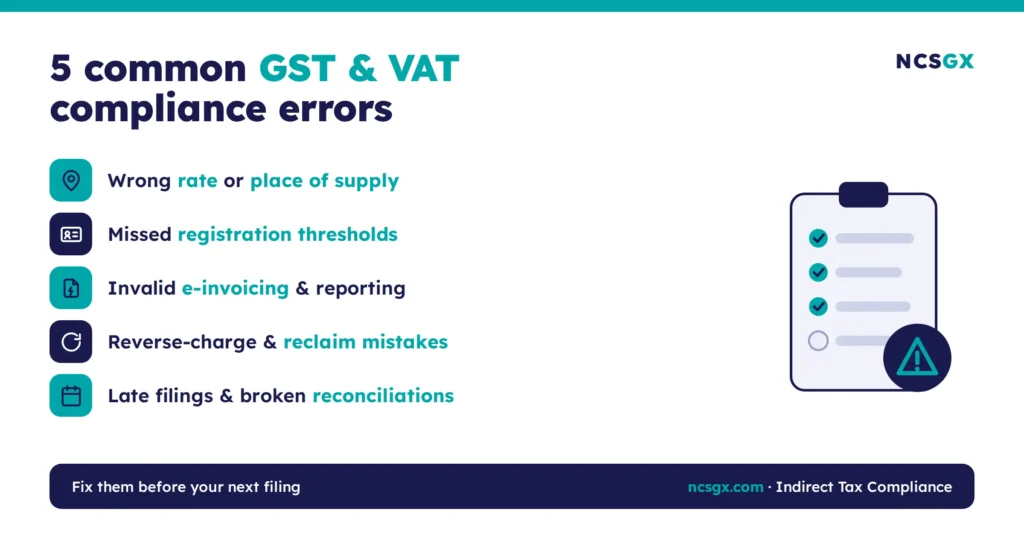
Getting the rate or place of supply wrong
The single biggest source of error is applying the wrong rate or taxing a sale in the wrong country. Reduced rates, zero-rated goods and exempt supplies all behave differently, and the “place of supply” rules for digital services and B2B sales decide which country rate even applies. Sell an e-book to a consumer in Germany, and you owe German VAT; sell the same file to a VAT-registered business there, and the reverse charge usually shifts the obligation to the buyer. Treat those two transactions the same, and you’ve under- or over-charged.
Missing or mismanaging registration thresholds
Every jurisdiction sets a turnover threshold above which you must register. Cross-border sellers’ trip on this constantly, because each country counts separately, and the thresholds keep changing. The EU’s One Stop Shop simplified this for distance sellers, but it doesn’t cover every scenario, and registering late means back-paying tax you never collected.
E-invoicing and real-time reporting failures
E-invoicing is no longer nice to have. Countries from Italy and Poland to India, Brazil and Saudi Arabia now require invoices to be issued in a structured digital format and, in many cases, cleared by the tax authority before the sale completes. Sending a PDF where a validated XML file is mandated isn’t a formatting quibble; it can invalidate the invoice and block your customers reclaim.
Input tax and reverse-charge mistakes
Reclaiming tax, you weren’t entitled to, or failing to claim tax you were, both create problems. Common slips include reclaiming blocked entertainment or vehicle costs, missing the reverse charge on imported services, and holding invoices that don’t meet the formal requirements to support a claim.
Late filings and broken reconciliations
Returns that don’t reconcile to your ledgers, numbers keyed by hand, and deadlines tracked in someone’s head: this is where avoidable penalties accumulate. The fix is rarely heroics. It’s a calendar, a checklist, and a reconciliation that runs before submission, not after a query.
| Common error | Why it happens | How to avoid it |
|---|---|---|
| Wrong rate or place of supply | Manual coding, complex cross-border rules | Tax-determination logic in your billing system |
| Registration gaps | Thresholds counted per country | Track turnover by jurisdiction monthly |
| Invalid e-invoices | Sending PDFs where structured files are required | Adopt compliant e-invoicing per market |
| Reclaim errors | Blocked costs, missing reverse charge | Standardise input-tax review rules |
| Late or mismatched returns | Manual prep, no reconciliation | Pre-submission reconciliation and a filing calendar |
Why e-invoicing is now central to indirect tax compliance
If there’s one shift redefining indirect tax compliance, it’s the move to e-invoicing and continuous transaction controls. Tax authorities have stopped waiting for periodic returns and started collecting transaction data in real time. The EU’s VAT in the Digital Age (ViDA) reforms are pushing the bloc toward digital reporting; Latin American clearance models have done this for years; and Gulf and Asian economies are rolling out mandates on staggered timelines.
For businesses, this changes the game in two ways. First, errors are visible to the authority almost immediately, so there’s less room to fix things quietly at quarter-end. Second, once your data is structured and validated at source, your own reporting gets cleaner. Getting e-invoicing right early turns a compliance obligation into a reconciliation advantage.
How to build a reliable GST compliance process
Strong GST compliance is a process, not a personality. The businesses that stay out of trouble tend to do the same boring things well:
- Map your obligations by jurisdiction. Know where you’re registered, what rates apply, and when each return is due.
- Automate tax determination. Let your billing or ERP system decide the rate and place of supply, rather than relying on staff to remember exceptions.
- Reconcile before you file. Match the return to the general ledger every period, and investigate variances before submission.
- Keep audit-ready records. Store valid tax invoices, registration certificates and reclaim support where you can produce them on request.
- Stay ahead of mandates. Track e-invoicing and reporting rollouts in every market you sell into, ideally six months out.
When to bring in VAT compliance services
Plenty of finance teams manage indirect tax in-house, and for a single-country business that’s often fine. The calculus changes once you’re registered in several jurisdictions, expanding into new markets, or facing fresh e-invoicing mandates. That’s where VAT compliance services earn their keep, absorbing the jurisdiction-by-jurisdiction complexity, so your team isn’t tracking deadlines across a dozen tax calendars.
Specialist support typically covers registration, return preparation and filing, e-invoicing setup, reverse-charge and reclaim reviews, and audit support. Done well, it’s not just risk reduction; it frees your finance function to focus on work that moves the business.
Conclusion
GST and VAT errors are rarely dramatic. They’re small, recurring, and preventable, which is exactly why they’re worth fixing. Get the rate and place of supply right, register on time, adopt compliant e-invoicing, reconcile before you file, and keep clean records. Build that discipline into your process, or partner with someone like NCSGX who already has it, and indirect tax stops being a source of nasty surprises.
How NCSGX can help
NCSGX provides end-to-end indirect tax compliance services for businesses operating across multiple jurisdictions. Our team handles GST and VAT registration, return preparation and filing, e-invoicing setup, reclaim reviews and audit support, so your in-house finance team isn’t juggling a dozen tax calendars.
Whether you need full finance and accounting outsourcing or targeted VAT compliance support for a new market, we build the process and run it to your standard. Book a 30-minute indirect tax review and we’ll map your current exposures and the e-invoicing mandates heading your way.
Frequently asked questions (FAQ)
1. What's the difference between GST and VAT?
Functionally, very little. Both are multi-stage consumption taxes where businesses collect tax on sales and reclaim tax on purchases. “VAT” is the common term in the UK, EU and Middle East; “GST” is used in India, Australia, Canada, New Zealand and Singapore.
2. What is the most common VAT compliance error?
Applying the wrong rate or taxing a sale in the wrong country. Place-of-supply rules for digital and cross-border B2B sales are the usual culprit, and they’re easy to get wrong without automated tax determination.
3. Does e-invoicing apply to my business?
It depends on where you sell. Many countries now mandate structured e-invoicing or real-time reporting, often phased in by business size. If you sell into the EU, Latin America, India or the Gulf, you should assume it applies or soon will and check the timeline per market.
4. Can I reclaim VAT or GST paid in another country?
Often, yes, through foreign VAT reclaim schemes, the rules, deadlines and eligible costs vary widely by jurisdiction. Many businesses leave recoverable tax on the table simply because the process is fiddly.

Aayushi Shah
Aayushi Shah is a Chartered Accountant with over 6 years of experience in Canadian accounting and currently serves as the Chief Branding Officer at NCS Global. She specializes in outsourced services including tax preparation, payroll, financial reporting, and business consulting for Canadian CPAs and businesses. With strong expertise in Canadian tax laws and tools like QuickBooks, Sage, and Xero, she helps streamline financial operations and reduce costs. Aayushi has supported over 50 CPA firms in cutting operating expenses by 50–70% and is known for delivering scalable, client-focused solutions. Outside of work, she enjoys typography and scrapbooking, bringing creativity into her professional approach.
All Posts