

 USA
USA
 Canada
 Australia


Every business that moves goods, services, intellectual property, or financing between entities in different countries faces transfer pricing compliance, and it isn’t a niche tax issue. It’s one of the largest exposures on your balance sheet. Tax authorities treat intercompany pricing as a prime audit target, and the penalties for getting it wrong run well beyond a single adjustment. They reach double taxation, interest charges, reputational damage, and years of disputes across multiple jurisdictions.
The good news is that transfer pricing compliance is manageable when it’s built on the right principles and documented properly. At NCSGX, we see the same pattern across the multinational groups we support: the businesses that treat compliance as an ongoing discipline rarely face nasty surprises. This guide walks through every multinational business, from a two-country start-up to an established group, must get right.
What Is Transfer Pricing Compliance, and Why Does It Matter?
Transfer pricing is the price of one entity in a corporate group to charge another for goods, services, royalties, management fees, or loans. Transfer pricing compliance is the discipline of making sure those prices reflect what unrelated parties would have agreed to in a genuine commercial transaction and being able to prove it.
It matters because related entities can, in theory, shift profit to lower-tax jurisdictions simply by setting prices artificially. Tax authorities know this, which is why transfer pricing consistently ranks among the top tax risks reported by multinationals in global surveys. A mispriced intercompany transaction can trigger a tax adjustment in one country with no matching relief in the other, leaving you taxed twice on the same income.
For most groups, the question isn’t whether your pricing will be scrutinised, but when. Compliance is what keeps that scrutiny from turning into a costly dispute.
The Arm’s Length Principle: The Foundation of Intercompany Pricing
Every transfer pricing system in the world rests on one idea: the arm’s length principle. It says that transactions between related entities should be priced as if those entities were independent parties dealing at arm’s length in an open market.
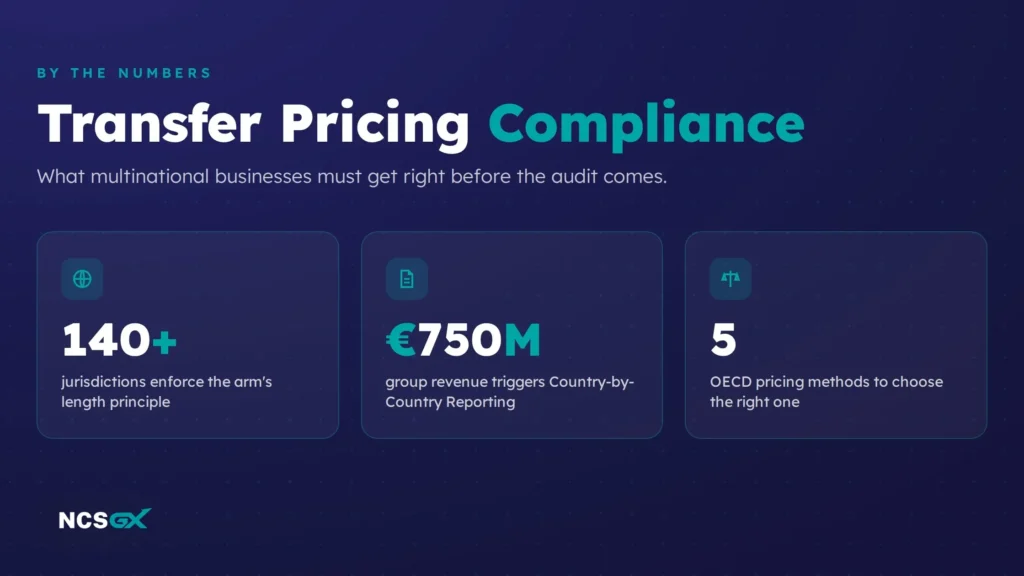
The principle is codified in Article 9 of the OECD Model Tax Convention and adopted, in some form, by more than 140 jurisdictions through the OECD/G20 Inclusive Framework. To apply it, you choose a method that best fits the transaction:
- Comparable Uncontrolled Price (CUP): compares your intercompany price directly to a price charged between unrelated parties.
- Resale Price Method: works back from the price a product is resold at to an independent buyer.
- Cost Plus: adds an appropriate margin to the supplier’s costs.
- Transactional Net Margin Method (TNMM): compares net profit margins against comparable independent businesses.
- Profit Split: divides combined profit between entities based on their relative contributions.
The method you select must suit the facts of the transaction and be supported by a benchmarking study. Picking a method because it produces a convenient result rather than because it’s the most appropriate is one of the fastest ways to lose an audit.
OECD Transfer Pricing Guidelines and the Documentation You Need
The OECD transfer pricing framework, set out in the consolidated OECD Transfer Pricing Guidelines, is the global reference point most tax authorities align to. Its most practical requirement is the three-tiered documentation model introduced under BEPS Action 13.
| Document | What it covers | Who needs it |
| Master File | The group’s global structure, business, intangibles, and financing | MNE groups above local thresholds |
| Local File | Detailed analysis of the local entity’s intercompany transactions | The local taxable entity |
| Country-by-Country Report (CbCR) | Revenue, profit, tax, and employees per jurisdiction | Groups with consolidated revenue ≥ EUR 750 million |
Thresholds, deadlines, and local-file content vary by country, EY’s Worldwide Transfer Pricing Reference Guide tracks these jurisdiction by jurisdiction, so a group operating in five jurisdictions effectively manages five sets of rules at once. The principle to hold onto is simple: documentation isn’t paperwork you produce after an audit notice arrives. It’s the contemporaneous evidence that your pricing was reasonable when the transaction happened. Prepare it on time, or it carries far less weight.
How Do You Prepare for a Transfer Pricing Audit?
A transfer pricing audit typically begins with a request for your documentation and a challenge to one or more of your methods or margins. Groups that handle audits well are the ones that are prepared long before the letter arrives. Work through this checklist:
- Confirm that your documentation is current: Outdated benchmarking studies are a common weak point comparables should be refreshed regularly, not left to age.
- Check consistency across jurisdictions: Your Local File in one country shouldn’t contradict your Master File or your CbCR. Authorities now share data, and mismatches invite questions.
- Maintain intercompany agreements: Written agreements should exist for every material related-party transaction and should match what actually happens in practice.
- Trace the substance: Be ready to show that the entity earning the profit performs the functions, owns the assets, and bears the risks that justify it.
- Reconcile to your financials: Margins in your documentation must tie back to the numbers in your statutory accounts.
The single biggest predictor of a smooth audit is whether your story is consistent across documents, across countries, and against commercial reality.
Common Transfer Pricing Compliance Mistakes
Even well-run groups stumble on the same few issues:
- Treating documentation as an annual afterthought rather than a live record updated as the business changes.
- Ignoring intercompany financing interest rates on related-party loans face the same arm’s length test as goods and services.
- Letting intangibles slip royalties and IP licensing are heavily scrutinised and frequently under-documented.
- Forgetting management and service fees, which must reflect genuine benefit received, not just a convenient allocation.
- Assuming one policy fits every country, local rules and thresholds differ enough that a single global template will leave gaps.
Building a Defensible Intercompany Pricing Strategy
A sound transfer pricing policy is forward-looking, not reactive. Set your pricing methods deliberately, benchmark them against real market data, document the rationale, and review the whole policy whenever your business model, supply chain, or footprint changes. With global minimum tax rules (Pillar Two) now reshaping how groups think about effective tax rates across jurisdictions, the cost of a poorly designed policy has only grown.
The aim isn’t to minimise tax through clever pricing. It’s to set prices you can defend, document them properly, and apply them consistently, so that when a question comes, the answer is already on file.
Conclusion
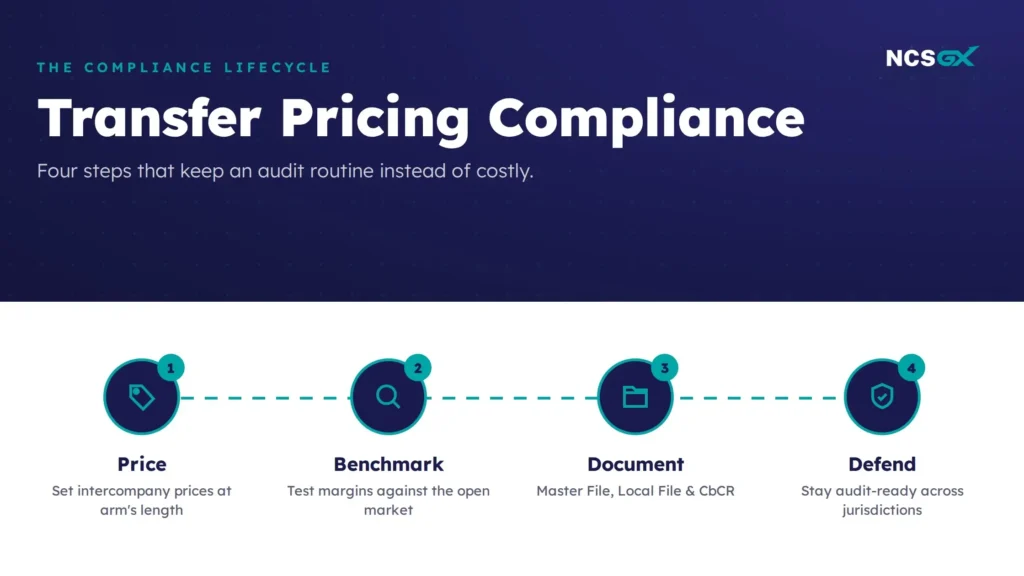
Transfer pricing compliance comes down to three things: pricing intercompany transactions at arm’s length, documenting them on time, and keeping your story consistent across every jurisdiction you operate in.
Get that right, and an audit becomes a routine review rather than a crisis. Get them wrong, and you risk double taxation, penalties, and disputes that drag on for years. For growing multinational groups, building this discipline early is far cheaper than fixing it under audit, and if you’d rather not carry that load in-house, NCSGX provides tax services for multinational groups.
Contact NCSGX to put a defensible transfer pricing framework in place before the next audit cycle.
How NCSGX Can Help
Transfer pricing compliance demands accurate documentation, current benchmarking, and consistency across every jurisdiction you operate in work that stretches in-house finance teams thin. NCSGX supports multinational businesses and the accounting firms that serve them with the back-office capacity to keep transfer pricing obligations on track.
Our teams help you:
- Prepare and maintain Master File, Local File, and CbCR documentation
- Keep intercompany agreements and benchmarking current and consistent
- Reconcile transfer pricing positions back to statutory financials
- Build the contemporaneous records that hold up under audit
Explore our outsourced tax and compliance services and accounting back-office support, or get in touch to discuss how we can support your transfer pricing workflow.
Frequently Asked Questions (FAQ)
1. What is the arm's length principle in transfer pricing?
It’s the rule that transactions between related entities should be priced as though the parties were independent and dealing in an open market. It’s the foundation of transfer pricing compliance and is recognised by more than 140 jurisdictions through the OECD framework.
2. Who needs to comply with transfer pricing rules?
Any business with cross-border transactions between related entities goods, services, royalties, management fees, or intercompany loans. The level of documentation required scales with the size of the group and the value of the transactions.
3. What documents do I need for transfer pricing compliance?
Under the OECD model, most multinational groups need a Master File, a Local File for each relevant jurisdiction, and above the revenue threshold a Country-by-Country Report. Written intercompany agreements and current benchmarking studies sit alongside these.
4. What triggers a transfer pricing audit?
Common triggers include sustained losses in one entity, large or unusual intercompany payments, inconsistent documentation across jurisdictions, and significant royalty or financing flows. Authorities increasingly share data, so mismatches between filings draw attention.
5. How often should transfer pricing documentation be updated?
Documentation should be prepared contemporaneously and reviewed at least annually, with benchmarking studies refreshed regularly. It should also be updated whenever the business model, supply chain, or operating footprint changes materially.