

 USA
USA
 Canada
 Australia

Introduction
The accountant shortage Australia is facing right now isn’t a rumour circulating at industry conferences, it’s showing up in vacancy data, professional body warnings, and a training pipeline that’s shrinking fast.
Firms across the country are struggling to fill roles from graduate positions through to senior tax and audit staff, and the pressure is starting to show up in client-facing delays: slower turnaround on compliance work, longer waits for advisory conversations, and recruitment costs eating into margins that used to fund growth. Here’s what the actual workforce data says about how big the gap is, why it’s happening, and how practices are adapting.
How Big Is the Shortage? What the Workforce Data Shows
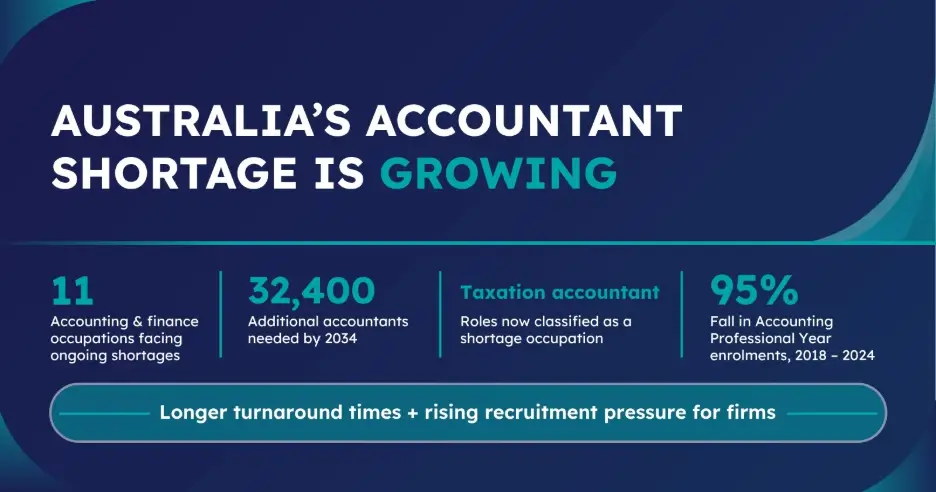
The clearest recent picture comes from Chartered Accountants Australia and New Zealand (CA ANZ), which identified 11 accounting, audit and finance-related occupations facing ongoing shortages that aren’t being filled by domestic graduates, international students, recent migrants, or skilled visa holders combined.
- External Auditors: 310 vacant roles surveyed, fill rate below 67%
- Taxation Accountants: 219 vacant roles, fill rate below 67%
- General Accountants: 179 vacant roles, fill rate below 67%
- Management Consultants: 108 vacant roles
- Management Accountants: 72 vacant roles, fill rate below 67%
- Internal Auditors: 67 vacant roles, fill rate below 67%
Zooming out, Jobs and Skills Australia’s national analysis found that 36% of assessed occupations faced a shortage in 2023, up from 31% the year before, with “Taxation Accountant” flagging as a newly emerged shortage occupation that year. The Professionals category as a whole recorded shortages in roughly 48% of its occupations accounting sits inside a much broader squeeze on skilled labour, not an isolated problem.
The forward-looking numbers are just as stark. Industry research cited by CPA Australia, CA ANZ and the Institute of Public Accountants projects Australia will need an additional 32,400 accountants within the next decade, with total roles in the profession growing from around 201,600 in 2024 to roughly 234,000 by 2034.
Why Is Australia Facing This Shortage?
Why is there an accountant shortage in Australia? The honest answer is that it’s a training pipeline problem more than a demand problem demand for accountants hasn’t collapsed, but the supply of newly qualified professionals has.
The clearest evidence: enrolments in the Accounting Professional Year Program the pathway many international graduates use to gain registrable experience fell from 7,122 participants in 2018 to just 340 in 2024, a 95% decline. The collapse was severe enough that CPA Australia, CA ANZ and the Institute of Public Accountants jointly ceased new enrolments in the program in March 2025, citing financial unsustainability alongside the enrolment drop.
A few forces are compounding the accounting skills shortage Australia is dealing with:
- Fewer domestic school leavers choosing accounting degrees, as students gravitate to other business and tech-adjacent fields
- International student caps and immigration policy changes narrowing a pathway that firms had come to rely on
- Experienced staff moving into industry, advisory, or leaving the profession altogether rather than staying in traditional practice roles
- Rising compliance complexity (audit standards, climate reporting requirements) increasing the workload per available staff member, even before accounting for the headcount gap
- How Are Australian Practices Responding?
- How accounting firms are dealing with staff shortages varies by size and resourcing, but a few clear patterns have emerged across the profession:
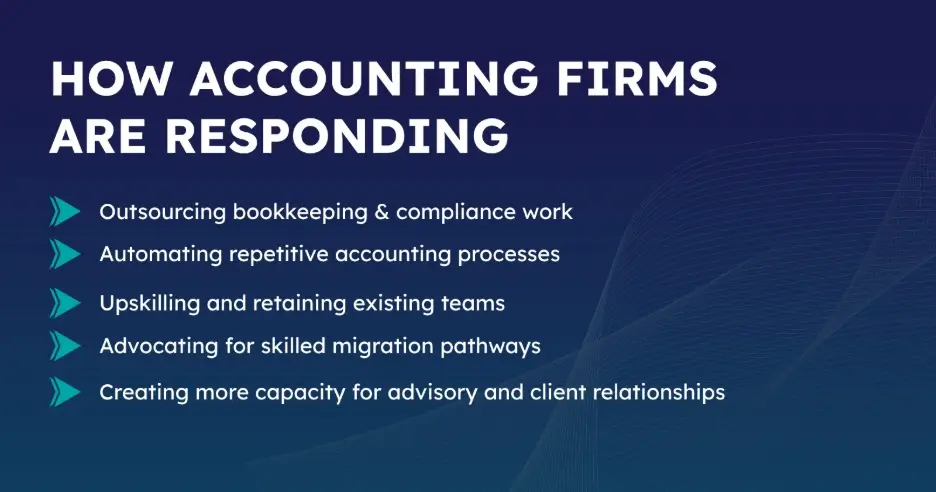
- Offshoring and outsourcing. Offshoring accounting Australia-wide has become one of the most common responses practices are shifting bookkeeping, compliance processing, and back-office work to outsourced accounting teams so in-house staff can focus on advisory and client relationships.
- Advocacy for migration settings. CA ANZ has formally recommended the federal government add all 11 shortage occupations to Australia’s Core Skills Occupation List, arguing that without it, businesses risk being unable to meet obligations like mandatory climate reporting audits.
- Internal upskilling and retention. Some firms are investing in retention and internal training rather than competing purely on recruitment, though data shows this response is limited only around 1% of employers nationally adjusted remuneration specifically to attract skilled workers in 2023, despite widespread recruitment difficulty.
- Technology adoption. Automation of reconciliation, data entry and first-pass reporting is freeing up existing staff capacity, though it doesn’t replace the need for registered, qualified professionals to review and sign off on compliance work.
What This Means for Businesses and the Accounting Profession
For small and mid-sized businesses, the shortage translates into real friction: longer lodgement timeframes, less availability for proactive advisory conversations, and firms becoming more selective about which clients they can take on. For the profession itself, it raises a genuine question: is accounting a good career in Australia in 2026?
By the numbers, yes strong demand, a widening supply gap, and growing recognition (including migration policy advocacy) point to sustained opportunity for people entering or staying in the field, even as the profession works through a difficult structural adjustment.
The accountant shortage 2026 outlook isn’t a short-term blip that resolves on its own. With the training pipeline still recovering and demand continuing to grow, most forecasts point to this gap persisting for several more years.
How NCSGX Can Help
NCSGX Australia works alongside accounting and bookkeeping practices as an extension of their team, taking on bookkeeping, compliance processing, and back-office work so existing staff can focus on higher-value client and advisory work. This is exactly the kind of response the data above points to using outsourced capacity to absorb workload pressure without the lead time and cost of hiring into a genuinely tight talent market, all under a “We Administer, Never Advise” model that keeps client-facing advisory responsibility with your team.
For practices facing bookkeeper shortage Australia-wide alongside their accountant vacancies, NCSGX’s bookkeeping services and broader finance operations outsourcing are built specifically to plug that gap.
Conclusion
The data is consistent across every source: Australia’s accountant and bookkeeper shortage is real, it’s structural, and it’s not resolving itself quickly. Firms that build a deliberate response, whether that’s outsourcing, technology, retention, or a combination are better positioned than those waiting for the graduate pipeline to recover on its own.
Frequently Asked Question (FAQ)
1. Is accounting officially on Australia's skills shortage list in 2026?
Jobs and Skills Australia identified “Taxation Accountant” as a newly emerged national shortage occupation in its 2023 analysis, and CA ANZ has formally recommended 11 accounting, audit and finance occupations be added to the Core Skills Occupation List. For the current, live listing status, check the Jobs and Skills Australia Skills Priority List directly, as this is updated periodically.
2. Why are fewer people studying accounting in Australia?
Domestic enrolments have declined as students choose other fields, while the international pathway has narrowed sharply enrolments in the Accounting Professional Year Program fell 95%, from 7,122 in 2018 to 340 in 2024, driven by immigration policy changes and international student caps.
3. How does the accountant shortage affect small business compliance and lodgement timeframes?
With firms stretched across fewer qualified staff, businesses are seeing longer turnaround times on compliance work and reduced availability for proactive advisory support, particularly during peak lodgement periods.
4. Are Australian accounting and bookkeeping firms using offshore staff, and is this compliant with TPB rules?
Yes, offshoring is a common response to the shortage. It can be TPB-compliant provided the registered agent maintains adequate supervision and control to direct, oversee and check the services being delivered the compliance obligation stays with the registered agent regardless of where the work is performed.
5. Is bookkeeping a good career choice in Australia given current demand?
Yes, bookkeeping sits inside the same broader shortage affecting accounting and finance roles, with strong ongoing demand and limited supply of qualified staff, making it a stable career path for those entering the field.
6. How long is the accountant shortage expected to last in Australia?
Most forecasts point to the gap persisting for several more years, given the training pipeline is still recovering and industry projections show demand for accountants growing well ahead of the current pace of new entrants to the profession.