

 USA
USA
 Canada
 Australia

DBFO Tranche 2 SOA Changes: What They Mean for Your Advice Process
The DBFO Tranche 2 SOA changes are the reform every adviser and paraplanner has been half-watching for two years. The short version: the Statement of Advice as you know it is on its way out, to be replaced by a leaner client-facing record. But “on its way out” is doing a lot of work in that sentence. As of 2026, the draft is out, the direction is clear, and the timeline is anything but. Here’s what’s actually proposed, what’s still speculation, and how to get your SOA process ready without betting the practice on a date.
What Tranche 2 actually changes for advice records
The Delivering Better Financial Outcomes package runs in tranches. Tranche 1 passed in July 2024, that’s the fee-consent, FSG and ongoing-fee-arrangement work you’ve already absorbed. Tranche 2 is where the Statement of Advice reform sits.
Treasury released the first slice of Tranche 2 as exposure draft legislation in March 2025 (the industry calls it “2a”). It does three things: replaces the SOA with a Client Advice Record (CAR), sets clearer rules on what super funds can collectively charge for, and lets funds send “targeted prompts” to members.
The bit that lands on your desk is the first one. The CAR is meant to be shorter, plainer, and focused on what the client needs to make a decision, not on defensive documentation built to survive an audit.
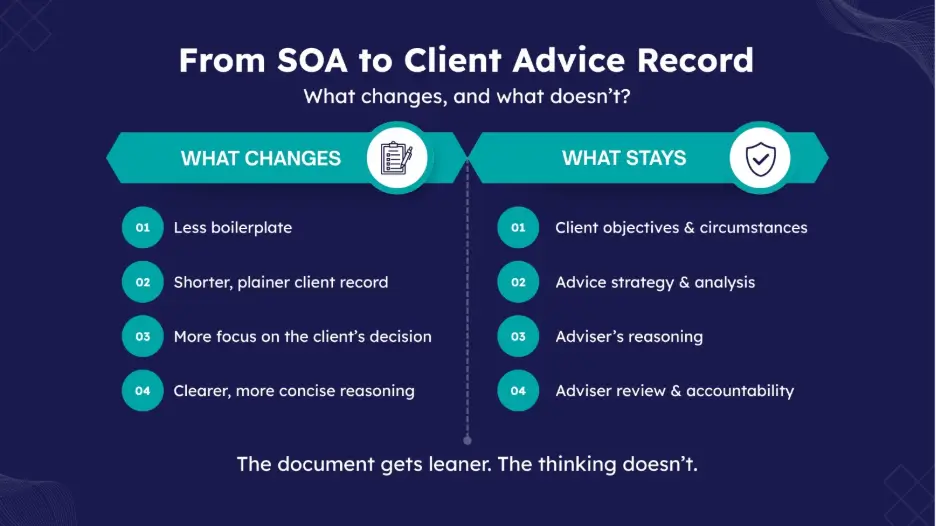
From SOA to the new advice record: what stays, what goes
The SOA replacement isn’t a rebrand. The intent behind the CAR is to strip out boilerplate and let advisers document advice in a way that’s genuinely readable.
What goes: prescribed content-for-content’s-sake, length as a proxy for compliance, and the reflexive habit of padding a file so it “looks defensible.”
What stays: the obligation to give appropriate advice, to record the client’s objectives and circumstances, and to show your reasoning. A shorter document still has to carry the logic of the advice. The record can be leaner; the thinking behind it can’t.
Worth being blunt about the status: this is still an exposure draft. The Best Interests Duty changes and the proposed new class of adviser were carved into a later “2b” tranche that hasn’t been released, and through 2026 the government stayed uncommitted on timing. Nothing here is law yet.
What it means for your SOA process, step by step
Practically, your current SOA process doesn’t change tomorrow. But the direction of travel is clear enough to build toward.
- Intake and scoping stay the same. Objectives, circumstances, scope of advice, still the foundation.
- Strategy and modelling stay the same. The analysis doesn’t get shorter because the document does.
- Drafting is where the shift lands. Less templated boilerplate, more plain-English reasoning tied to the client’s actual goals.
- Review and sign-off still sit with the adviser. The record is shorter; the accountability isn’t.
If your SOA template runs 40 pages, of which 25 are generic risk warnings and product boilerplate, that’s the part built for deletion. The pages of actual reasoning are the part that survives, and probably needs to get sharper.
Where the compliance risk moves
Here’s the trap. A shorter advice record feels lower-risk. It isn’t. The risk just moves.
When you strip out the boilerplate, there’s nowhere to hide thin reasoning. A long SOA can bury a weak recommendation under 30 pages of disclaimers. A tight CAR can’t. The quality of your “why” becomes the whole document. That reasoning is also what clients pay for: median advice fees have climbed 58% in five years, driven partly by the compliance documentation load.
Best Interests Duty is the clearest example. The BID reform, including any change to the safe-harbour steps, sits in the un-released 2b tranche. Until that passes, BID applies exactly as it does today. So the risk isn’t that BID goes away; it’s that advisers treat a leaner document as a licence to document less of their reasoning, right as that reasoning becomes the only thing on the page. That’s the file that gets picked apart if a complaint reaches AFCA.
Getting your SOA workflow ready now
You can’t implement a law that isn’t finalised. You can get the practice ready so the transition is a formatting change, not a rebuild.
- Audit your current SOA template. Tag every section as “reasoning” or “boilerplate.” The boilerplate is what shrinks.
- Tighten your reasoning language now. If your strategy rationale only makes sense wrapped in 40 pages, it isn’t tight enough for a CAR.
- Keep your file notes disciplined. Leaner client-facing records raise the value of a clean back-file.
- Don’t rip up compliant processes on spec. The draft can still change, and like most financial advice reform Australia has attempted, the timeline is the least reliable part.
Treat it as sharpening, not scrapping. Everything that makes advice clearer helps you now and lands you ahead when the CAR arrives.
How Can NCSGX Help?
NCSGX can help Australian financial advice practices manage the documentation and paraplanning work associated with the proposed shift from SOAs to Client Advice Records.
This can include:
- Reviewing and updating existing SOA templates
- Turning adviser recommendations into clear, client-focused documentation
- Reducing unnecessary boilerplate while retaining the reasoning behind the advice
- Keeping documentation processes aligned as the reforms develop
- Supporting consistent file notes and documentation
The benefit is not simply producing a shorter advice record. It is having a clear, disciplined documentation process that keeps the reasoning behind the advice at the centre while reducing the administrative workload for advisers.
Where outsourced paraplanning fits the transition
This is where an outsourced paraplanning partner earns its keep, precisely because the work is shifting from volume to clarity.
At NCSGX, we administer; we never advise. The adviser owns the strategy and the recommendation. What we do is the documentation heavy-lifting: turning your reasoning into a clean, decision-focused record, keeping templates current as the rules move, and holding the file discipline that a leaner client document quietly depends on.
When the SOA-to-CAR shift lands, the practices that cope best won’t be the ones scrambling to rebuild templates overnight. They’ll be the ones whose documentation was already lean, whose reasoning already carried the file, and whose back-office could turn drafts around without the adviser touching formatting.
If you want a second set of hands on that transition, that’s the work we do every day. Send through a recent SOA and we’ll show you what shrinks and what has to get sharper.
Frequently Asked Questions (FAQ)
1. Does DBFO Tranche 2 abolish the SOA entirely?
Not yet, and not exactly. The draft replaces the Statement of Advice with a Client Advice Record, a leaner, plainer document. But it still exposes draft legislation, not law, so the SOA remains the required format today.
2.Do I still need to document Best Interests Duty?
Yes. The Best Interests Duty changes flagged for DBFO sit in a later, un-released tranche. Until that passes, BID applies in full and your advice record must still show how you met it.
3. When do the SOA changes take effect?
There’s no confirmed date. The draft came out in March 2025, but through 2026 the government stayed uncommitted on timing after other reform priorities intervened. Treat any start date as unconfirmed for now.
4. Does a shorter advice record mean less work for paraplanners?
No, it reframes the work. Less boilerplate, but more emphasis on sharp, plain-English reasoning. Drafting judgment matters more, not less.
5. Will Tranche 2 change how I present advice to clients?
Yes. A Client Advice Record is meant to be genuinely readable, focused on the decision the client needs to make rather than on defensive length. Expect the client conversation to lean on a clearer, shorter document.