

 USA
USA
 Canada
 Australia

Introduction
Missing the TPAR due date can happen when contractor records are incomplete, financial data is still being reconciled, or the deadline is simply overlooked. If you have a missed Taxable Payments Annual Report, the important thing is to act quickly rather than wait for an ATO reminder. NCSGX Australia can support businesses with bookkeeping, financial administration and back-office processes that help keep contractor payment records organised and reporting ready.
A Taxable Payments Annual Report (TPAR) is generally due on 28 August each year for businesses required to report payments made to contractors for relevant services. The ATO can take compliance action when required reports remain outstanding.
If you have missed the deadline, review your records, determine what needs to be reported, and lodge the outstanding TPAR as soon as possible.
What Happens If You Miss the TPAR Due Date?
If your TPAR is not lodged by the due date, it becomes overdue. The ATO may take compliance action and, depending on the circumstances, a failure to lodge on time (FTL) penalty may apply.
The ATO has previously taken action against businesses with overdue TPARs. For example, the ATO stated that it would apply penalties to businesses that had not lodged older TPARs after receiving multiple reminder letters.
This is why businesses should not assume that a late report can simply be left until the ATO contacts them.
A TPAR late lodgement can also create additional administrative work. You may need to locate contractor invoices, verify ABNs, reconcile payments and check whether the information reported is complete and accurate.
For the 2025–26 financial year, the TPAR due date was 28 August 2026. If your report remains outstanding, the priority should be getting your records together and lodging it promptly.
Can You Submit a TPAR After the Deadline?
Yes. You can still lodge a TPAR after the due date.
If you discover that your report is late, there is no benefit in waiting simply because the original deadline has passed. Complete the required information and lodge the outstanding report as soon as possible.
The ATO states that overdue TPARs should be lodged through the available online lodgement channels. If a business does not actually need to lodge a TPAR, it may need to submit a non-lodgment of advice instead.
Before lodging, make sure your contractor’s information is accurate. A rushed submission containing incorrect payment information can create another compliance issue.
Businesses that need help keeping financial information organised can use structured finance and accounting support to improve record management, bookkeeping and finance administration.
Are There Penalties for a Late TPAR?
A TPAR penalty may apply when a required report is not lodged on time.
Under the general FTL rules, the base penalty for failing to lodge certain documents on time is one penalty unit for each 28-day period, or part of a 28-day period, that the document remains outstanding, up to a maximum of five penalty units. Higher penalties can apply to certain medium and large entities.
For infringements occurring on or after 7 November 2024, one penalty unit is $330. This means the base penalty can reach $1,650 at five penalty units, before considering circumstances that may increase the amount.
However, businesses should not assume that a penalty will automatically be imposed immediately after the TPAR deadline. The ATO considers the circumstances and may notify a business if a penalty is applied.
If you receive a penalty notice, review it carefully. Depending on your circumstances and compliance history, you may be able to request remission of the penalty.
Steps to Take After Missing the TPAR Deadline
If you have realised that your TPAR is late, follow these steps to fix a missed TPAR deadline.
- Confirm your TPAR obligation
First, check whether your business was required to lodge a TPAR for the relevant financial year.
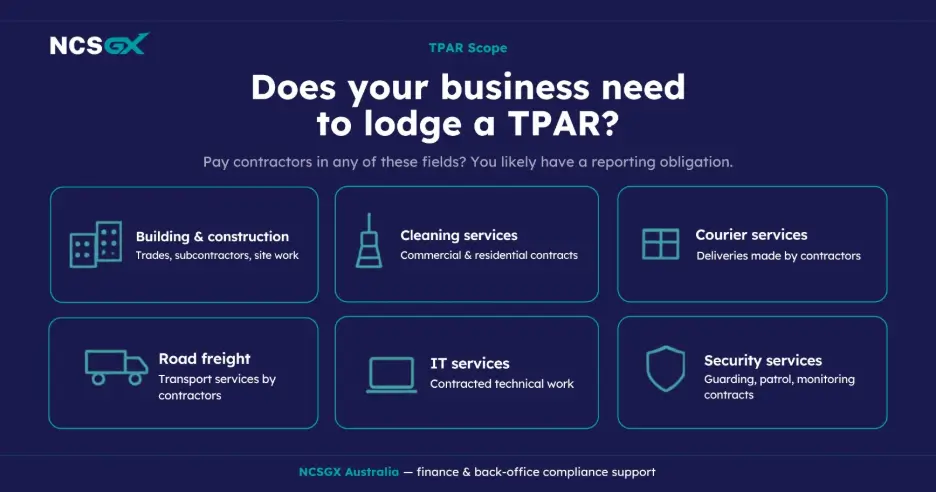
TPAR obligations generally apply to businesses that make payments to contractors for certain services, including building and construction, cleaning, courier, road freight, information technology and security services. The ATO provides guidance to help businesses determine whether they need to report.
- Gather your contractor records
Collect the information required for each reportable contractor, including:
- Contractor or business name
- ABN Address and contact information
- Total payments made during the financial year
- GST included in those payments
- Relevant withholding information, where applicable
Invoices, contracts, payment records, and accounting reports can help verify the figures.
- Reconcile the payments
Before submitting a late TPAR, compare your contractor’s records against your accounting software, accounts payable records and bank transactions.
Look for duplicated payments, missing invoices, incorrect ABNs, and payments that may not need to be reported.
- Lodge the outstanding TPAR
Once the information has been checked, lodge the TPAR through the appropriate ATO online channel.
If you use a registered tax or BAS professional, provide them with the relevant records so they can review and lodge the report where appropriate.
- Check for penalties
After lodging, check whether the ATO has issued an FTL penalty notice.
If a penalty has been issued, review the circumstances and consider whether you have grounds to request remission. The ATO considers factors such as compliance history and the circumstances surrounding the failure when deciding whether penalties should be remitted.
How to Avoid Missing Future TPAR Deadlines
A missed deadline is often a process problem rather than a one-off mistake.
Businesses can reduce the risk of future late lodgement by:
- Recording contractor details when they are onboarded
- Keeping ABN information current
- Separating contractor and employee records
- Reconciling contractor payments throughout the year
- Keeping invoices and contracts organised
- Setting reminders well before 28 August
- Assigning clear responsibility for TPAR preparation
- Allowing sufficient time for review before lodgement
Using outsourced accounting support can also help businesses manage recurring bookkeeping, reconciliations, and finance administration.
Common Mistakes Businesses Make After Missing a TPAR Deadline
One of the biggest mistakes is doing nothing because the deadline has already passed.
Other common problems include:
Waiting for an ATO reminder: An overdue obligation should be addressed proactively rather than waiting for compliance action.
Submitting without checking: A late report still needs to be accurate. Incorrect contractor information can create additional issues.
Estimating missing figures: If records are incomplete, investigate the missing information rather than submitting unsupported amounts.
Assuming there is automatically no penalty: The possibility of a TPAR penalty should be taken seriously even when the report is only slightly late.
Fixing the report but not the process: Once the late TPAR is lodged, businesses should identify why the deadline was missed and improve the workflow before the next reporting period.
How NCSGX Australia Can Help
NCSGX Australia can support businesses with the finance and back-office work that sits behind accurate reporting. Our teams can help organise financial data, maintain records, reconcile transactions, and prepare information required by your accounting or tax professionals.
Support can include:
- Contractor payment data preparation
- Bookkeeping and transaction processing
- Account and payment reconciliations
- Financial record organisation
- Compliance administration support
- Recurring deadline and workflow support
NCSGX provides outsourced staffing and business support services rather than regulated tax or legal advice. Where professional tax advice or sign-off is required, these services remain with the appropriately qualified professional.
Conclusion
A missed TPAR due date should be treated as a compliance issue to resolve, not a reason to delay further. If you have a late TPAR, confirm your obligation, gather your contractor records, reconcile the figures and lodge the outstanding report as soon as possible.
Taking action early can help limit further compliance issues and gives your business an opportunity to improve the process that caused the missed deadline.
With NCSGX Australia’s business support solutions, businesses can strengthen the back-office processes behind their financial reporting, from bookkeeping and reconciliations to organised contractor payment records.
Frequently Asked Questions (FAQ)
1. What happens if I lodge my TPAR late?
If you lodge your TPAR after the due date, it becomes an overdue lodgement and an FTL penalty may apply. The best approach is to lodge the report as soon as possible rather than wait for an ATO reminder.
2. Is there an ATO penalty for missing the TPAR deadline?
Yes, an FTL penalty may apply. For certain documents, the base penalty is calculated at one penalty unit for each 28-day period or part period the document remains overdue, up to five penalty units.
3. Can I still lodge a TPAR after the due date?
Yes. You can lodge an overdue TPAR after the deadline. If you have a TPAR late lodgement, prepare and check the required information and submit the report as soon as possible.
4. How do I correct a late TPAR submission?
If you identify an error after lodging, you may need to amend the TPAR. Check the ATO’s current requirements or speak with your registered tax or BAS professional about the appropriate correction process.
5. What records do I need for a TPAR?
You should retain records supporting the payments reported, including contractor details, ABNs, invoices, contracts, payment records and relevant GST or withholding information. Keeping these records organised throughout the year makes TPAR preparation easier.