

 USA
USA
 Canada
 Australia

Why Trustee Structure Matters for Business Owners
The choice between an SMSF corporate trustee and individual trustees is made once, usually in the first week of the fund’s life, and then affects every year that follows. It determines whose names sit on the title of each asset, how a penalty is calculated when something goes wrong, and how much work is triggered the day a member joins, leaves or dies.
For business owners the stakes are higher than for most members. A fund holding business real property, an operating premises leased back to the trading entity, or a limited recourse borrowing arrangement carries more paperwork on every structural change. The SMSF trustee structure decision is worth making deliberately with your accountant and licensed adviser, rather than defaulting to whichever option the setup form presented first. For SMSF professionals looking to manage the additional workload, NCSGX provides back- office support.
What Is an SMSF Corporate Trustee?
An SMSF corporate trustee is a company that acts as trustee of the fund. The members of the fund are the directors of that company, and the company – not the individuals – is recorded as the legal owner of every fund asset.
The company is usually established as a special purpose company whose constitution restricts it to acting as trustee of a superannuation fund. That restriction matters, because a special purpose company attracts a reduced ASIC annual review fee compared with a standard proprietary company.
Each director needs a director identification number, must consent to act, and takes on the officeholder duties ASIC sets out for company directors – alongside the trustee duties imposed by superannuation law. A single– member fund can operate with that member as the sole director.
What Is an Individual Trustee SMSF?
In an individual trustee SMSF, each member is personally appointed as a trustee of the fund, and assets are held in the names of all trustees jointly, as trustees for the fund.
A fund with individual trustees must have at least two trustees. Where the fund has one member, a second individual must be appointed as trustee even though they hold no benefit in the fund; typically a family member, and not an employer of the member unless they are related. Every member must be a trustee, and every trustee must be a member.
There is no company to establish and no ASIC annual review fee, which is why this structure is often chosen at setup. The trade-offs appear later, when the membership changes.
For SMSF professionals managing these ongoing requirements, NCSGX provides SMSF back-office support.
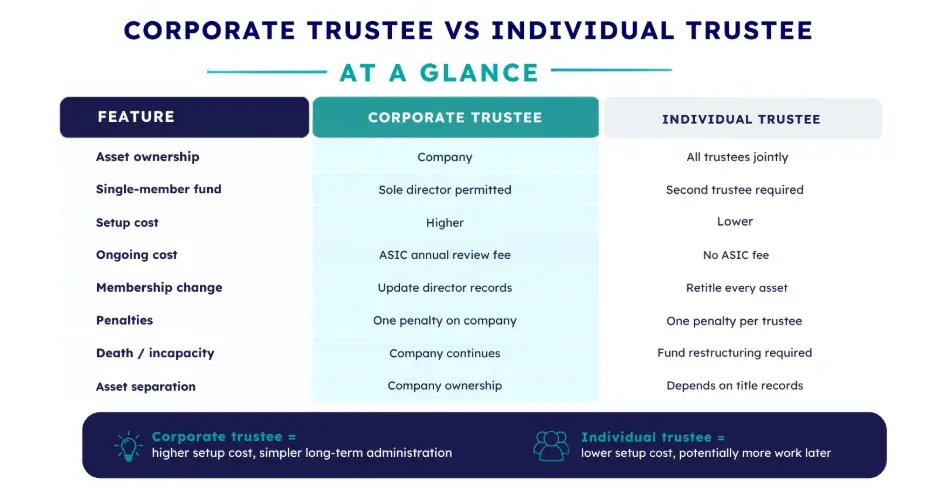
Corporate Trustee vs Individual Trustee at a Glance
| Feature | Corporate Trustee | Individual Trustees |
|---|---|---|
| Legal owner of assets | The company | All trustees jointly |
| Minimum people required | One director | Two trustees |
| Single-member fund | Sole director permitted | Second trustee must be appointed |
| Setup cost | Company registration fee, plus fund setup | Fund setup only |
| Ongoing cost | ASIC annual review fee (reduced for a special purpose company) | None |
| Membership change | Update ASIC director records | Transfer title on every asset |
| Administrative penalties | One penalty levied on the company; directors jointly and severally liable | One penalty levied on each trustee personally |
| Continuity on death | Company continues; appoint or remove a director | Fund must be restructured, generally within six months |
| Separation of assets | Clearly separated from personal assets by company ownership | Depends on accurate title records and file discipline |
Key Differences Business Owners Should Understand
The corporate trustee vs individual trustee comparison usually comes down to four practical questions: who owns the assets on paper, what happens when a member changes, how a penalty is measured, and what the fund looks like if a member dies or loses capacity.
Cost is the difference most people notice first, and it is the smallest one. A company adds a registration fee at setup and an annual review fee thereafter. Against that sits the cost of retitling every asset the first time a member joins or leaves – a cost that lands in a single year, is difficult to predict, and is significantly larger for a fund holding property.
Business owners should also weigh the operating relationship between the fund and the trading entity. Where the fund owns premises leased to a related business, the lease, the title and the loan documentation all name the trustee. Changing that name later means amending each of them.
Asset Ownership and Administration Differences
SMSF asset ownership must be clearly separated from the personal assets of members and from any related business. A corporate trustee achieves that separation structurally: the company holds the asset, and the company exists for no other purpose.
With individual trustees, separation depends on the title records being correct and staying correct. Assets are held in the names of all trustees as trustees for the fund, and the fund’s ownership must be evidenced on the title, holding statement or share register – not simply recorded in the accounts.
The practical difference shows up on change of membership:
- Corporate trustee: the member becomes or ceases to be a director, ASIC is notified, and the assets do not move. Titles, leases and loan documents are unaffected.
- Individual trustees: every asset must be retitled into the names of the new trustee group. Property transfers involve state revenue offices, lenders must be notified, and share registries and platforms each apply their own process.
For a fund with several members and a mix of property, unlisted units and listed investments, that retitling exercise is the single largest piece of avoidable work a trustee structure can create.
Penalties and Trustee Responsibility
SMSF trustee penalties are where the structures diverge most sharply. The ATO can impose administrative penalties for a range of contraventions, and the penalty is levied on each trustee.
With individual trustees, that means each trustee is separately liable for the full penalty amount. A four- member fund with a single contravention faces four penalties for the same event. With a corporate trustee, one penalty is levied on the company, and the directors are jointly and severally liable for it – one penalty, shared.
In both cases the penalty must be paid personally and cannot be met from fund assets. That point is often missed, and it is the reason the multiplier matters.
A corporate trustee does not shield directors from their duties. Directors remain responsible for the fund’s compliance, sign the trustee declaration, and carry the officeholder obligations ASIC applies to every company director.
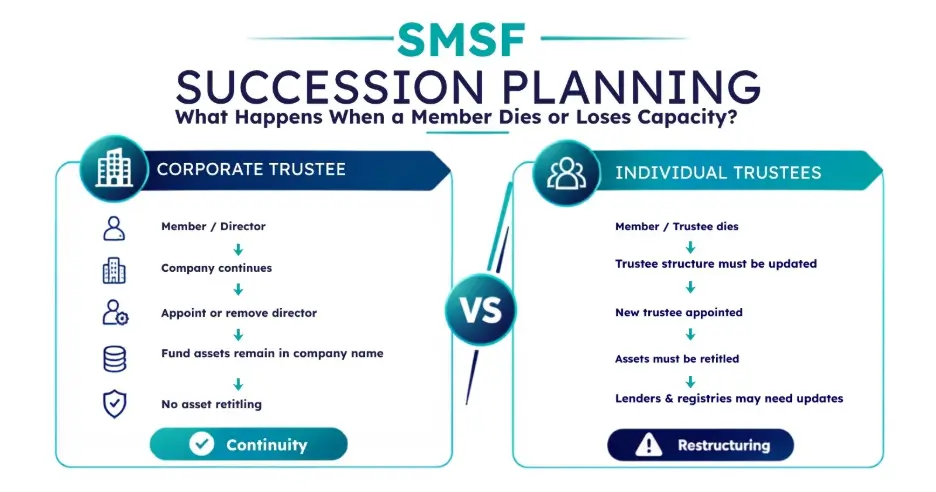
SMSF succession planning is the argument that decides the question for most family and business- owner funds.
A company does not die. If a director dies or loses capacity, the company continues to hold every asset, and the fund continues to operate while the estate is administered and a replacement director is appointed. Nothing needs to be retitled, and no external party needs to be involved before the fund can act.
With individual trustees, the death of a trustee generally requires the fund to be restructured so it again satisfies the trustee rules, usually within six months. Assets must be retitled into the names of the remaining and incoming trustees, at exactly the point when the family is least equipped to manage a paperwork exercise and when a death benefit may be payable.
Control over who becomes a director, and how, is also easier to document in advance through the company constitution and the fund’s deed working together.
When an Individual Trustee Structure May Be Suitable
An individual trustee SMSF can be a reasonable choice where:
- The fund is small, simple and holds cash and listed investments only
- The membership is stable and no change is expected in the medium term
- Setup cost is a genuine constraint and the fund is being established quickly
- The members already have a second trustee available and willing to act
The structure is not defective. It simply front- loads less cost and back- loads more work, and it suits funds where that later work is unlikely to be triggered.
When a Corporate Trustee Structure May Be More Practical
A corporate trustee is more often the practical answer where:
- The fund holds real property, including business real property leased to a related entity
- The fund has borrowed under a limited recourse borrowing arrangement, where lenders commonly require a corporate trustee
- Membership is expected to change – children joining, a spouse exiting, a member reaching a point of transition
- The fund has a single member who would otherwise need to appoint a second individual
- Succession and continuity are a stated objective for the family or the business
Questions to Ask Before Choosing a Trustee Structure
Take these to your accountant or licensed adviser before the fund is established:
- What assets will the fund hold in the first five years, and what would retitling them cost?
- Is a change of membership likely – children, a spouse, a business partner?
- Will the fund borrow, and does the intended lender require a corporate trustee?
- Who should control the fund if a member dies or loses capacity, and is that documented?
- If a contravention occurred, how many separate penalties would the current structure produce?
- Who will maintain the ASIC records, director consents and annual review, and when?
An existing fund can move from individual trustees to a corporate trustee. It is a real project – company registration, deed review, retitling, lender and platform notifications, and notification to the ATO – but it is generally cheaper to do deliberately than in the middle of a death benefit claim.
Conclusion
Neither structure is universally correct. For a stable two- member fund holding listed investments, individual trustees remain workable. For a business owner whose fund holds property, borrows, or expects the membership to change, a corporate trustee usually costs less over the life of the fund than the paperwork it avoids.
The decision belongs to the members, with their accountant and licensed adviser. What follows the decision; the records, the evidence, the file that has to hold up at audit; is where volume tends to become the constraint.
Need support managing the ongoing SMSF workload? Contact NCSGX.
How NCSGX Can Help
NCSGX Australia works as remote SMSF preparers for accounting firms, paraplanning firms and financial advisers. Our teams prepare financial statements and member statements, maintain trustee and ownership records across changes of structure, reconcile contributions, pensions and rollovers, and assemble the evidence pack your auditor works from.
We also provide audit support – coordinating queries, tracking responses and keeping funds moving through to lodgement – so your firm retains the client relationship and every professional decision while the preparation work runs to a documented method.
Book a Quick Call to review your fund volumes and turnaround requirements before the next lodgement cycle.
Frequently Asked Questions
1. Is a corporate trustee required for an SMSF?
No. Australian law permits both individual trustees and a corporate trustee. The choice is made by the members, and either structure can be compliant provided the trustee rules are satisfied.
2. Can a single- member SMSF have individual trustees?
Yes, but a second individual must also be appointed as trustee even though they are not a member. That person cannot be an employer of the member unless they are a relative. A corporate trustee avoids this by allowing the member to be the sole director.
3. Is a corporate trustee more expensive?
It costs more to establish and carries an annual ASIC review fee, which is reduced where the company is a special purpose company. Whether it is more expensive overall depends on how often the fund’s membership changes, since each change under individual trustees requires every asset to be retitled.
4. Can an SMSF change from individual trustees to a corporate trustee?
Yes. It requires registering the company, checking the deed permits the change, appointing the company as trustee, transferring the title of every asset into the company’s name, notifying lenders and registries, and notifying the ATO within the required period.
5. Does a corporate trustee protect directors from SMSF penalties?
No. It changes how penalties are counted, not whether they apply. One administrative penalty is levied on the company rather than one on each trustee, but directors are jointly and severally liable for it, and it must be paid personally rather than from fund assets.