

 USA
USA
 Canada
 Australia

Introduction
An SMSF investment strategy 2026 template does not make a fund compliant. What makes a fund compliant is a strategy that reflects the fund’s actual circumstances, is reviewed at least annually, and is documented well enough that an auditor can see the thinking behind it.
The framework below is a review structure, not a filled-in strategy. It sets out the nine sections trustees need to work through, and the evidence each one should leave behind. Superannuation law requires trustees to formulate, review regularly and give effect to an investment strategy that has regard to risk and return, the composition of the fund’s investments, liquidity, the fund’s ability to discharge its liabilities, and whether to hold insurance for members. Every section here maps back to one of those requirements.
What This SMSF Investment Strategy 2026 Template Is For
Three things, in order of how often they matter:
- Documenting the annual review. Most funds already have a strategy. What they lack is dated evidence that it was revisited, and a record of what was considered.
- Recording justification. Where the fund is concentrated in one asset, or holds a wide allocation range, the strategy needs to show that the position was a decision rather than a default.
- Producing an audit trail. The strategy, the review notes and the trustee minute travel together. An auditor asks for all three.
It is not a set of recommended allocations. Anyone offering you percentages without knowing the members’ ages, balances and timeframes is not giving you a strategy.
Who Should Use the Template
- Trustees completing their annual review or updating the strategy after a change in the fund.
- Accountants preparing the review documentation for trustee clients ahead of audit.
- Financial advisers and paraplanners aligning the fund’s documented strategy with the advice already given to members.
The trustees formulate and approve the strategy. That responsibility cannot be delegated to a template, an accountant, or a preparer. What can be delegated is the assembly of the document and the evidence behind it.
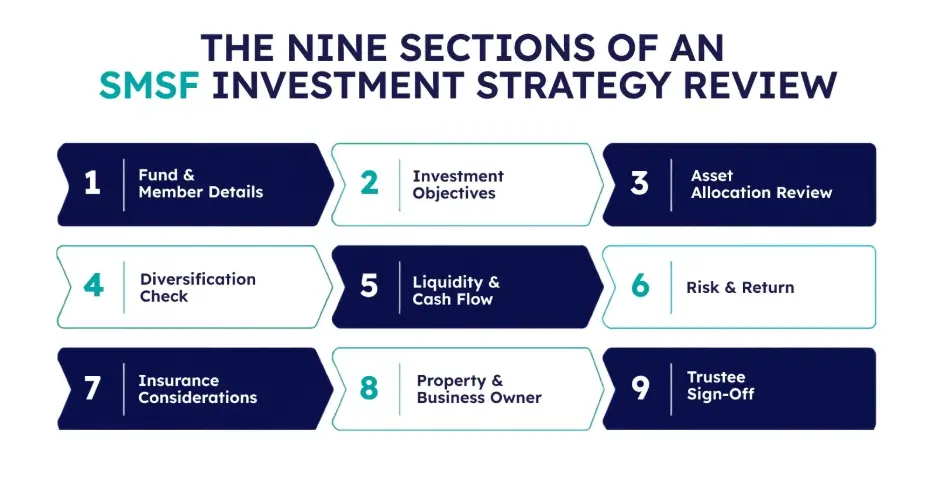
Section 1: Fund and Member Details
The section auditors check first, because it dates the document.
- Fund name, ABN, date established
- Trustee structure, individual trustees or corporate trustees, with the company name and ACN
- Each member: name, age, phase (accumulation or retirement), approximate balance
- Expected retirement year for each member
- Date of this review, and date of the previous one
Where a member is approaching or has entered the pension phase, note it here. It changes everything in Sections 5 and 6.
Section 2: Investment Objectives
State what the fund is trying to achieve, in terms that can be tested later.
- The objective: capital growth, income, capital preservation, or a stated mix
- A target return, expressed against a reference point, for example, a margin above CPI over a rolling period
- The timeframe over which that return is measured
- How the objective connects to each member’s expected retirement year
Avoid objectives written so broadly that no outcome could ever contradict them. “Maximise returns” is not an objective; it is a sentiment.
Section 3: Asset Allocation Review
For each asset class the fund invests in, record four things: whether the strategy permits it, the intended range, the actual position at review date, and what the trustees did where those last two disagree.
The classes to work through are Australian shares, international shares, property, fixed interest, cash, and anything held outside those, unlisted companies and unit trusts, collectables, crypto assets. The fillable version of this table sits in the download.
What separates a record that holds up from one that draws a comment:
| Field | Weak record | Holds up at audit |
| Permitted classes | A list copied from a template, including classes the fund has never held | Only the classes this fund holds or realistically may hold |
| Target range | Nought to one hundred per cent on every line | A band narrow enough to act as a constraint, and one the trustees can explain |
| Actual at review | Omitted, or last year’s figure carried forward | The position at review date, reconciling to the financial statements |
| Variance | Noted and left | Either rebalanced, or a dated note on why the fund is holding the position |
| Unlisted and other | Grouped as “other investments” | Each holding named and valued, with the valuation basis stated |
Percentage ranges are acceptable and generally more practical than fixed targets. Ranges so wide that they permit any position do not demonstrate that the composition was considered; the range must be capable of being breached, or it is not a range.
A reference point, not a target: the ATO publishes the asset allocation of the whole SMSF sector in its quarterly statistical report. Comparing the fund mix against the sector is a useful sense-check for trustees, and it is a legitimate thing to note in the review. It is not a benchmark the fund is required to track, and a fund that looks nothing like the sector average is not for that reason non-compliant.
Section 4: Diversification Check
SMSF diversification is where single-asset funds attract comment. The law does not require a diversified portfolio. It requires trustees to have regard to the composition of the fund’s investments, including the extent of diversification.
- Largest single asset as a percentage of total fund value
- Concentration by asset class, by geography, and by tenant or counterparty
- Where the fund is concentrated: the reasons, the risks the trustees accept, and how those risks are managed
- Whether any member’s benefit depends materially on one asset performing
A concentrated fund with a documented rationale is defensible. A concentrated fund whose strategy does not mention the concentration is not.
Section 5: Liquidity and Cash Flow Review
Project the next twelve months in cash, not in percentages.
Money out: pension minimums, tax, the annual audit and preparation fees, ASIC review fee, insurance premiums, loan repayments, rates, land tax, property outgoings.
Money in : contributions, rent, dividends and distributions, interest, expected asset sales.
Then the question that matters: if rent stopped for three months, or a distribution was suspended, could the fund still meet its obligations without selling an asset at a bad time?
Note the answer. This is also where the fund’s ability to discharge existing and prospective liabilities gets addressed.
Section 6: Risk and Return Review
- The fund’s SMSF risk profile, stated in plain terms and tied to the members’ ages and timeframes
- The main risks the fund carries: market, concentration, liquidity, interest rate, tenant, currency, counterparty
- Which risks the trustees accept, and which they act to reduce
- Return achieved since the last review, against the objective in Section 2
- Whether any variance changes the strategy or is within expected variation
Members at different life stages pull in different directions. Where one member is drawing a pension and another has twenty years to run, say how the strategy accommodates both.
Section 7: Insurance Considerations
Trustees are required to consider whether to hold insurance cover for one or more members. They are not required to hold it, but the consideration must be documented, and this is one of the most commonly missing sections in a strategy.
- Life, total and permanent disability, and income protection: considered for each member
- Cover held inside the fund, and cover held elsewhere that the trustees are aware of
- The decision reached for each member, and the reasoning
- Where no cover is held: the basis for that decision
“Insurance was considered” on its own is a weak record. Name the members and state the outcome.
Section 8: SMSF Property and Business Owner Review
Complete this section only where the fund holds real property or a business asset.
- Property address, use, and current market value with the evidence supporting it
- Whether the property is leased to a related party, at what rent, and whether the rent has been paid on the stated terms
- Any borrowing: the arrangement, the lender, the balance, and the repayment position
- The concentration and liquidity consequences already recorded in Sections 4 and 5
One point has changed since July 2026. For a limited recourse borrowing arrangement entered on or after 10 August 2026, real property acquired under the arrangement must be business real property, and it must remain business real property for the life of the arrangement. Where the fund is contemplating a purchase, or where a property use may change, the strategy review is the right place to note it. Our guide to SMSF property lending sets out the current position.
Section 9: Trustee Sign-Off and Review Notes
Unsigned is undated, and undated is unreviewed.
- Signature and date for every trustee, or every director of the corporate trustee
- A review note: what was considered, what changed, what did not, and why
- A trustee minute recording that the strategy was reviewed and adopted
- The next scheduled review date
- Where the fund holds the previous versions
Keep superseded versions. The sequence of dated strategies is what demonstrates ongoing review, and it costs nothing to retain.
How Often Trustees Should Update the Template
At least annually and the ATO expects the review to be documented, not merely conducted. Beyond the annual cycle, review whenever:
- A member joins or leaves the fund
- A member starts or stops a pension
- A significant asset is bought or sold
- The fund enters or repays a borrowing arrangement
- A member’s circumstances change materially: employment, health, a marriage breakdown
- A legislative change affects what the fund can hold or how
A review that produces no changes is still a review. Record that the strategy was considered and remains appropriate and date it.
Common Mistakes to Avoid When Using a Template
- Adopting a template unchanged, so the strategy describes asset classes the fund does not hold.
- Allocation ranges wide enough to permit any position, with no justification.
- Insurance left as a single unexplained line.
- No signature, no date, or a date that has not moved in three years.
- A major asset purchased after the last review and never reflected in the strategy.
- Liquidity addressed as a percentage rather than the actual cash the fund needs next year.
- The strategy filed separately from the trustee minute, so neither evidences the other.
- Treating the document as the compliance outcome rather than the record of a decision the trustees made.
Conclusion
Where the constraint is the volume of funds needing that documentation assembled before lodgement, rather than the judgement behind it, the preparation work can move without the decisions moving with it.
If your practice needs support managing the preparation workload while keeping the final judgement and client relationship with your team, contact NCSGX to discuss how we can support your SMSF workflow.
How NCSGX Can Help
NCSGX Australia works as remote SMSF preparers for accounting firms, paraplanning firms and financial advisers. Our teams assemble the strategy review documentation, gather valuation and insurance evidence, prepare financial statements and member statements, reconcile contributions, pensions and rollovers, and build the indexed pack your auditor works from.
We also provide audit support , coordinating queries, tracking responses and keeping funds moving through to lodgment, so your firm retains the client relationship and every professional decision while the preparation work runs to a documented method.
Book a Quick Call to review your fund volumes and turnaround requirements before the next lodgement cycle.
Frequently Asked Questions (FAQ)
1. Is an SMSF investment strategy 2026 template enough for compliance?
No. A template is a structure. Compliance depends on the strategy reflecting the fund’s actual circumstances, addressing each of the matters superannuation law requires trustees to consider, being reviewed regularly, and being signed and dated by the trustees.
2. Does every SMSF need an investment strategy?
Yes. Every SMSF must have a written investment strategy, and trustees must review it regularly and give effect to it. It is a standard item in the annual audit.
3. How often should trustees review the strategy?
At least annually, with the review documented. It should also be reviewed whenever the fund or a member’s circumstances change materially, a new member, a pension starting, a major asset bought or sold, or a borrowing entered into or repaid.
4. Can an SMSF investment strategy 2026 be property-focused?
It can. The law does not mandate diversification; it requires trustees to have regard to the composition of the fund’s investments, including diversification. A property-heavy fund needs the concentration, liquidity and risk consequences addressed and the reasoning recorded.
5. Should insurance be included in the strategy?
Yes. Trustees are required to consider whether to hold insurance cover for members, and that consideration must be documented. Holding cover is not mandatory; recording the decision is.
6. Should trustees keep meeting minutes with the template?
Yes. The minute evidences that the trustees reviewed and adopted the strategy on a particular date. Keep the minute, the signed strategy and the superseded versions together.