

 USA
USA
 Canada
 Australia


Introduction
Outsourcing in 2026 is no longer simply about moving routine work to an external provider. Businesses are using outsourcing to access specialist skills, increase capacity, improve processes and adopt technology without building every capability internally. NCSGX supports this shift through finance, accounting and business operations services that help organisations build more flexible and scalable operating models.
But how large is the outsourcing market today? What functions are businesses actually outsourcing? And is artificial intelligence reducing the need for outsourced teams?
The latest outsourcing statistics 2026 provide some useful answers.
How Big Is the Global Outsourcing Market in 2026?
There is no single figure for the entire global outsourcing market because different research firms measure different segments. Business process outsourcing, IT outsourcing, finance and accounting outsourcing and managed services are often reported separately.
One of the clearest current benchmarks is the global business process outsourcing (BPO) market.
Grand View Research estimates that the global BPO market will reach US$358.6 billion in 2026, up from US$328.4 billion in 2025. It projects the market to reach approximately US$695.8 billion by 2033, representing a compound annual growth rate of 9.9% between 2026 and 2033.
That growth reflects continued demand for outsourced business processes across finance, accounting, customer services, HR, procurement and other functions.
The data also shows that outsourcing is becoming increasingly technology-enabled. Cloud platforms, automation and AI-driven analytics are among the factors contributing to market growth.
So while outsourcing itself is not new, the outsourcing model is changing.
Why Outsourcing Market Numbers Vary So Widely
Search for the “global outsourcing market size” and you will find very different figures. The reason is that outsourcing is not one clearly defined market.
One research report might measure only BPO. Another may include IT services, while another focuses specifically on finance and accounting outsourcing.
The figures can therefore vary based on:
- The services included
- Whether IT outsourcing is counted
- Whether managed services are included
- Geographic coverage
- The year used as the market baseline
- Revenue versus contract value
- Forecast methodology
For this reason, businesses should be careful when comparing outsourcing statistics from different sources.
For a 2026 BPO benchmark, the US$358.6 billion estimate is useful because it clearly defines the market being measured. It covers services including finance and accounting, HR, procurement, customer services and sales and marketing.
The bigger takeaway is straightforward: outsourcing represents a large and growing part of global business operations.
What Businesses Outsource Most in 2026
Businesses are outsourcing a broader range of functions than they did when outsourcing was primarily associated with call centres and data entry.
Finance and accounting, IT, customer service, HR, payroll, procurement, data processing and administrative operations are among the areas commonly delivered through external providers.
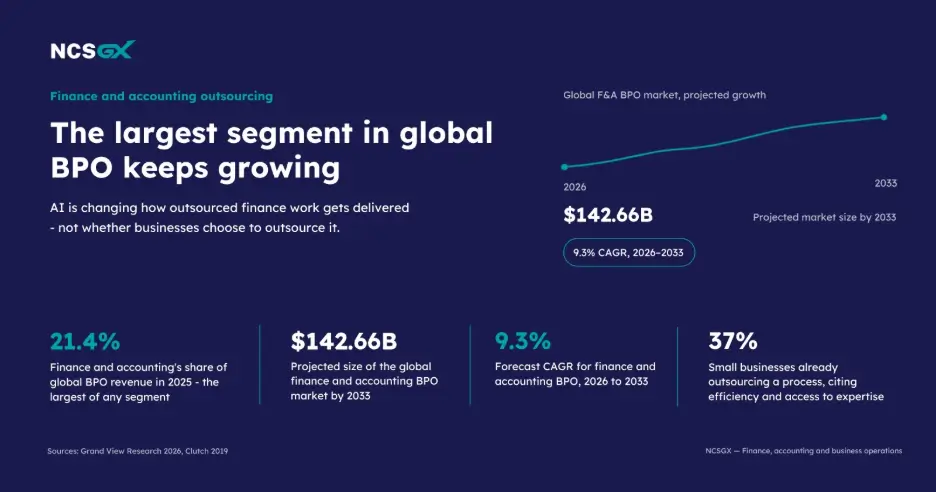
Historical small-business research also shows why specialist functions are attractive outsourcing candidates. Clutch found that accounting, IT services and digital marketing were among the most outsourced functions among small businesses in its 2019 research. The study found that 37% of surveyed small businesses were already outsourcing a business process, with efficiency and access to expertise among the leading motivations.
That data should not be treated as a 2026 adoption rate. However, it highlights a pattern that remains relevant: businesses tend to outsource functions when they require specialist knowledge, additional capacity, or greater efficiency.
In 2026, that pattern is being reinforced by technology.
Instead of outsourcing simply because a task is repetitive, businesses are increasingly looking at whether an external provider can deliver a complete process more efficiently than an internal team.
Finance, Accounting, and Tax Outsourcing Statistics
Finance and accounting remains one of the most significant outsourcing categories.
Grand View Research reports that finance and accounting represented 21.4% of global BPO revenue in 2025, making it the largest service segment in its BPO market analysis.
A separate 2026 analysis from Grand View Research estimates that the global finance and accounting BPO market will reach US$142.66 billion by 2033, growing at a 9.3% CAGR from 2026 to 2033. The report highlights automation and robotic process automation as important factors influencing the market.
The reason finance is such a strong outsourcing category is not difficult to understand.
Finance functions combine recurring processes with specialist knowledge and strict deadlines. Businesses may outsource bookkeeping, accounts payable, accounts receivable, reconciliations, general ledger activities, payroll, financial reporting and other back-office processes.
The model is also moving away from isolated task outsourcing.
Businesses increasingly want connected processes that provide better visibility, consistent controls, and scalable delivery. End-to-end finance and accounting operations can bring record-to-report, order-to-cash and procure-to-pay activities into a more structured operating model.
Tax-related work is part of this wider trend, although the exact responsibilities depend on the jurisdiction and the regulatory requirements involved. For businesses, the attraction is often less about simply reducing headcounts and more about gaining reliable capacity around recurring financial and compliance processes.
The Growing Role of AI in Outsourcing
AI is changing the outsourcing industry, but it is not making outsourcing obsolete.
Instead, AI is changing the type of work that businesses expect external providers to perform.
Routine activities such as document processing, data classification, reconciliation support, information extraction, and workflow management are increasingly suitable for automation.
That creates an important distinction between labour-based outsourcing and technology-enabled outsourcing.
A provider that simply supplies people to perform repetitive tasks may face greater pressure as automation improves. A provider that combines people, technology, process knowledge and quality controls can deliver something different.
The future of finance describes this shift clearly: finance operating models are evolving around automation, new skills and managed services, while people continue to provide oversight, interpretation, judgement and strategic decision-making.
This is likely to be one of the defining outsourcing trends 2026: human teams are not necessarily being replaced by AI; rather, AI is being incorporated into the processes those teams manage.
For businesses, this means the value of an outsourcing partner increasingly depends on its ability to combine people + process + technology.
What the 2026 Data Actually Shows
The statistics point to five clear conclusions.
First, outsourcing is still growing. The global BPO market is estimated at US$358.6 billion in 2026 and is forecast to nearly double by 2033.
Second, finance and accounting remain in major outsourcing categories. Their 21.4% share of BPO revenue demonstrates how important these processes are within the wider market.
Third, expertise matters alongside cost. Historical small-business research found that efficiency and access to expertise were key outsourcing motivations. More recent research similarly points toward businesses using external partners to access capabilities they do not have internally.
Fourth, AI is changing delivery rather than eliminating outsourcing. Automation can reduce manual work while increasing the importance of human oversight and process governance.
Finally, outsourcing is becoming more integrated. Businesses are increasingly looking beyond individual tasks and considering whether external partners can manage connected processes and provide measurable operational outcomes.
What Businesses Should Look for in an Outsourcing Partner
The growth of the outsourcing market does not mean every outsourcing arrangement will deliver the same results.
Businesses should look beyond hourly rates and ask how a provider will actually operate the function.
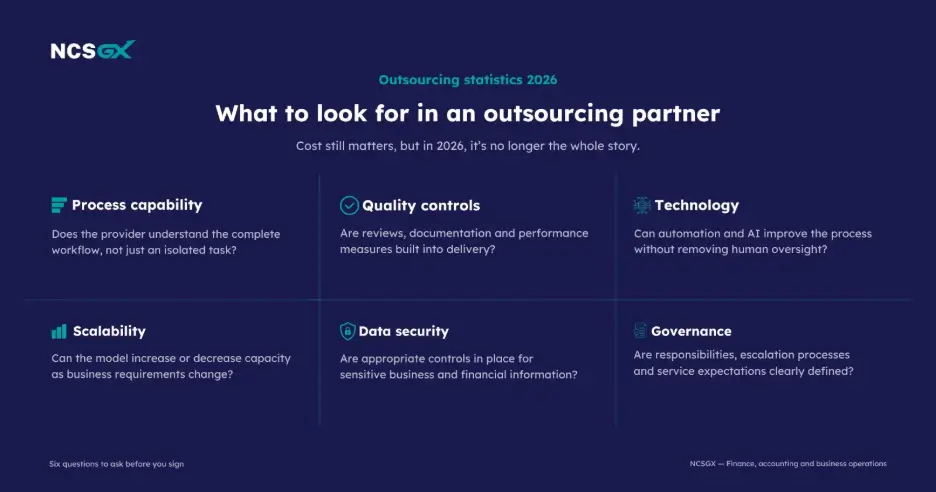
Key considerations include:
- Process capability: Does the provider understand the complete workflow?
- Quality controls: Are reviews, documentation and performance measures built into delivery?
- Technology: Can automation and AI improve the process without removing necessary human oversight?
- Scalability: Can the model increase or decrease capacity as business requirements change?
- Data security: Are appropriate controls in place for sensitive business and financial information?
- Governance: Are responsibilities, escalation processes and service expectations clearly defined?
A strong outsourcing relationship should ultimately provide more than additional hands.
It should create a reliable operating capability that can improve as the business grows. Finance transformation services can support this approach by combining process redesign, technology and operational delivery rather than treating outsourcing as a simple staffing exercise.
Conclusion
The most useful conclusion from the outsourcing statistics 2026 is not simply that businesses are outsourcing more.
They are outsourcing differently.
The global BPO market continues to expand; finance and accounting remain in major categories, and AI is changing how outsourced work is performed. At the same time, businesses are becoming more selective about the capabilities they expect from external partners.
Cost will continue to matter, but it is no longer the whole story.
The stronger outsourcing models are increasingly built around specialist expertise, scalable teams, technology, process governance, and measurable outcomes.
For businesses considering outsourcing in 2026, the better question is therefore not just, “How much can we save?”
It is:
“Can an external partner help us run this function more efficiently, reliably and intelligently than we can on our own?”
For organisations exploring that approach, NCSGX’s global services combine finance and accounting operations with technology-enabled business support designed to help organisations improve capacity, control and scalability. If outsourcing is part of your 2026 growth strategy, contact NCSGX to discuss the right operating model for your business.
How NCSGX Can Help
NCSGX helps businesses and accounting firms access skilled offshore support across finance, accounting, tax and back-office operations. With scalable teams, structured processes, and technology-enabled delivery, NCSGX helps reduce operational pressure while allowing internal teams to focus on higher-value work.
- Finance & Accounting Support – Bookkeeping, reconciliations, AP, AR and reporting.
- Tax support – Assistance with tax preparation and compliance processes.
- Scalable teams – Flexible capacity as workloads change.
- Process-driven delivery – Structured workflows and quality controls.
- Technology-enabled support – Combining skilled professionals with automation.
- Back-office operations – Reliable support for recurring administrative tasks.
Frequently Asked Questions (FAQ)
1. Is outsourcing still growing in 2026?
Yes. Grand View Research Estimates the global BPO market at US$358.6 billion in 2026, with the market projected to reach US$695.8 billion by 2033 at a 9.9% CAGR.
2. What function do most businesses outsource?
There is no single function across every market, but finance and accounting is one of the largest BPO categories. It represented 21.4% of BPO revenue in 2025 according to Grand View Research.
3. Why do businesses outsource accounting and tax work?
Common reasons include access to specialist expertise, additional capacity, process efficiency, and the ability to manage recurring workloads without building every capability internally.
4. Does outsourcing save money?
It can, but savings are not automatic. The outcome depends on the provider, scope of work, operating model, technology, quality controls, and management requirements. Businesses should compare total cost and outcomes rather than hourly rates alone.
5. Is AI reducing the need for outsourcing?
AI is reducing some repetitive manual work, but it is also creating demand for outsourcing models that combine automation with human expertise. The emerging model is increasingly AI + people + process governance, rather than AI replacing outsourced teams altogether.

Bijal Bodiwala
Bijal Bodiwala is a Chartered Accountant with over 10 years of experience at NCSGX Australia, where he serves as AVP - Accounting & Bookkeeping. He specialises in bookkeeping, BAS and IAS, GST, payroll and STP reporting, financial reporting, and management accounts for Australian accounting firms and SMEs. With command of Australian tax frameworks and tools like Xero, MYOB, and QuickBooks Online, he has driven 50-70% reductions in operating costs for top firms, delivering scalable, partner-ready solutions.
All Posts