
 USA
USA
 Canada
 Australia

Introduction
Running a Canadian small business means juggling more than most people realize. Between chasing invoices, sorting receipts, and trying to remember when the next GST/HST filing is due, the books often end up at the bottom of the to-do list. That is exactly the gap virtual bookkeeping was built to fill.
Virtual bookkeeping has changed how thousands of Canadian business owners manage their finances. Instead of dropping off a shoebox of receipts or running spreadsheets at midnight, owners now hand the work to a remote bookkeeper who connects through cloud-based software. The data lives online, the workflow stays current, and the books stop being a monthly emergency.
What Is Virtual Bookkeeping?
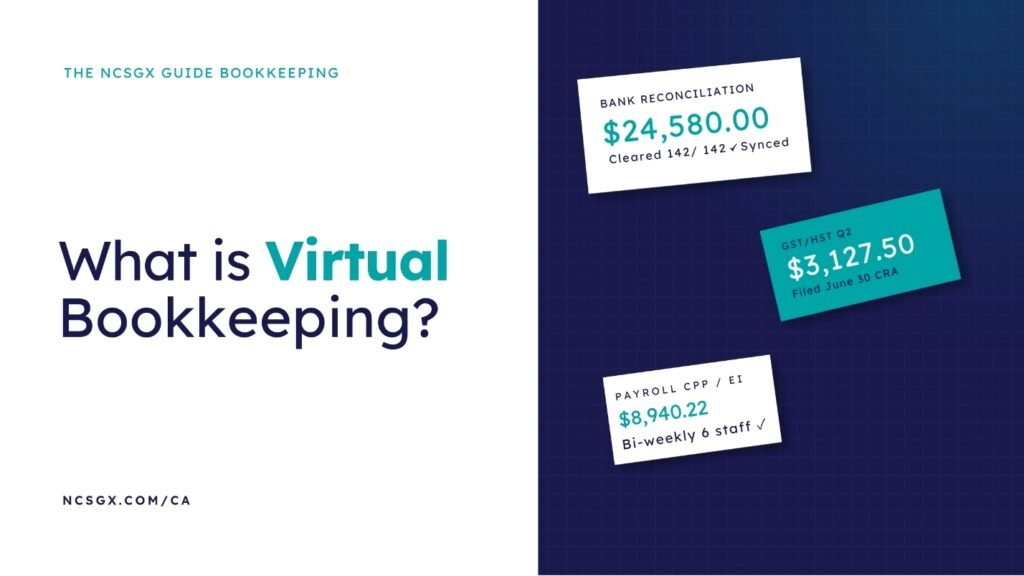
Virtual bookkeeping is the practice of recording, organizing, and reconciling a business’s financial transactions remotely, using cloud-based accounting software.
A virtual bookkeeper handles the same work an in-house bookkeeper would, but does it from a separate location, often as part of a team that supports several clients at once.
Platforms like QuickBooks Online, Xero, Sage Business Cloud, and Wave let bookkeepers and business owners view the same numbers in real time, from anywhere with an internet connection. Choosing the right platform is equally important for businesses evaluating the best bookkeeping software for small businesses in Canada based on automation, scalability, and reporting needs.
For a Canadian SME, that usually means working with a bookkeeper or team in another city or province, while staying fully aligned with CRA rules, GST/HST filings, and any provincial requirements that apply.
Key Takeaways
- Virtual bookkeeping is bookkeeping done remotely through cloud-based software like QuickBooks Online or Xero, covering the same scope as an in-house bookkeeper.
- Setup is simple: bank feeds, digital receipts, monthly reports. Once you’re live, most of it runs in the background.
- Most Canadian SMEs pay between $300 and $1,500 a month, with GST/HST, payroll, reconciliations, and year-end prep included.
- The biggest wins are lower overhead, real-time financial visibility, and access to a full team instead of a single hire.
- It fits most service businesses, e-commerce, and growing companies. Cash-heavy operations may still prefer a traditional setup.
How Virtual Bookkeeping Works
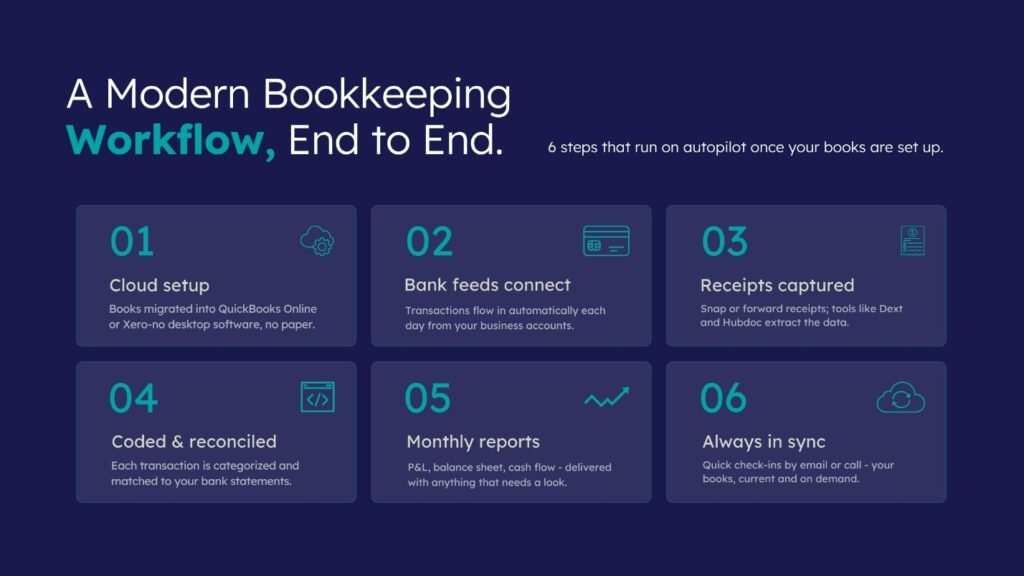
The day-to-day workflow is simpler than most owners expect. Once your business is onboarded, the bulk of the routine work happens automatically through software integrations. Here is what a typical setup looks like:
- Cloud accounting software is set up or migrated. Your bookkeeper installs or moves your books into a platform like QuickBooks Online or Xero.
- Bank and credit card feeds are connected. Transactions flow automatically each day from your business accounts.
- Receipts and invoices are captured digitally. You snap a photo or forward a PDF to a dedicated email address, and tools like Dext or Hubdoc pull the data.
- Transactions are categorized and reconciled. Your bookkeeper codes each entry and matches the books to your bank statements.
- Reports are delivered. At the end of the month, you receive financial statements, cash flow summaries, and a list of any items that need your attention.
- Communication stays simple. Questions, approvals, and quick check-ins happen over email, secure chat, or scheduled video calls.
There is no physical hand-off, no waiting until tax season to find out where your numbers stand, and no scrambling to pull records when the CRA asks for them.
What Services Does a Virtual Bookkeeper Handle?
Most virtual engagements cover the same core work as a traditional in-house bookkeeper, with a few cloud-driven extras. Common services include:
- Daily transaction categorization and coding
- Bank and credit card reconciliations
- Accounts payable and accounts receivable management
- GST/HST tracking and filing preparation
- Payroll processing, including CPP, EI, and income tax remittances
- Monthly financial statements (profit and loss, balance sheet, cash flow)
- Year-end file preparation for your accountant or CPA
- CRA correspondence support
Some firms also bundle in advisory work, budgeting, KPI tracking, and management reporting, which moves the engagement closer to an outsourced controller role. Businesses looking for more structured financial oversight often benefit from virtual bookkeeping services that support reconciliations, reporting accuracy, payroll coordination, and CRA compliance requirements.
Key Benefits of Virtual Bookkeeping for Canadian Businesses
Cost savings often get the headline, but the real value sits in a handful of practical wins that add up over the year.
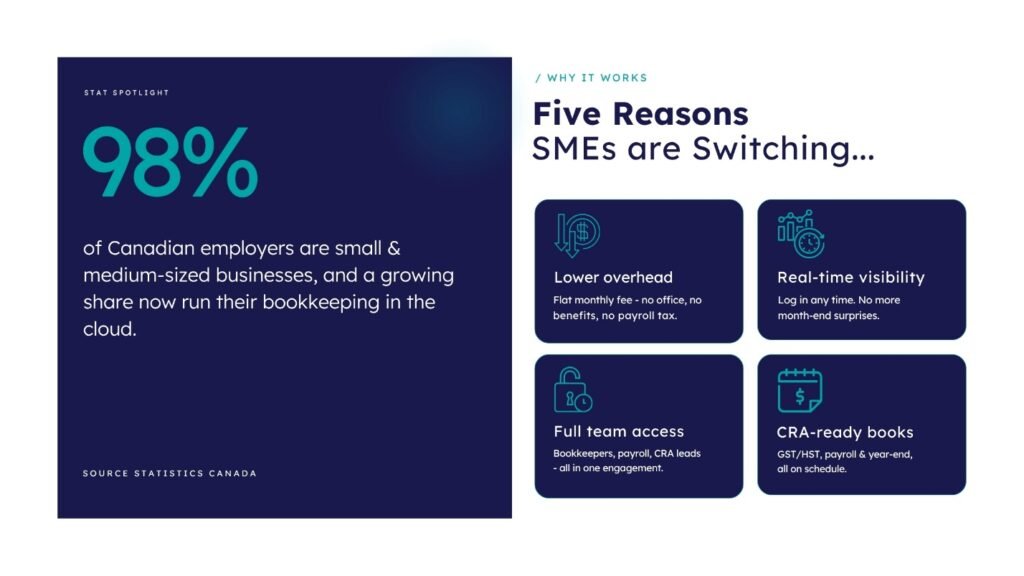
Lower overhead. You skip the cost of office space, recruitment, training, payroll taxes, and benefits that come with an in-house hire. Most virtual bookkeeping engagements run on a flat monthly fee, which makes budgeting predictable.
Real-time financial visibility. Cloud software lets you log in at any time and see exactly where the business stands. There is no more waiting until month-end to find out whether you are profitable.
Access to a full team. A virtual bookkeeping firm usually brings a team, including bookkeepers, payroll specialists, and CRA compliance leads, rather than a single hire who must know everything.
Scalability. As your business grows from one entity to multiple, or adds payroll, inventory, or multi-currency transactions, the service can flex without you needing to re-hire.
Stronger CRA readiness. Clean, current books make tax season faster and reduce the risk of penalties from missed GST/HST or payroll remittance deadlines.
Statistics Canada data shows small and medium-sized businesses make up over 98% of Canadian employers, and a growing share of them have moved their bookkeeping and accounting workflows online over the past five years. The shift is not a trend anymore, it is the new baseline.
Virtual Bookkeeping vs Traditional Bookkeeping
Factor | Virtual Bookkeeping | Traditional Bookkeeping |
Location | Remote, cloud-based | On-site or local office |
Software | Cloud platforms (QBO, Xero, Sage) | Desktop software or paper records |
Access to data | 24/7 from any device | Limited to office hours |
Cost structure | Flat monthly fee | Hourly rate or salaried role |
Document exchange | Digital uploads, secure portal | Physical drop-off, fax, or mail |
Scalability | Easy to scale up or down | Tied to hiring decisions |
Reporting cadence | Real-time and monthly | Often monthly or quarterly |
Is Virtual Bookkeeping Right for Your Business?
Virtual bookkeeping fits most Canadian SMEs, and it works especially well for:
- Service-based businesses such as agencies, consultants, trades, and healthcare practices
- E-commerce operations with high transaction volume
- Owners who travel or work remotely
- Companies that want monthly reporting without making a full-time hire
- Businesses preparing for an audit, sale, or financing round
Businesses that deal heavily in cash transactions, or owners who genuinely prefer face-to-face meetings, may still lean toward a traditional setup. For most modern small businesses, though, the question is no longer about technology; it is about whether the owner is ready to digitise the workflow.
Final Thought
The best bookkeeping setup is the one you actually keep up with. For most Canadian SMEs, that means moving on from spreadsheets and shoeboxes and onto something that talks to your bank account, your payroll, and the CRA without needing your constant attention. If you’re spending more time on the books than on running the business, that’s a sign worth listening to.
How “NCSGX” Can Help
At NCSGX, we provide full-service virtual bookkeeping for Canadian businesses, with experienced bookkeepers who understand CRA requirements, GST/HST rules, payroll compliance, and the realities of running an SME in Canada.
Our team handles the day-to-day work, so you do not have to:
- Daily transaction recording and reconciliation
- Monthly financial statements written in plain English
- GST/HST and payroll remittance tracking
- Year-end preparation aligned with your accountant
- Cloud setup or migration if you are moving from desktop software or paper records
Whether you are a sole proprietor in Ontario or a growing company managing operations across provinces, our bookkeeping services work as an extension of your team, keeping the books current, the CRA on-side, and your time focused on running the business. To talk through whether virtual bookkeeping is a fit, get in touch with NCSGX for a no-pressure conversation.
Frequently Asked Questions (FAQ)
Is virtual bookkeeping safe and secure?
Yes, when it is set up properly. Reputable virtual bookkeepers use encrypted software, multi-factor authentication, and secure document portals. Most cloud accounting platforms meet or exceed the security standards used by Canadian banks.
What can you expect to pay for virtual bookkeeping in Canada?
Virtual bookkeeping fees vary based on your business size, monthly transactions, payroll needs, and the level of financial support required. In Canada, most small and mid-sized businesses typically spend between $300 and $1,500 per month. Many bookkeeping firms also provide fixed monthly pricing, making it easier to budget without unexpected costs.
Do I need to be tech-savvy to use virtual bookkeeping?
No. Most cloud platforms are designed for business owners, not accountants. Your virtual bookkeeper handles the technical setup and walks you through only the parts you need to know.
Will my virtual bookkeeper handle my CRA filings?
Bookkeepers prepare the data for filings, GST/HST returns, payroll remittances, and year-end records, and many will file on your behalf. Corporate and personal income tax returns are typically prepared by an accountant or CPA, often working alongside your bookkeeper.
Can I switch from a traditional bookkeeper to a virtual one?
Yes, and it is more straightforward than most owners expect. A good virtual bookkeeping firm will migrate your data, configure the cloud software, and reconcile any gaps before going live, so nothing falls through the cracks.