
 USA
USA
 Canada
 Australia

Introduction
Operating a small business in Canada involves managing more than just customers and cash flow. You are tracking GST/HST, managing payroll deductions, reconciling bank statements, and trying to keep CRA filings on schedule. The right bookkeeping software takes a lot of that pressure off your plate, but only when it actually fits how your business operates.
We work with Canadian founders and finance teams every day, and one of the first questions we hear is which tool to pick. Honestly, the “best” software depends on your size, sector, and reporting complexity. This guide walks through the strongest options, the features that matter for Canadian businesses, and where automation alone stops being enough.
Why Choosing the Right Bookkeeping Software Matters
A solid bookkeeping system does three things well. It keeps your numbers accurate, makes compliance straightforward, and gives you real visibility into how your business is performing.
The wrong choice creates the opposite. Mismatched software pushes teams into manual workarounds, delays filings, and produces reports nobody trusts. According to Statistics Canada, small businesses account for most of the private sector employment in the country, which means every hour spent fighting your own tools is an hour pulled away from growth.
Modern platforms automate bank feeds, categorize transactions, and produce reports that used to take days. The benefit is not just speed. It is confidence in the numbers when a lender, investor, or CRA auditor asks them.
Key Takeaways
- Cloud-based bookkeeping software helps Canadian small businesses automate GST/HST tracking, payroll, and reporting.
- The right pick depends on business size, transaction volume, and whether you operate a cross-border.
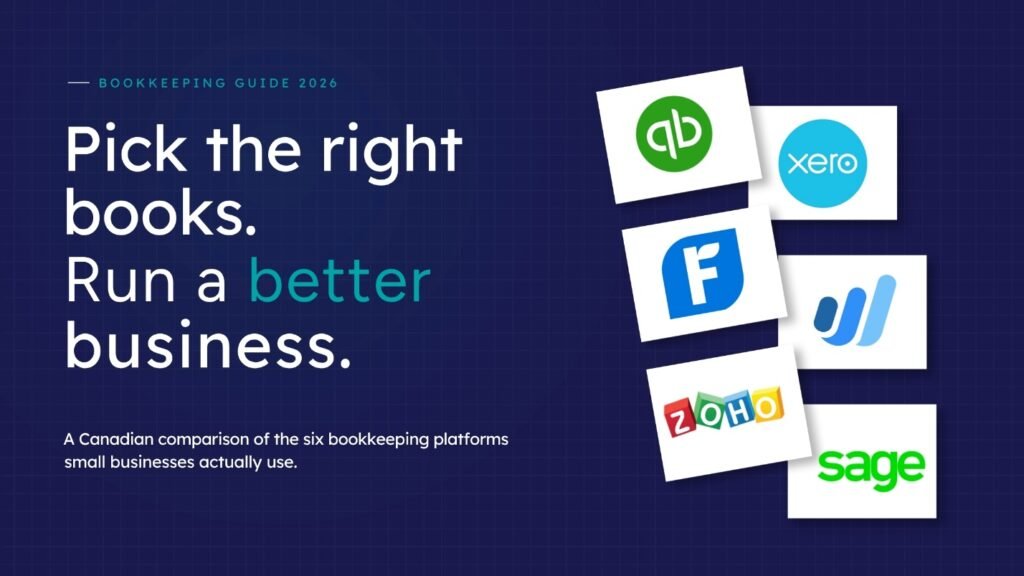
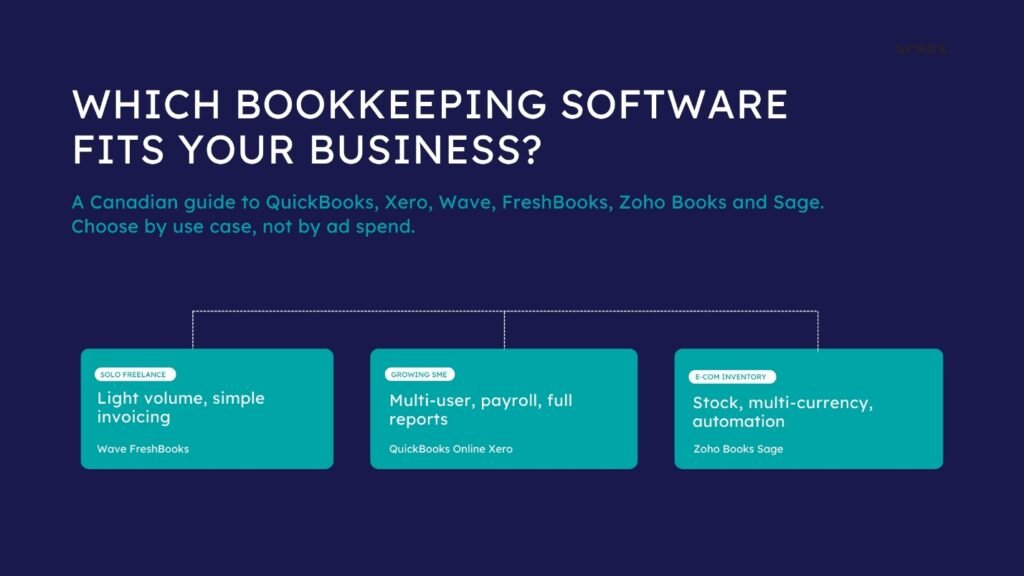
- QuickBooks Online and Xero lead the market, but Wave, FreshBooks, Zoho Books, and Sage all have a clear place.
- Software handles mechanics. Expert oversight is what keeps your books audit ready.
- Pairing the right platform with an outsourced bookkeeping partner often produces stronger outcomes than software alone.
What Features Should Canadian Businesses Look For?
Not every accounting tool is built with Canadian rules in mind. When evaluating bookkeeping software for small business use, prioritize these features:
- GST/HST and PST/QST support: native sales tax tracking by province, with reports that align with CRA filing formats and broader Canadian tax compliance requirements.
- Payroll integration: built-in or partnered payroll that handles CPP, EI, and provincial deductions, including T4 generation.
- Cloud access: a true cloud-first setup so you, your bookkeeper, and your accountant can work from anywhere.
- Multi-currency: critical if you sell or buy in USD or other currencies, common for SaaS and cross-border e-commerce.
- Automation: bank rules, recurring invoices, and AI-assisted categorization that cut down on manual entry.
- Reporting dashboards: real-time views of cash flow, AR, AP, and profitability.
- Security and compliance: encryption, role-based access, two-factor authentication, and regular backups.
If a tool falls short on any of these, you will likely outgrow it within a year or two.
Best Bookkeeping Software Options for Small Businesses in Canada
Here are the platforms we see most often in Canadian small business stacks, with honest notes on where each one fits.
QuickBooks Online
QuickBooks Online is a default choice for many Canadian businesses, and for good reason. It offers strong CRA-aligned sales tax handling, deep integration with Canadian banks, and a wide ecosystem of apps and bookkeepers who already know it inside out.
- Best for: service businesses, retailers, and growing SMEs.
- Pricing: from around $26/month CAD, with tiered plans for advanced features.
- Pros: feature-rich, strong reporting, excellent local support.
- Limitations: pricier than competitors, can feel cluttered for very small operations.
Xero
A serious contender, especially for businesses with a tech-forward team. Xero offers a clean interface, unlimited users on every plan, and excellent app integrations.
- Best for: SaaS, agencies, and multi-entity businesses.
- Pricing: from around $20/month CAD.
- Pros: scalable, intuitive, strong multi-currency support.
- Limitations: lower-tier plans cap invoices and bills.
FreshBooks
FreshBooks was originally built for freelancers and service businesses. Time tracking, project profitability, and clean invoicing are where it shines. The platform was founded in Toronto, which gives it a clear understanding of Canadian needs.
- Best for: Consultants, agencies, and solopreneurs.
- Pricing: From around $21/month CAD.
- Pros: Easy to use, strong invoicing.
- Limitations: Lighter on inventory and complex multi-entity accounting.
Wave Accounting
Free for core accounting and invoicing, with paid add-ons for payments and payroll. Wave is another Canadian-built bookkeeping app, headquartered in Toronto, so its tax features were designed with the CRA in mind from day one.
- Best for: very small businesses, freelancers, and side businesses.
- Pricing: free core; paid payroll and payments.
- Pros: no cost for the basics, simple to set up.
- Limitations: limited advanced reporting, fewer integrations.
Zoho Books
Part of the wider Zoho ecosystem, which appeals to businesses already running Zoho CRM or other Zoho apps. It brings strong automation and competitive pricing.
- Best for: e-commerce and businesses operating inside the Zoho stack.
- Pricing: free for very small revenue tiers; paid plans from $15/month CAD.
- Pros: affordable, automation heavy.
- Limitations: smaller bookkeeper community in Canada compared with QuickBooks or Xero.
Sage Accounting
A long-standing name in accounting, with cloud and desktop options. It suits businesses that want a more traditional structure with reliable inventory features.
- Best for: established SMEs and product-based businesses.
- Pricing: from around $20/month CAD.
- Pros: dependable, solid inventory tools.
- Limitations: the interface feels dated next to newer cloud-first platforms.
For broader perspective, both NerdWallet’s accounting app comparison and this Canadian-focused review are useful cross-checks.
Comparison Table
Software | Best For | Pricing (CAD) | Key Feature |
QuickBooks Online | Growing SMEs | From $26/month | Robust CRA-aligned reporting |
Xero | SaaS and agencies | From $20/month | Unlimited users, multi-currency |
FreshBooks | Consultants, freelancers | From $21/month | Time tracking and invoicing |
Wave | Micro businesses | Free core | Free accounting and invoicing |
Zoho Books | E-commerce, Zoho users | From $15/month | Workflow automation |
Sage Accounting | Established SMEs | From $20/month | Inventory management |
Cloud-Based Accounting and Online Bookkeeping in Canada
Cloud is the default now. Almost every credible platform offers a true online experience, with mobile apps, real-time bank feeds, and live collaboration with your bookkeeper or accountant.
For online bookkeeping Canada users, the practical benefits are real. You see up-to-date numbers without waiting for monthly summaries. Your team submits expenses from anywhere. Backups happen automatically. And when audit season arrives, every record is searchable rather than buried in a filing cabinet.
The other shift worth noting is AI. Receipt scanning, transaction categorization, and anomaly detection are now standard inside mainstream platforms, as Pilot’s breakdown of business bookkeeping software highlights.
When Software Alone Is Not Enough
Here is where we will be direct. Software is excellent at recording transactions. It does not interpret them, catch nuanced errors, or guide a business through a tricky CRA review.
We see this pattern often. A business sets up QuickBooks or Xero, runs it themselves for a year or two, then hits a ceiling. Reconciliations slip. Sales tax categories drift. Payroll mistakes accumulate quietly. By the time a CPA gets involved, cleanup costs more than ongoing bookkeeping would have.
Scaling businesses, multi-entity operations, and cross-border sellers especially benefit from professional oversight. The tool stays in place. What changes is who runs it day to day and how strategically the numbers get reviewed.
Final Thoughts
The best bookkeeping software is the one that matches your business and gets used consistently. QuickBooks, Xero, and the rest all do good work when set up properly. The real difference between books that hold up under scrutiny and books that do not usually comes down to who is reviewing them.
If you would rather focus on running your business while a team handles the numbers, our team is here to help.
How NCSGX Canada Can Help
Whether you are choosing your first bookkeeping platform or cleaning up years of inconsistent records, our team supports the full lifecycle:
- Software selection and setup tailored to your business model.
- Virtual bookkeeping with monthly reconciliations and reporting.
- Management reports that translate raw data into decisions.
- Ongoing bookkeeping management covering sales tax, payroll, and year-end coordination.
- Financial process optimization to help you scale without scaling headcount.
If you are ready to talk it through, book a consultation with NCSGX Canada.
Frequently Asked Questions (FAQ)
1. What is the best bookkeeping software for small businesses in Canada?
QuickBooks Online and Xero are the strongest all-rounders. Wave is excellent for very small businesses, and FreshBooks suits service-based work. The best fit depends on your industry, size, and growth plans.
2. Is cloud bookkeeping secure?
Yes, when you use reputable platforms. Leading providers offer bank-grade encryption, two-factor authentication, and automatic backups. In most cases, cloud security is stronger than what a typical small business could maintain on its own infrastructure.
3. Can bookkeeping software replace accountants?
No. Software handles data entry and reporting. Accountants and bookkeepers interpret the numbers, catch errors, manage CRA filings, and advise on decisions. The two work together.
4. Which bookkeeping app is best for startups?
Xero and QuickBooks Online both serve startups well. Xero tends to win for SaaS and tech-forward teams, while QuickBooks is strong for service businesses, retail, and trades.
5. How much does bookkeeping software cost in Canada?
Most plans range from free (Wave) to roughly $80/month CAD for advanced tiers. Most small businesses spend between $20 and $50/month CAD on software, plus the cost of a bookkeeper or outsourced provider.