
 USA
USA
 Canada
 Australia

Introduction
AI bookkeeping tools are becoming an essential part of modern financial workflows, helping businesses automate repetitive tasks such as transaction categorization, invoice processing, and bank reconciliation. Companies are increasingly using automation to improve efficiency while maintaining accurate financial records. At NCSGX, we help businesses combine practical automation with professional bookkeeping oversight to maintain accurate financial records.
In 2026, the greatest advantage of AI-assisted bookkeeping is faster processing, not complete replacement of human expertise. While automation can reduce manual work, professional review is still necessary to ensure accuracy, compliance, and reliable financial reporting.
Key Takeaways
- AI bookkeeping automation can significantly reduce manual data entry and repetitive processing tasks.
- Bookkeeping AI is commonly used for transaction categorization, duplicate detection, and vendor pattern recognition.
- Automated bank reconciliation helps match transactions faster, but unmatched items still require human review.
- AI invoice processing and receipt of data extraction can improve efficiency by capturing information from invoices and receipts automatically.
- The most reliable results come from combining automation with professional bookkeeping oversight before final posting.
What AI Bookkeeping Tools Actually Automate in 2026 (and What They Don’t)
AI bookkeeping tools are becoming a standard part of financial operations for many small and medium-sized businesses in 2026. Platforms that integrate with QuickBooks and Xero now use machine learning to assist with transaction processing, document capture, and reconciliation workflows.
Businesses are increasingly adopting AI-assisted bookkeeping workflows to reduce repetitive administrative work. While automation can speed up many bookkeeping tasks, human review remains essential to ensure accuracy, compliance, and proper financial reporting.
What AI Bookkeeping Automation Means in 2026
Modern AI bookkeeping automation is less about replacing bookkeepers and more about assisting them. The software learns from historical transactions, vendor names, account mappings, and user corrections.
For example, if a business regularly records internet expenses from the same vendor, the system can suggest the appropriate expense account automatically. Over time, these suggestions become more accurate as the system receives additional feedback.
Automation Means Repetitive Work Can Be Handled Faster
The biggest benefit of automation is speed. Tasks that once required hours of manual data entry can often be completed in minutes.
Common examples include:
- Receipt data extraction from scanned receipts
- AI invoice processing for supplier bills
- Duplicate transaction detection
- Vendor and expense pattern recognition
- Document organization and filing
- Initial reconciliation matching
Many firms combine automation with cloud accounting services to streamline data collection while maintaining review controls.
It Does Not Mean the Books Are Automatically Correct
This is the most important limitation to understand. AI can suggest a category, but it cannot always determine whether the transaction should be treated as an expense, asset, prepaid item, or shareholder-related transaction.
Errors can occur when:
- A new vendor has not been seen before.
- A transaction contains mixed business and personal expenses.
- Sales tax treatment differs from previous transactions.
- An unusual one-time payment is processed.
- A document is scanned with incomplete or unclear information.
For this reason, professional review before final posting remains a critical control step. According to the Federal Trade Commission, businesses should maintain accurate financial records and implement appropriate internal controls when using automated systems that process sensitive financial information.
Bookkeeping Tasks AI Tools Actually Automate
Most modern platforms automate the following tasks effectively:
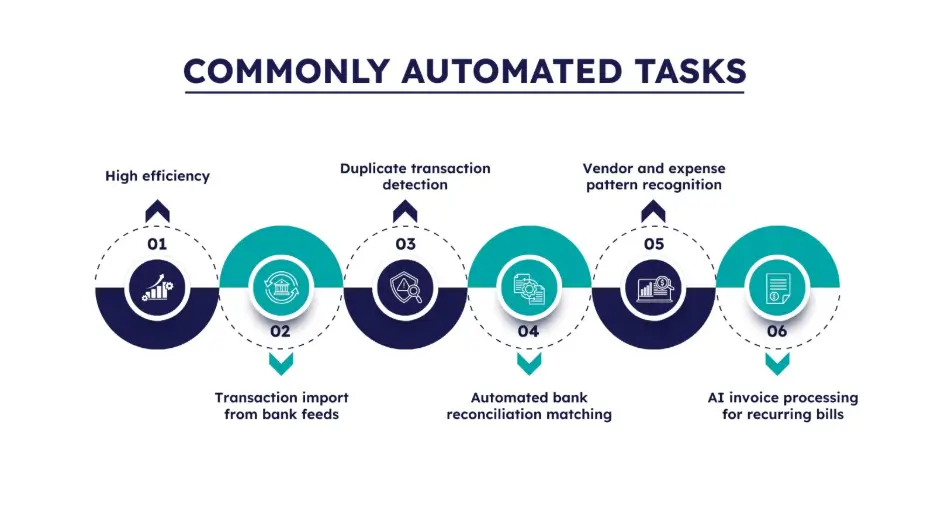
These features are particularly useful for businesses processing dozens or hundreds of transactions each month.
Transaction Categorization
Bookkeeping AI is especially effective at transaction categorization when the business has consistent spending patterns.
For example:
| Vendor | Likely AI Suggestion |
|---|---|
| Office supply retailer | Office Supplies Expense |
| Internet provider | Utilities or Communications |
| Monthly software subscription | Software Expense |
| Fuel station | Vehicle Expense |
The software can also flag transactions that do not match historical patterns, which helps identify potential errors before month-end.
Bookkeeping Tasks AI Only Assists With
Some tasks are partially automated but still require human judgment:
- Month-end preparation support
- Accrual identification
- Prepaid expense treatment
- Sales tax verification
- Intercompany transactions
- Inventory adjustments
- Year-end review preparation
AI can surface relevant transactions and generate exception reports, but a bookkeeper or accountant must determine the correct accounting treatment.
Businesses implementing Real-time Bookkeeping practices often use automation to identify issues earlier in the month, making final review more efficient.
What AI Bookkeeping Tools Do Not Fully Automate
Despite rapid advances, AI tools do not fully automate:
- Financial statement review
- Tax planning
- Sales tax interpretation
- Complex journal entries
- Payroll compliance decisions
- Audit support explanations
- Management reporting analysis
- Professional judgment on unusual transactions
Many firms combine automation with cloud accounting services to streamline data collection while maintaining review controls. Businesses should also ensure that automated bookkeeping processes align with current IRS recordkeeping requirements and reporting obligations. Understanding the latest guidance on digital records and business expense documentation can help reduce compliance risks when implementing AI-assisted bookkeeping workflows.
Before and After AI Bookkeeping Automation
| Task | Before AI | With AI Assistance |
|---|---|---|
| Transaction categorization | Manual review | Suggested categories |
| Bank reconciliation | Manual matching | Automated matching support |
| Invoice processing | Manual data entry | AI-assisted extraction |
| Month-end preparation | Several hours | Reduced preparation time |
Conclusion
AI bookkeeping tools have become valuable productivity tools in 2026, especially for transaction categorization, document capture, and reconciliation support. They can reduce repetitive work and improve efficiency, but they do not replace the need for professional oversight and review.
The best results come from combining AI bookkeeping automation with experienced bookkeeping expertise. Businesses that balance automation with human judgment can maintain accurate financial records, improve operational efficiency, and make more informed financial decisions. If you would like to discuss how a balanced bookkeeping approach can support your business, contact NCSGX through our Contact Us page.
How NCSGX Can Help
NCSGX helps businesses use AI-assisted bookkeeping in a practical and controlled way. We combine modern automation tools with experienced bookkeeping reviews to improve efficiency, reduce manual processing time, and maintain accurate financial records. Businesses that automate bookkeeping workflows often benefit from integrated Payroll services that support accurate financial reporting and compliance.
Our approach focuses on the right balance between technology and professional oversight, helping businesses streamline transaction processing, reconciliation, and document management while ensuring the books remain reliable for reporting, compliance, and decision-making.
Frequently Asked Questions (FAQ)
1. Can AI bookkeeping tools replace accountants?
No. AI bookkeeping tools can automate data entry, categorization, and document processing, but they do not replace professional judgment, financial analysis, or tax expertise. Accountants remain responsible for reviewing records, interpreting regulations, and advising on complex financial matters.
2. How accurate are AI bookkeeping tools in 2026?
Accuracy has improved significantly, especially for recurring transactions and standardized documents. However, accuracy varies depending on transaction complexity, data quality, and how well the system has been trained on the business’s historical records. Human review is still necessary for exceptions and unusual items.
3. What bookkeeping tasks still require human input?
Tasks such as reviewing financial statements, approving unusual transactions, verifying tax treatment, preparing complex journal entries, and handling year-end adjustments still require human expertise. AI assists with these processes but does not make final accounting decisions.
4. Are AI bookkeeping tools worth it for small businesses?
For many small businesses, the main benefit is time savings. Businesses with regular transaction volumes can reduce manual data entry, improve document organization, and accelerate reconciliation workflows while maintaining professional oversight.
5. How much time do AI bookkeeping tools actually save?
Time savings depend on transaction volume and workflow complexity. Businesses that previously spent several hours per week on receipt entry, invoice processing, and reconciliation often see substantial reductions in administrative time after implementing automation.

Rahul Sharma
Rahul Sharma is a Chartered Accountant with over 7+ years of experience in global accounting, bookkeeping, tax preparation, financial reporting, and compliance. At NCSGX, he leads accounting outsourcing operations, manages client engagements, and drives process improvements for international businesses. Through his writing, Rahul shares practical insights on accounting, outsourcing, taxation, and business finance, helping firms and professionals make informed financial and operational decisions.
All Posts