

 USA
USA
 Canada
 Australia


Introduction
As the October 15 deadline approaches, many accounting firms find themselves racing to complete a growing backlog of extended tax returns. While the pressure often feels inevitable, the October extension crunch is usually the result of delayed workflows, inconsistent client follow-ups, and uneven workload distribution rather than the deadline itself.
At NCSGX we’ve seen that firms with structured processes, proactive planning, and consistent communication are far better equipped to manage extension season without overwhelming their staff or compromising quality.

Key Takeaways
- The October extension crunch is often caused by workflow inefficiencies rather than the October 15 filing deadline itself.
- A filing extension provides additional time to file a return, not additional time to pay taxes owed, making early planning essential.
- A structured tax season workflow helps firms spread extension work across several months instead of concentrating on it in October.
- Strong client document collection accounting practices and proactive communication reduce delays caused by missing information.
- Effective capacity planning for accounting firms, combined with standardized review processes and staff scheduling, minimizes bottlenecks and overtime.
- When internal resources are stretched, tax preparation outsourcing can help firms maintain productivity and deliver returns on time without sacrificing quality.
Why the October Extension Crunch Is Self-Inflicted (and How to Fix It)
Every year, many accounting firms find themselves working long hours as the October 15 deadline approaches. While the volume of extended tax returns may seem unavoidable, the October extension crunch is often the result of internal workflow challenges rather than the filing deadline itself. Firms that postpone work until clients provide complete information frequently end up compressing weeks of work into just a few days.
Filing an extension gives taxpayers more time to file, not more time to pay, so taxes are generally due by the original deadline, and interest or penalties may still apply. For accounting firms, the real challenge is managing extension work consistently. A structured workflow, proactive planning, and timely client communication can reduce the October workload while improving staff efficiency and client service.
What the October Extension Crunch Is
The term October extension crunch refers to the intense workload many accounting firms experience during the final weeks before the October 15 deadline for validly extended federal income tax returns. Instead of spreading work across several months, firms often find themselves completing a large percentage of returns during September and early October.
Although filing extensions are common, they are sometimes misunderstood. A federal filing extension generally provides additional time to submit the tax return, not additional time to pay taxes owed. Estimated tax liabilities are generally due by the original filing deadline. If a taxpayer underpays, Interest and applicable Penalties may continue to accrue even when an extension has been properly filed.
Why the Crunch Happens Inside the Firm
The root causes of the October crunch are almost always internal.
Common issues include:
- Poor client document collection accounting: Clients delay providing documents, and firms don’t enforce early deadlines. Keeping Bookkeeping current throughout the year can also reduce the cleanup required when tax returns enter the preparation queue.
- No prioritization: Extended returns aren’t segmented by complexity or risk, so everything gets done at once.
- Capacity issues: Staffing levels don’t match the extended return volume, leading to last-minute overtime.
- Last-minute communication: Firms wait until October to contact clients about missing items.
These problems turn what should be a manageable six-month window into a high-pressure sprint during Busy seasons.
How Firms Prevent It: The Workflow
Successful firms treat extensions as a planned phase of the tax season, not an afterthought. A structured workflow also makes it easier to coordinate Tax Services with document collection, preparation, review, and final filing requirements.
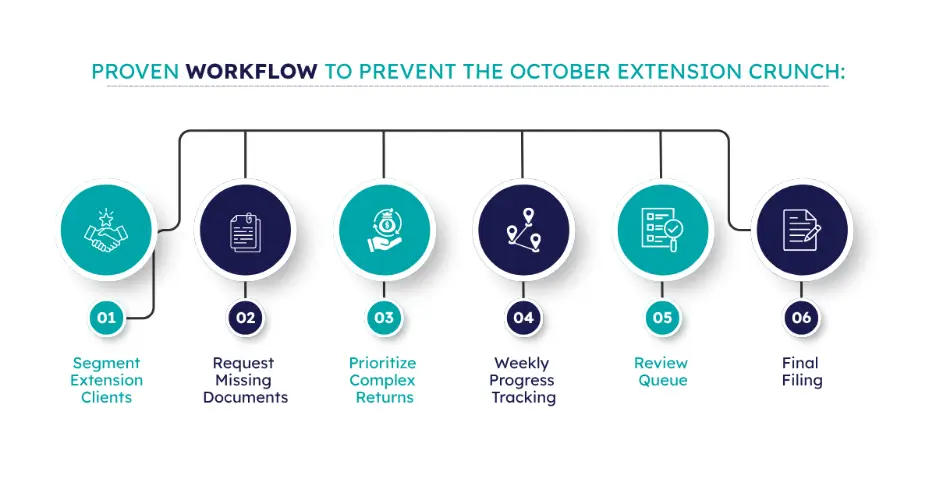
Here’s a proven workflow to prevent the October extension crunch:
Step 1: Segment Extension Clients
Categorize extended clients by return complexity, document readiness, and risk level. High-complexity returns (e.g., those with K-1s, international items, or significant schedules) should be prioritized early.
Step 2: Request Missing Documents
Send document requests immediately after filing extensions. Set clear deadlines ideally by mid-July and follow up systematically. Use client portals or secure email to track submissions.
Step 3: Prioritize Complex Returns
Begin work on complex returns in August. This gives your team time to resolve issues without the October time pressure.
Step 4: Weekly Progress Tracking
Maintain a dashboard showing the status of each extended return. Review weekly to identify bottlenecks and reallocate staff as needed.
Step 5: Review Queue
Workflow automation can reduce repetitive preparation tasks, while professional review remains important for exceptions and unusual transactions, as discussed in NCSGX’s AI Bookkeeping tools guide..
Step 6: Final Filing
Aim to complete 90% of extended returns by October 10. Reserve the final days for exceptions, client corrections, and last-minute filings.
This workflow, combined with automation tools and clear staff scheduling, smooths out the extension season and prevents the October rush.
A Prevention Timeline (August → October 15)
A structured timeline helps firms stay on track. Here’s a practical schedule for managing extended returns:
| Period | Key Actions |
| August | Review extension list; request all missing documents; assign work by complexity |
| Early September | Complete 40% of returns; focus on complex filings; begin client follow-ups |
| Late September | Complete 75% of returns; conduct final reviews; resolve outstanding items |
| October 1–10 | Finish remaining returns; file bulk of extensions; confirm client approvals |
| October 11–15 | File final returns; resolve exceptions; confirm IRS acceptance |
Following this timeline ensures that the October 15 deadline is met without last-minute panic.
Conclusion
The October extension crunch is largely preventable with a well-planned tax season workflow, proactive capacity planning for accounting firms, and consistent client communication. By spreading extension work across the months leading up to the October 15 deadline, firms can reduce bottlenecks, improve efficiency, and deliver better client service.
If your firm is looking to manage extension season and strengthen its tax operations, don’t wait until October to make improvements. Contact Us to learn how our bookkeeping, accounting, and tax support solutions can help your firm stay ahead of every filing season.
How NCSGX Can Help
At NCSGX, we help accounting firms build more efficient extension workflows by improving planning, organizing return pipelines, and supporting timely completion of extended filings. With a structured approach to workload management and consistent execution, firms can reduce the October extension crunch, minimize the risk of missed deadlines and avoidable penalties, and maintain a smoother experience for both staff and clients.
Frequently Asked Questions (FAQ)
1. What is the October extension crunch?
The October extension crunch is the workload surge accounting firms experience before the October 15 deadline for extended tax returns. It occurs when firms delay extended returns until the final days, creating a bottleneck.
2. Why do extended tax returns pile up every October?
Returns pile up because firms often lack structured workflows for managing extensions. Without early document collection, prioritization, and progress tracking, extended returns slide to the end of the queue.
3. How can accounting firms prevent the October crunch?
Firms can prevent the crunch by segmenting extension clients, setting early document deadlines, prioritizing complex returns, and tracking progress weekly. Outsourcing and automation also help distribute workloads.
4. When does the extension busy season actually start?
The extension busy season should start in August, not October. Firms that begin document collection and prioritization in summer avoid the last-minute rush before October 15.
5. Is the October 15 deadline the same for individuals and businesses?
For 2026, October 15 is the extended deadline for individual returns (Form 1040), C-Corporations (Form 1120), trusts/estates (Form 1041), and tax-exempt organizations (Form 990). S-Corporations and partnerships had a September 15 deadline.

Aayushi Shah
Aayushi Shah is a Chartered Accountant with over 6 years of experience in Canadian accounting and currently serves as the Chief Branding Officer at NCS Global. She specializes in outsourced services including tax preparation, payroll, financial reporting, and business consulting for Canadian CPAs and businesses. With strong expertise in Canadian tax laws and tools like QuickBooks, Sage, and Xero, she helps streamline financial operations and reduce costs. Aayushi has supported over 50 CPA firms in cutting operating expenses by 50–70% and is known for delivering scalable, client-focused solutions. Outside of work, she enjoys typography and scrapbooking, bringing creativity into her professional approach.
All Posts