
 USA
USA
 Canada
 Australia

Introduction
The Saver’s Match begins with qualifying retirement contributions made for tax years beginning after December 31, 2026. IRS guidance confirms the program’s 2027 start and related filing requirements. For U.S. accounting firms, accurate Saver’s Match payroll records will help substantiate employee deferrals, IRA deposits, and other retirement contributions before 2027 activity flows into the 2028 tax-filing season. For firms supporting clients with ongoing bookkeeping and financial recordkeeping, NCSGX’s accounting services can help keep these records organized and easier to reconcile. Organizing records now can reduce reconciliation problems and make Form 8880-A preparation more efficient.
Key Takeaways
- The Saver’s Match replaces the Saver’s Credit for qualifying retirement contributions beginning with the 2027 tax year.
- Eligible taxpayers can receive up to 50% of their first $2,000 of qualified contributions, for a maximum of $1,000 per person.
- Saver’s Match MAGI thresholds vary by filing status and determine whether the taxpayer receives a full, partial, or no match.
- Payroll records should be reconciled with retirement plan contribution reports and other supporting documentation.
- payroll deferral reconciliation retirement records can help identify missing or duplicate contribution transactions before tax filing.
- The match is claimed on Form 8880-A with the taxpayer’s 2027 federal return in 2028.
Saver’s Match 2027 – How US Accounting Firms Can Get Payroll Records Ready
The Saver’s Match introduces new retirement savings considerations for the 2027 tax year. While employers do not fund the federal match, accurate payroll and retirement contribution records will help accounting firms reconcile client data and prepare for the 2028 tax-filing season.
What the Saver’s Match Actually Changes for Clients
The Saver’s Match is a new federal retirement savings incentive created under SECURE 2.0. For qualifying retirement contributions beginning in 2027, it generally replaces the Saver’s Credit. Unlike the previous non-refundable credit, the Saver’s Match is generally paid as a contribution to an eligible retirement savings vehicle after the taxpayer claims it on the federal return.
An eligible individual can receive a match of up to 50% of the first $2,000 of qualified retirement savings contributions. That means the maximum Saver’s Match is $1,000 per person. The federal government provides the contribution, so employers and payroll providers do not fund or administer it as an employer payroll match.
| Filing status | Full-match starting point | Phaseout range | No match at or above |
| Single | $20,500 | $15,000 | $35,500 |
| Married Filing Jointly | $41,000 | $30,000 | $71,000 |
| Surviving Spouse | $41,000 | $30,000 | $71,000 |
| Head of Household | $30,750 | $22,500 | $53,250 |
| Married Filing Separately | $20,500 | $15,000 | $35,500 |
The applicable percentage decreases as MAGI moves through the phaseout range. For example, a single taxpayer with $30,000 of 2027 MAGI and $1,500 of qualified contributions would receive a 19% match under the calculation described in Notice 2026-48.
These amounts apply for 2027. The applicable dollar amounts are adjusted for inflation after 2027, while the $2,000 contribution limit is not adjusted for inflation.
Which Contributions Count and Which Records to Start Capturing Now
Qualified contributions can include traditional or Roth IRA contributions, elective deferrals to qualifying employer-sponsored plans, certain voluntary after-tax employee contributions, and contributions to a qualifying section 501(c)(18) plan. The first $2,000 of qualified contributions is used when calculating the match.
A Saver’s Match traditional IRA deposit may be relevant for a client who chooses an eligible traditional IRA as the destination. However, the IRS and Treasury are still developing the procedures for directing Saver’s Match contributions to IRAs, so firms should monitor final guidance rather than treating the current process as permanent.
Why Payroll Records Matter Even Though Employers Don’t Fund the Match
The Saver’s Match is not an employer-sponsored payroll match. Still, payroll records can provide evidence of employee elective deferrals made during 2027.
For example, a year-end payroll report can be compared with retirement plan records to confirm that employee deferrals recorded in payroll agree with the amounts reported by the plan or recordkeeper. This creates a stronger audit trail for tax preparation.
When reviewing SECURE 2.0 payroll reporting requirements, firms should separate ordinary retirement-plan payroll reporting from the federal Saver’s Match claim process. SECURE 2.0 payroll reporting requirements do not mean an employer should calculate or fund the federal Saver’s Match through payroll.
Step 1 – Reconcile Client Elective Deferral Records for 2027
Start with a simple three-way comparison:
- Payroll records showing employee elective deferrals.
- Retirement plan or recordkeeper contribution reports.
- Accounting records or year-to-date payroll totals.
Look for missing transactions, duplicate entries, incorrect employee allocations, and differences between payroll and plan reports.
A consistent payroll deferral reconciliation retirement process should be completed throughout the year rather than left entirely until tax season. Repeat the payroll deferral reconciliation retirement review at year-end and document how discrepancies were resolved.
Step 2 – Track MAGI Inputs Alongside Contribution Data
Contribution records alone do not tell you whether a client will receive the full match.
During tax preparation, compare qualified contributions with MAGI, filing status, and other information used to determine eligibility and the applicable match percentage. Keep the Saver’s Match MAGI thresholds available when reviewing projected client income and preparing the return.
This is especially important for taxpayers near a phaseout range. A client may make the same retirement contribution as another client but receive a different match because their MAGI or filing status differs.
Step 3 – Confirm Where the Match Can Legally Land
The Saver’s Match is generally paid by the Treasury to an applicable retirement savings vehicle rather than being treated as an employer contribution. Current Notice 2026-48 identifies qualifying employer-sponsored retirement arrangements and certain IRAs, subject to specific requirements. The chosen vehicle must meet the applicable rules and accept Saver’s Match contributions.
For a Saver’s Match traditional IRA deposit, the taxpayer will need to follow the applicable designation process. Because the IRS and Treasury are still developing some IRA registration and payment procedures, firms should verify the final instructions before completing the 2028 return.
Step 4 – Prepare for Form 8880-A Filing in the 2028 Season
The 2027 Saver’s Match will be claimed when the taxpayer files their 2027 federal income tax return in 2028. The IRS states that taxpayers will use Form 8880-A for the claim.
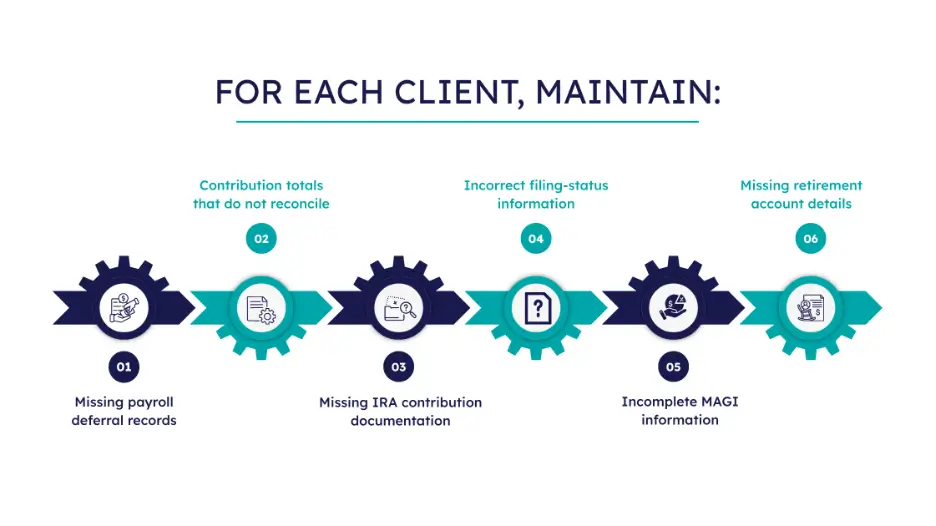
Before Form 8880-A preparation, have the following organized:
- Filing status and taxpayer information
- 2027 MAGI information
- Qualified contribution totals
- Payroll and retirement plan records
- IRA contribution documentation
- Retirement account details
- Supporting statements and confirmations
Good Form 8880-A preparation starts with clean records, not with the tax software screen.
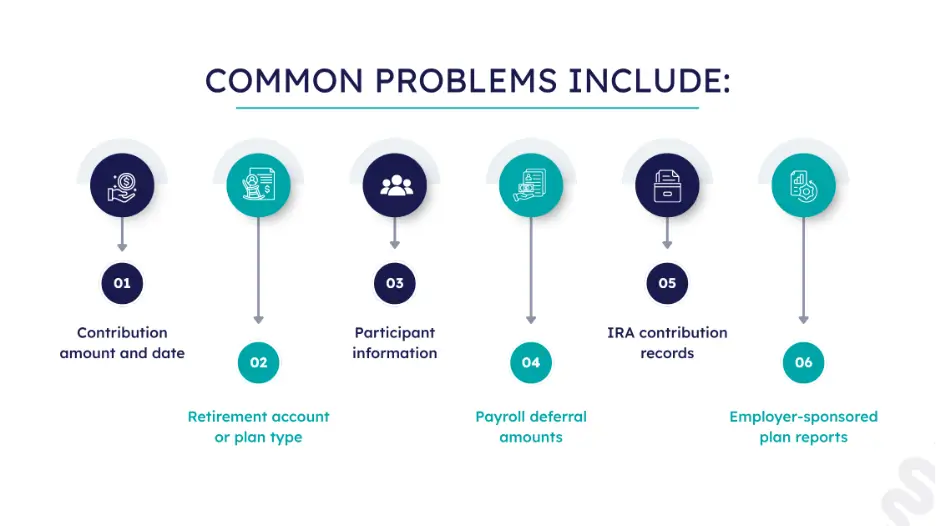
Maintaining organized accounting firm retirement match records can make these issues easier to identify. Strong accounting firm retirement match records should connect payroll, retirement-plan, IRA, and tax-return information without treating the Saver’s Match as an employer-funded benefit.
Conclusion
Accurate 2027 payroll and retirement contribution records can make 2028 tax preparation and Form 8880-A preparation much easier. By reconciling payroll deferrals, IRA contributions, and retirement plan records early, firms can reduce errors and keep client files ready for the Saver’s Match. Contact us for support with organized bookkeeping and financial records.
Frequently Asked Questions (FAQ)
1. When do accounting firms actually need Saver's Match payroll records ready?
Start organizing records before 2027 contributions begin. Keep them updated throughout 2027 for smoother 2028 tax preparation.
2. Do employ ers or payroll providers calculate and fund the Saver's Match?
No. The federal government provides the Saver’s Match. It is not an employer-funded payroll match.
3. What payroll data should firms cross-check first?
Cross-check employee deferrals, payroll year-to-date totals, and retirement plan contribution reports. Resolve any missing or mismatched transactions.
4. Why does MAGI matter if the match isn't calculated through payroll?
MAGI and filing status determine eligibility and the applicable match percentage. Payroll data should therefore be reviewed alongside tax-return information.
5. Can the Saver's Match be deposited into any retirement account a client already has?
Not necessarily. The account must meet the applicable eligibility requirements and be able to accept the Saver’s Match.
6. What should firms do differently for the 2028 filing season compared to prior years?
Include Saver’s Match records in the tax-preparation checklist. Reconcile contribution, payroll, IRA, and MAGI information before filing.

Bijal Bodiwala
Bijal Bodiwala is a Chartered Accountant with over 10 years of experience at NCSGX Australia, where he serves as AVP - Accounting & Bookkeeping. He specialises in bookkeeping, BAS and IAS, GST, payroll and STP reporting, financial reporting, and management accounts for Australian accounting firms and SMEs. With command of Australian tax frameworks and tools like Xero, MYOB, and QuickBooks Online, he has driven 50-70% reductions in operating costs for top firms, delivering scalable, partner-ready solutions.
All Posts