
 USA
USA
 Canada
 Australia

Introduction
Many U.S. small businesses, freelancers, and gig workers now receive payments through platforms such as PayPal, Venmo, Stripe, Etsy, Uber, and DoorDash. A consistent 1099-K bookkeeping checklist helps ensure these payments are recorded correctly, especially as the current 1099-K reporting threshold small business rules make monthly reconciliation more important than ever.
As highlighted by NCSGX, accurate bookkeeping is essential for reliable financial reporting and tax compliance. Rather than waiting until year-end, business owners should reconcile 1099-K with bookkeeping records each month to support small business income reconciliation and maintain year-round bookkeeping for gig and side income.
Key Takeaways
- A monthly bookkeeping checklist small business owners can follow reduces errors, supports better small business income reconciliation, and makes it easier to reconcile 1099-K with bookkeeping records.
- The IRS says Form 1099-K is a gross payment report, so platform totals can include fees, refunds, and other amounts that are not the same as taxable income.
- The 1099-K reporting threshold small business owners should understand is tied to payments for goods or services through payment apps and marketplaces, and the IRS has lowered thresholds from older rules in recent years.
- Year-round bookkeeping for gig and side income helps you keep payment app activity, bank deposits, and accounting records aligned before year-end.
- Businesses using QuickBooks, Xero, or similar systems should reconcile 1099-K with bookkeeping records every month to catch mismatches early.
A Monthly Bookkeeping Checklist for Small Business Owners Under the New 1099-K Rules
A 1099-K bookkeeping checklist helps small business owners stay organized when income flows through PayPal, Venmo, Stripe, Etsy, Uber, DoorDash, and other payment platforms. With the 1099-K reporting threshold small business rules still reshaped by recent IRS changes, monthly reconciliation matters more than ever for accurate books and cleaner tax filing.
Many U.S. businesses, freelancers, and gig workers now receive payments across multiple apps and marketplaces, which makes small business income reconciliation harder than it used to be. The smartest approach is year-round bookkeeping for gig and side income, not a last-minute clean-up during tax season.
What the Current 1099-K Threshold Means for Your Books
For 2026, the IRS continues to treat Form 1099-K as a report of gross payments received for goods or services through payment cards, payment apps, and online marketplaces. Under current IRS guidance, payment app and marketplace reporting generally applies when a payee has more than $20,000 in payments and more than 200 transactions, though platforms may still issue forms below that level.
That is very different from the older, higher-visibility reporting debate that pushed many owners to assume every app payment would be fully visible to the IRS. The practical takeaway is simple: the 1099-K reporting threshold small business owners track does not remove the need to record all income, and it does not replace bookkeeping.
The Core Problem, Platform Totals Rarely Match Your Actual Income
Form 1099-K reports gross payment activity, not your net profit. That means the platform total often includes items that should be adjusted in the books, such as payment processing fees, refunds, chargebacks, and sales tax collected on behalf of the business.
This is why small business income reconciliation cannot rely on the deposit amount alone. A net bank deposit may be lower than gross sales because the platform already subtracted fees or held back amounts, while taxable income may still be based on the underlying sale, not the deposit.
| Item | 1099-K Gross Total | Bookkeeping Adjustment |
|---|---|---|
| Customer payment | $1,000 | $1,000 income |
| Platform fee | Included | Expense |
| Refund | Included | Reduce income |
| Sales tax | Included | Liability, not income |
| Net deposit | $955 | Reconciled amount |
That table is the heart of any 1099-K bookkeeping checklist because it shows why gross platform activity rarely equals final income. It also explains why you should reconcile 1099-K with bookkeeping records instead of waiting for tax season.
The Monthly Bookkeeping Checklist
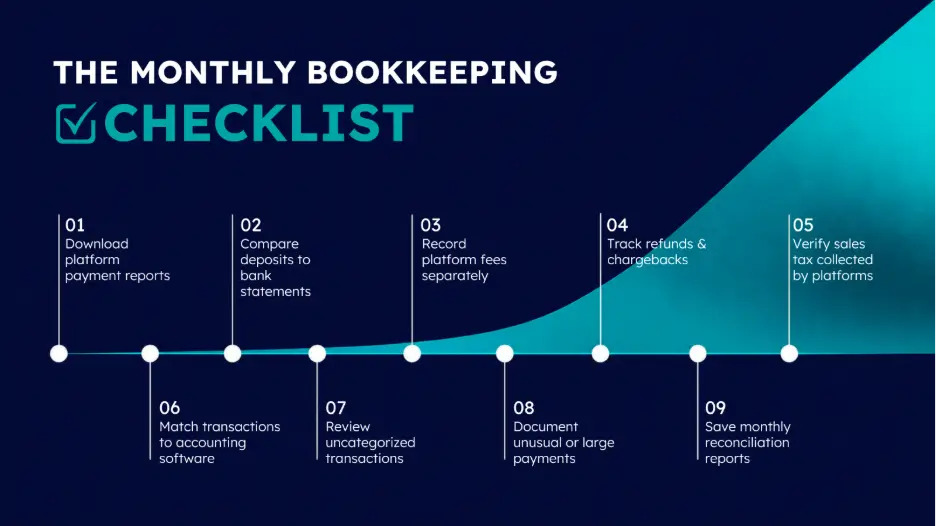
A practical monthly bookkeeping checklist small business owners can follow should include the following steps every month.
- Download platform payment reports
Export monthly reports from PayPal, Venmo, Stripe, Etsy, Uber, DoorDash, and any other payment networks you use. Save both summary and transaction-level reports.
- Compare deposits to bank statements
Match the total deposits received in your bank account to the platform reports. Identify any missing deposits, delayed transfers, or duplicate entries.
- Record platform fees separately
Processing fees should generally be recorded as a business expense rather than reducing reported sales. This improves financial reporting and tax preparation accuracy.
- Track refunds and chargebacks
Create separate bookkeeping categories for customer refunds and chargebacks. These amounts are often included in gross platform totals even though they reduce income.
- Verify sales tax collected by platforms
Many marketplaces collect and remit sales tax on behalf of sellers. Confirm that sales tax amounts are recorded as liabilities, not revenue.
- Match transactions to accounting software
Review imported transactions in QuickBooks or Xero. Ensure each deposit is linked to the correct invoice, sale, or income category.
- Review uncategorized transactions
Uncategorized items are a common source of year-end confusion. Investigate them while the transactions are still fresh.
- Document unusual or large payments
Add notes for significant transactions, one-time events, or unusual customer payments. Documentation can be valuable if questions arise later.
- Save monthly reconciliation reports
Store reconciliation reports, platform exports, and supporting documents in a secure folder. These records support year-round bookkeeping for gig and side income and make tax preparation easier.
Monthly routine that works
Following this monthly bookkeeping checklist, small business routine consistently helps reconcile 1099-K with bookkeeping records before the year-end rush.
Common Reconciliation Mistakes That Trigger IRS Mismatches
Several issues frequently create mismatches between bookkeeping records and information reported to the IRS.
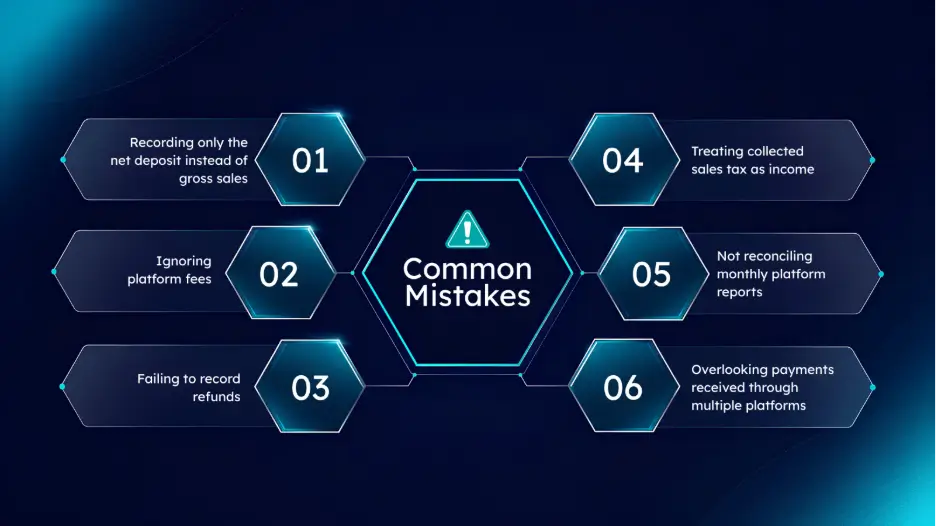
Many businesses seek professional Bookkeeping Services or cloud accounting services when platform activity becomes difficult to manage manually. Adopting real-time bookkeeping practices can also reduce the number of unreconciled transactions that build up over time.
A Simple Year-End Cross-Check Before Filing
Conclusion
A consistent 1099-K bookkeeping checklist helps reduce the risk of IRS mismatches by ensuring that platform payments, fees, refunds, and taxes are recorded correctly. The key is to reconcile 1099-K with bookkeeping records every month rather than waiting until tax season.
For most small businesses, freelancers, and gig workers, the best approach is ongoing small business income reconciliation supported by organized records and year-round bookkeeping for gig and side income. Maintaining accurate books throughout the year provides a stronger foundation for tax reporting, financial decision-making, and long-term business growth. If you need help reviewing your platform transactions or strengthening your monthly reconciliation process, Contact Us to discuss your bookkeeping needs.
How NCSGX Can Help
NCSGX helps small businesses, freelancers, and gig workers manage the bookkeeping challenges that come with receiving payments through platforms such as PayPal, Venmo, Stripe, Etsy, Uber, and DoorDash. Our team assists with reconciling platform reports, tracking processing fees and refunds, and keeping your financial records organized so that your books remain accurate throughout the year.
Whether you need help reviewing monthly transactions, identifying discrepancies between platform reports and bank deposits, or maintaining tax-ready records, we can support your reconciliation process before issues become year-end problems.
Frequently Asked Questions (FAQ)
1. Do I need to change my bookkeeping if I only get a few payments through apps like PayPal or Venmo?
Yes. Even a small number of business payments should be recorded accurately. Using a basic 1099-K bookkeeping checklist each month can help prevent missing income or incorrectly categorizing transactions.
2. Why doesn't the amount on my 1099-K match my actual business income?
Form 1099-K generally reports gross payment amounts. The total may include refunds, processing fees, sales tax, and other adjustments that do not represent taxable income, which is why you should reconcile 1099-K with bookkeeping records.
3. What happens if the amount on my 1099-K doesn't match what I report on my tax return?
A mismatch does not automatically mean an error, but it may prompt additional IRS scrutiny. Maintaining documentation and performing small business income reconciliation throughout the year can help explain legitimate differences.
4. Should I keep a separate bookkeeping process for each payment platform I use?
It is usually helpful to maintain separate reconciliation reports for each platform. This makes it easier to trace deposits, identify missing transactions, and support year-round bookkeeping for gig and side income.
5. How is the current 1099-K threshold different from previous years?
The IRS has phased in lower federal reporting thresholds compared with the older rule that many businesses were familiar with. As a result, more businesses may receive Form 1099-K, making the 1099-K reporting threshold small business issue increasingly important.
6. Do personal payments, like a friend paying me back for dinner, count toward the 1099-K threshold?
Generally, personal reimbursements are not intended to be reported as business income. However, payment platforms may request information if accounts are used for both personal and business activity, so keeping business and personal transactions separate is a good practice.

Rahul Sharma
Rahul Sharma is a Chartered Accountant with over 7+ years of experience in global accounting, bookkeeping, tax preparation, financial reporting, and compliance. At NCSGX, he leads accounting outsourcing operations, manages client engagements, and drives process improvements for international businesses. Through his writing, Rahul shares practical insights on accounting, outsourcing, taxation, and business finance, helping firms and professionals make informed financial and operational decisions.
All Posts