
 USA
USA
 Canada
 Australia

Introduction
Many business owners assume that accounting software can fully automate bookkeeping, but QuickBooks doesn’t replace a bookkeeper when it comes to financial review, judgment, and business-specific decision-making. While QuickBooks has become more automated in 2026 with features such as bank feed imports, automatic transaction categorization, invoice creation, payment tracking, and expense tracking, software still cannot fully analyze unusual transactions, verify reconciliations, or provide strategic financial insights. Accurate bookkeeping requires more than processing data. It requires reviewing the information and understanding what it means for the business.
At NCSGX, we help businesses combine modern accounting technology with professional bookkeeping expertise to maintain accurate financial records and make informed decisions. Our team works with platforms such as QuickBooks while providing the human oversight that software alone cannot deliver.
Why QuickBooks Doesn’t Replace a bookkeeper (and What It’s Missing in 2026)
Many business owners believe accounting software can fully automate bookkeeping, but QuickBooks doesn’t replace a bookkeeper even with its advanced automation features in 2026. Tools such as bank feed imports, automatic transaction categorization, invoice creation, payment tracking, and expense management can reduce manual work and save time.
However, software cannot fully review accuracy, analyze unusual transactions, reconcile accounts correctly, or provide business-specific financial insight. For many small and medium-sized businesses, the most effective approach is combining QuickBooks with professional bookkeeping expertise to maintain accurate records and make better financial decisions.
Key Takeaways
- QuickBooks doesn’t replace a bookkeeper because software can process transactions, but it cannot fully review accuracy, investigate unusual activity, or provide business-specific financial insight.
- QuickBooks limitations become more noticeable as a business grows, especially with payroll, sales tax, reconciliations, and month-end financial review.
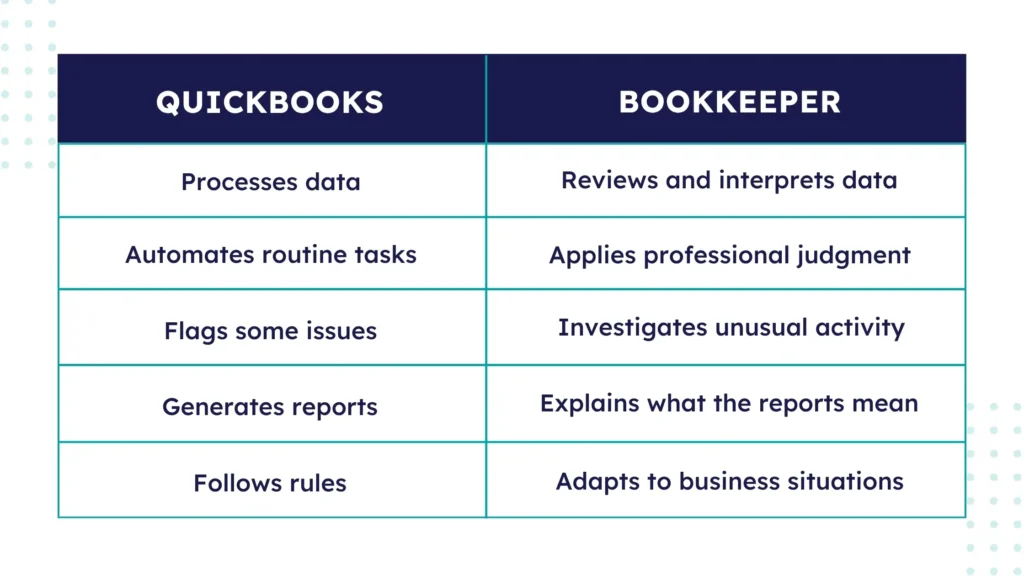
- The QuickBooks vs bookkeeper comparison shows that QuickBooks automates routine tasks, while a bookkeeper applies professional judgment and explains what financial reports mean.
- Questions such as Can QuickBooks replace a bookkeeper depend on the complexity of the business, transaction volume, and whether someone is reviewing the records regularly.
- Bookkeeping automation limitations and automated accounting software limitations mean that the strongest bookkeeping setup in 2026 is often QuickBooks combined with professional bookkeeping expertise.
Why QuickBooks Doesn’t Replace a bookkeeper (and What It’s Missing in 2026)
Many business owners believe accounting software can fully automate bookkeeping, but QuickBooks doesn’t replace a bookkeeper even with its advanced automation features in 2026. Tools such as bank feed imports, automatic transaction categorization, invoice creation, payment tracking, and expense management can reduce manual work and save time.
However, software cannot fully review accuracy, analyze unusual transactions, reconcile accounts correctly, or provide business-specific financial insight. For many small and medium-sized businesses, the most effective approach is combining QuickBooks with professional bookkeeping expertise to maintain accurate records and make better financial decisions.
QuickBooks Has Changed Bookkeeping, But It Does Not Perform Every Bookkeeping Task
QuickBooks has transformed how businesses manage their finances. Intuit continues to add automation features that make routine bookkeeping faster than ever.
Today, QuickBooks can:
- Import bank and credit card transactions automatically
- Suggest transaction categories
- Create and send invoices
- Track customer payments
- Monitor business expenses
- Generate standard financial reports
These improvements reduce data entry and improve efficiency. But they also highlight the QuickBooks limitations that appear when businesses need review, analysis, or judgment.
What QuickBooks Can Do Without a Bookkeeper
For straightforward businesses, QuickBooks can handle many day-to-day tasks.
QuickBooks can handle
- Automation
- Bank feed imports
- Automatic transaction categorization
- Invoice creation and payment tracking
- Expense tracking
- Basic payroll calculations
- Standard financial reports
For a very small business with few transactions, these features may cover much of the monthly bookkeeping work. This is why some owners ask, Can QuickBooks replace a bookkeeper for their specific situation.
The answer depends on how simple the business truly is and whether someone is reviewing the results.
What QuickBooks Cannot Do Like a Human Bookkeeper
Automation works best when transactions follow predictable patterns. Problems arise when exceptions occur.
A human bookkeeper can:
- Review reconciliations for accuracy
- Investigate missing or duplicate transactions
- Analyze unusual expenses
- Identify potential coding errors
- Review payroll for compliance issues
- Verify sales tax treatment
- Perform a month-end financial review
- Provide cash flow insights
- Recommend business-specific accounting treatment
These are examples of bookkeeping automation limitations that software alone cannot fully overcome. Businesses that need help with reconciliations, payroll oversight, and month-end reviews often benefit from professional Bookkeeping Services that combine QuickBooks automation with human financial review.
QuickBooks vs Bookkeeper: The Real Difference
The easiest way to understand the QuickBooks vs bookkeeper debate is to compare what each one actually does.
Lorem ipsum dolor sit amet, consectetur adipiscing elit. Ut elit tellus, luctus nec ullamcorper mattis, pulvinar dapibus leo.
Why Human Bookkeeping Expertise Still Matters in 2026
In 2026, bookkeeping is no longer just data entry. Much of that work has been automated.
What still requires expertise is:
- Interpreting financial trends
- Identifying risks
- Correcting errors before tax filing
- Preparing clean records for accountants
- Understanding industry-specific transactions
- Helping owners make informed decisions
Accurate bookkeeping is also essential for tax compliance. The IRS requires businesses to maintain records that support income, expenses, and deductions, which is why reconciliation review and error detection remain important even when software is highly automated.
Common Problems Businesses Face When They Depend Only on QuickBooks
Businesses that rely entirely on software often encounter recurring issues.
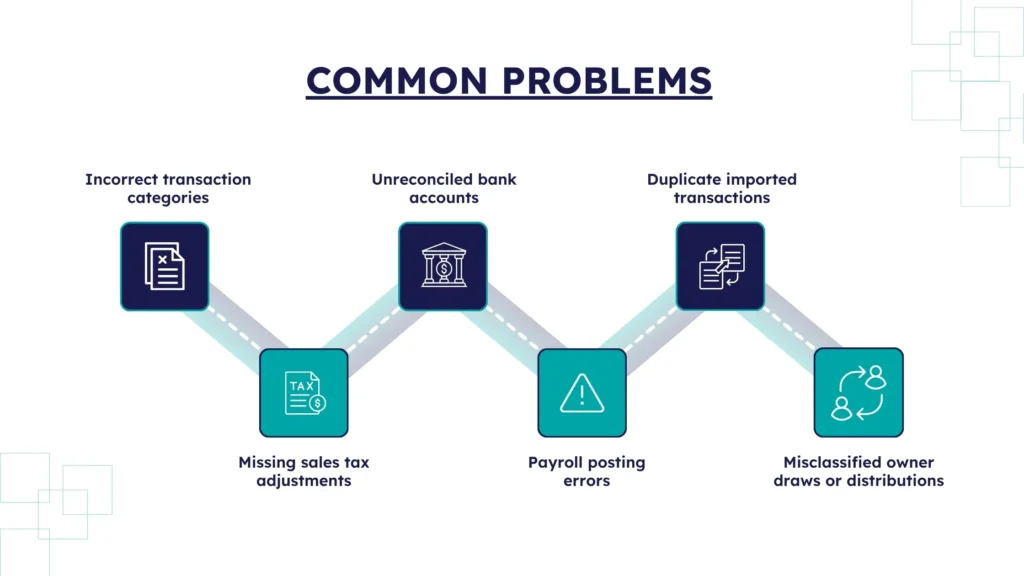
These problems illustrate the QuickBooks limitations that are not always obvious until month-end or tax season. Many of these issues can be identified earlier through regular Accounting and Financial Reporting Services, which help businesses review reconciliations, payroll entries, and month-end financial statements.
When QuickBooks May Be Enough Without a Bookkeeper
QuickBooks may be sufficient if your business has:
- Very few monthly transactions
- One owner
- No employees
- No inventory
- Simple sales tax requirements
- Strong personal accounting knowledge
In these situations, the question Can QuickBooks replace a bookkeeper may have a temporary yes for some business owners.
When Your Business Needs Bookkeeping Expertise Alongside QuickBooks
Most growing businesses benefit from both software and professional oversight.
Consider working with a bookkeeper if you have:
- Employees or contractors
- Inventory
- Multiple bank or credit card accounts
- High transaction volume
- Sales in multiple states
- Complex payroll
- Loan financing
- Regular financial reporting needs
- Plans for business growth
This is where the QuickBooks vs bookkeeper comparison becomes less about replacement and more about combining strengths. Businesses with employees, multi-state sales, or complex payroll requirements may also benefit from dedicated Payroll Processing Services to improving compliance and reducing reporting errors. The IRS has specific rules for payroll tax deposits and reporting, making professional oversight valuable as a business grows.
The Future of Bookkeeping Is QuickBooks Plus Human Expertise
The bookkeeping industry is moving toward collaboration between technology and professionals.
QuickBooks handles repetitive processing efficiently. Bookkeepers focus on review, analysis, problem-solving, and business guidance.
As automation improves, the value of human expertise becomes concentrated in areas that software struggles with:
- Judgment
- Context
- Communication
- Exception handling
- Strategic financial insight
These remain significant bookkeeping automation limitations and automated accounting software limitations that businesses should not ignore.
Conclusion
QuickBooks doesn’t replace a bookkeeper because software cannot fully replicate human judgment, financial review, error investigation, and business insight. Even with advanced automation in 2026, QuickBooks still has limitations when transactions become complex or unusual, making human oversight essential for accurate bookkeeping.
For many businesses, the most effective approach is combining QuickBooks with professional bookkeeping expertise. Automation handles routine processing, while a skilled bookkeeper ensures accuracy and provides meaningful financial insights. If you need reliable bookkeeping support and clearer financial visibility, contact our team to learn how we can support your business.
How NCSGX Can Help
At NCSGX, we help businesses get the best of both worlds: the efficiency of QuickBooks and the accuracy of professional bookkeeping expertise. Our team reviews reconciliations, identifies errors, monitors payroll and sales tax records, and provides clear financial insights that software alone cannot deliver.
Whether you already use QuickBooks or are looking to improve your bookkeeping process, we can help you maintain accurate books, reduce reporting mistakes, and gain better visibility into your business finances.
Frequently Asked Questions (FAQ)
Can QuickBooks completely replace a bookkeeper
No. QuickBooks can automate many routine tasks, but it cannot fully replace professional review, judgment, reconciliation analysis, and business-specific accounting decisions. Most growing businesses still benefit from human bookkeeping oversight.
What are the biggest limitations of QuickBooks?
The biggest QuickBooks limitations include limited judgment, inability to fully investigate unusual transactions, potential categorization errors, and lack of strategic financial insight. Software can process data, but it does not understand business context the way an experienced bookkeeper does.
Is QuickBooks enough for a small business?
For a very small business with few transactions and simple operations, QuickBooks may be enough for day-to-day bookkeeping. However, periodic professional review can help identify errors before they become larger financial or tax issues.
Do bookkeepers still matter with AI accounting tools?
Yes. AI accounting tools have reduced manual data entry, but bookkeepers still provide reconciliation review, error detection, cash flow analysis, payroll oversight, and interpretation of financial reports. Their role has evolved rather than disappeared.
Should I use QuickBooks with a bookkeeper?
For many businesses, this is the strongest approach. QuickBooks improves efficiency through automation, while a bookkeeper ensures accuracy, reviews exceptions, and helps translate financial data into useful business decisions.

Rahul Sharma
Rahul Sharma is a Chartered Accountant with over 7+ years of experience in global accounting, bookkeeping, tax preparation, financial reporting, and compliance. At NCSGX, he leads accounting outsourcing operations, manages client engagements, and drives process improvements for international businesses. Through his writing, Rahul shares practical insights on accounting, outsourcing, taxation, and business finance, helping firms and professionals make informed financial and operational decisions.
All Posts