

 USA
USA
 Canada
 Australia

SMSF loan file requirements changed on 10 August 2026 when the new limited recourse borrowing arrangement (LRBA) rules commenced. For brokers and support teams, the key issue is not simply when a file was opened. Each file must clearly show whether the transaction is protected under the earlier rules or meets the current property requirements.
This makes accurate dates, supporting evidence and file notes more important than ever. A binding property contract entered into before the commencement date may receive transitional protection even if settlement occurs later. However, an enquiry, pre-approval or draft application alone does not provide the same protection.
For brokerages reviewing applications already in their pipeline, NCSGX can help organise supporting documents, identify missing information and maintain clear file records. This allows brokers to focus on confirming eligibility with lenders and the client’s legal or tax advisers while keeping applications moving.
As the change was introduced through an amendment to the government’s original legislation, every application should be checked against current ATO guidance, legislation and lender policy before submission.
Why SMSF Loan File Requirements Now Need a Date Check
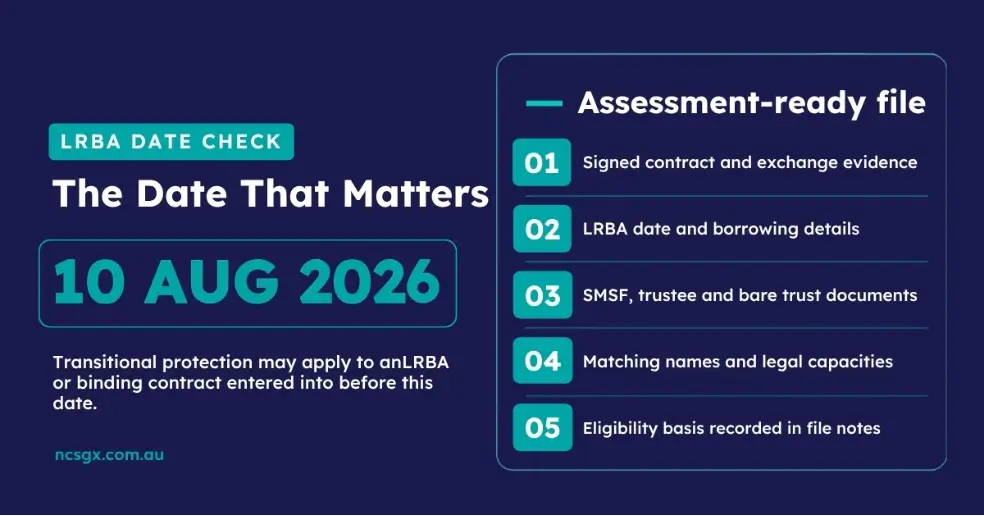
Before the change, dates were mainly part of the transaction history. They now help determine whether a file can rely on transitional protection. Transitional protection may apply where the SMSF entered into an LRBA or a binding property acquisition contract before 10 August 2026. Settlement may occur after that date.
Record the date source as well as the date itself. A signed contract, exchange confirmation or executed arrangement carries more weight than an email saying the matter was underway. This small discipline can prevent a file being packaged on the wrong eligibility basis, which is where structured loan file review processes add the most value.
What the SMSF Property Borrowing Ban Actually Stops and What It Does Not
For arrangements entered into from 10 August 2026, an LRBA can only be used to acquire real property that meets the legal definition of business real property. In practical terms, a new SMSF residential property borrowing file will generally not proceed under the LRBA exception.
The change does not cancel an existing LRBA. It also preserves qualifying refinances and acquisitions made under arrangements entered into before commencement. An SMSF may still buy residential property without borrowing, but that is a property-purchase matter rather than a new loan file, one that should still align with the fund’s documented SMSF investment strategy rather than being treated as a standalone transaction
Lenders have moved quickly in response, several withdrew or tightened SMSF residential lending products as soon as the change was announced, well ahead of commencement, which is part of why a lender’s stated policy needs checking on every file rather than assumed from an earlier matter.
Loan Files Already in Progress: What Qualifies for Grandfathering?
The strongest evidence is a borrowing arrangement entered into before 10 August 2026 or a binding property contract exchanged before that date. A protected contract can settle later, and the related LRBA may also be entered into after commencement.
A fact-find, servicing calculation, indicative approval, property search or bare trust draft does not by itself prove that the transitional rule applies. For grandfathered SMSF loans, retain evidence showing the date and legal status of the relevant arrangement.
Evidence to Place on a Grandfathered File
- Fully signed and dated contract of sale, including the exchange record
- Legal confirmation that the contract was binding before 10 August 2026
- Loan application, approval and correspondence showing the borrowing timeline
- SMSF and trustee documents current at the time of application
- Bare trust deed and custodian details where required
- Clear file notes stating which transitional protection is being relied on
What Stays the Same for Existing LRBA Compliance Files
Existing LRBA compliance has not disappeared. The fund, trustee and holding-trust structure still need to match the lender’s requirements. The single acquirable asset rules, trust execution, property title, servicing, valuation and insurance checks remain part of a sound file.
A bare trust loan file should still show that the correct entity is acquiring and holding the asset. Names must match across the contract, trust deed, loan documents and supporting identification. State requirements and lender policies can differ, so use the lender’s current checklist rather than a saved version from an earlier matter.
Loan File Checklist Changes: Before vs After 10 August 2026
| Before 10 August 2026 | From 10 August 2026 |
| Residential or business real property could be considered under an LRBA. | A new real-property LRBA must meet the business real property test. |
| Arrangement and contract dates formed part of the normal file history. | Dates determine whether transitional protection may apply. |
| Existing facility documents supported a refinance application. | Exchange evidence is critical when relying on a pre-10 August contract. |
The Biggest Documentation Risk in SMSF Loan Files
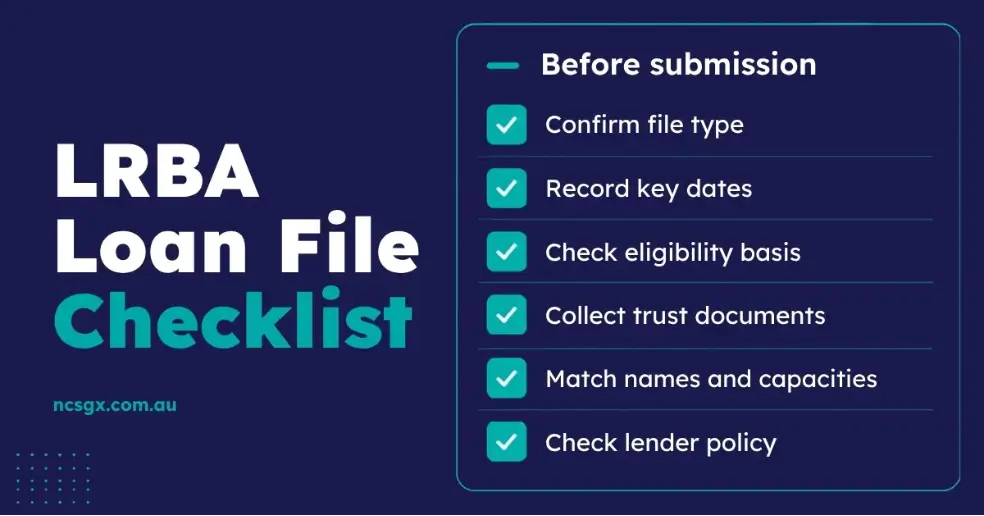
The biggest risk is assuming that ‘work started before 10 August’ equals grandfathering. It does not. A file may have months of broker work behind it yet still lack the binding contract or pre-commencement arrangement needed for protection.
Make the eligibility decision visible. A reviewer should be able to open the file and quickly see the key dates, supporting documents, lender position and any legal confirmation. If that story is unclear, the file is not ready to submit.
Conclusion
SMSF loan file requirements changed on 10 August 2026 when the new limited recourse borrowing arrangement (LRBA) rules commenced. Brokers must now show whether each transaction is protected under the earlier rules or meets the current property requirements.
Accurate dates, supporting evidence and clear file notes are essential. A binding contract entered into before commencement may be protected, while an enquiry or pre-approval alone is not enough.
For applications already in the pipeline, NCSGX can help organise documents, identify missing information and keep loan files moving efficiently.
How NCSGX Can Help
NCSGX Australia provides outsourced SMSF administration and back-office support to help accounting firms manage their ongoing workload. Our teams assist with file preparation, contribution and pension reconciliations, valuation evidence and record organisation, helping ensure each fund is ready for review, audit and lodgement.
NCSGX focuses on administration and operational support, while accountants and independent auditors retain their professional responsibilities. This clear division of roles helps make the process more efficient for everyone involved.
To discuss how we can support your SMSF administration workflow, contact the NCSGX team.
Frequently Asked Questions (FAQ)
1. Does the ban affect an SMSF loan file that settled before 10 August 2026?
Generally, no. An LRBA entered into before 10 August 2026 remains protected, provided the file contains documents confirming when the arrangement was established.
2. A contract was exchanged before 10 August but has not settled. Is it eligible?
It may receive transitional protection if the property acquisition contract became binding before 10 August 2026. Keep the signed contract and evidence confirming the binding date on file.
3. Can a borrower refinance an existing SMSF residential LRBA?
A qualifying refinance of a protected LRBA may proceed after the changes. The new facility should relate to the same property and clearly connect to the original borrowing arrangement.
4. Can an SMSF purchase residential property with cash after the changes?
Yes, an SMSF may still purchase residential property without borrowing, subject to the usual superannuation rules. As no LRBA is involved, it would not be treated as an SMSF loan file.
5. Do the changes apply to commercial or business real property loans?
New LRBAs may still be used where the property qualifies as business real property. The property must meet the relevant requirements when the LRBA begins and throughout the arrangement.