

 USA
USA
 Canada
 Australia


Introduction
Most finance leaders have heard “agentic AI” enough times by now to be suspicious of it. The term shows up in every vendor deck, usually attached to a promise that your close will run itself by the end of the year.
Strip away the marketing and there is something real underneath. Agentic AI is the first technology in a decade that changes what automation can actually do inside accounts payable and accounts receivable, rather than just doing the old thing slightly faster. That distinction matters, because it decides where you should invest attention in 2026 and where you should keep your hand firmly on the controls.
At NCSGX, we run AP and AR operations for finance teams across Australia, Canada, and the US, so we see up close where agentic AI genuinely earns its place and where it quietly introduces risk. Here is a straight read on what agentic AI in accounts payable and receivable really does, how it differs from the automation your team already runs, what to realistically expect this year, and the risks you cannot afford to wave through.
What is agentic AI, and how is it different from the automation finance teams already use?
Start with what your finance function probably already has.
Rules-based automation, usually robotic process automation (RPA), follows a script. It clicks the same buttons, copies the same fields, and moves data from one system to another exactly as programmed. It is fast and reliable right up until something changes a new invoice layout, a supplier who fills in the wrong field, a portal that moves a button. Then it breaks and waits for a human.
Generative AI, the tool most people met through chatbots, is good at understanding and producing language. It can read an invoice, draft an email, or summarize a dispute. But on its own it answers a question and stops. It does not act.
Agentic AI sits a step beyond both. An AI agent is given a goal rather than a script, “clear this invoice for payment” or “collect on this overdue account” and it works through the steps to reach that goal. It reads documents, pulls data from your ERP, checks it against policy, decides what to do next, and takes the action or escalates when it hits something it should not decide alone. Crucially, it can handle the messy variation that breaks RPA, because it reasons about each case instead of blindly repeating a pattern.
That is the real line between agentic AI vs traditional automation: traditional automation executes a fixed process, while an agent pursues an outcome and adapts the process to get there.
Why AP and AR are the first finance functions agentic AI is reaching
Agentic AI is landing in AP and AR first, and there is a good reason for it.
These functions are high-volume, rule-heavy, and full of structured decisions that a human makes hundreds of times a day: does this invoice match the purchase order, is this payment authorised, which overdue account should we chase first, does this incoming payment belong to that invoice. The logic is well defined, the data lives in systems the agent can read, and the outcome is measurable: invoices cleared, days sales outstanding reduced, cash applied.
They are also the two functions where the two big end-to-end finance cycles live. Procure-to-pay and order-to-cash automation has always been the holy grail, because those cycles touch cash, suppliers, and customers all at once. AP is the back half of procure-to-pay. AR is the back half of order-to-cash. Improve either and you improve working capital directly, which is exactly the number a CFO is judged on.
So this is not a coincidence of hype. AP and AR are where the volume, the clarity, and the cash impact all overlap the natural first stop for any technology that can act on structured decisions at scale.
What agentic AI actually does in accounts payable
Here is what agentic AI in accounts payable looks like when it is working, not in a demo.
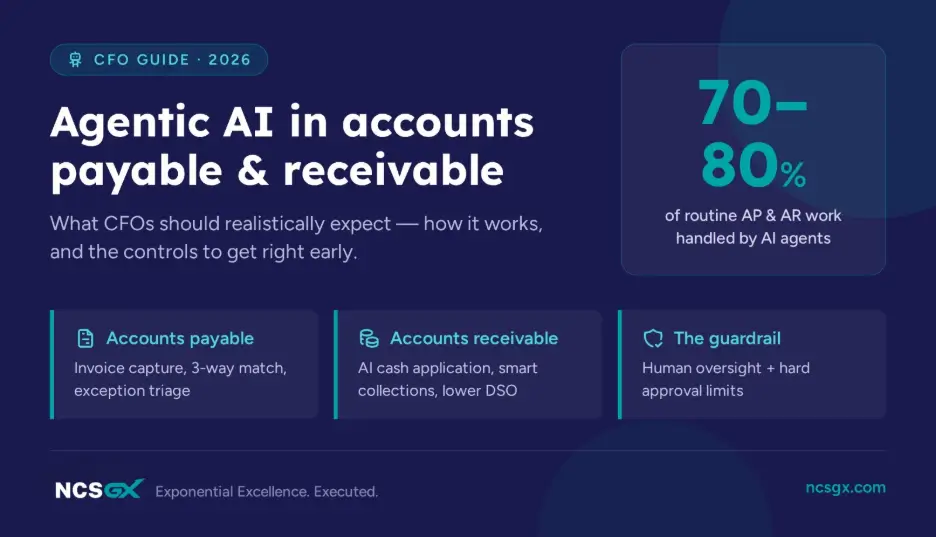
An invoice arrives via email, PDF, EDI, or supplier portal; it does not matter. The agent reads it, extracts the line items, and identifies the supplier even if the format is one it has never seen. It performs the two- or three-way match against the purchase order and goods receipt, and where everything ties out within tolerance, it codes the invoice and queues it for payment. Where it does not tie out, the agent does not just flag “exception” and walk away. It investigates: it checks whether the price variance is within an agreed threshold, whether a partial delivery explains the quantity gap, whether a duplicate already exists in the ledger. Then it either resolves the case or routes it to the right person with the discrepancy already explained.
Along the way, it watches for the things AP teams lose sleep over: duplicate invoices, suspicious bank-detail changes, invoices that do not match any PO. It can time payments to capture early-payment discounts or hold them to protect cash, within the rules you set. And it keeps a record of every decision it made and why.
The point is not that a human never touches an invoice again. The point is that the routine 70 to 80 per cent flows through with light-touch review, and your team spends its time on the exceptions, the supplier relationships, and the judgment calls, which is where they add value anyway.
Agentic AI vs. traditional RPA and AP automation – the real difference
It is worth being precise about this, because a lot of “agentic” products are RPA with a new label.
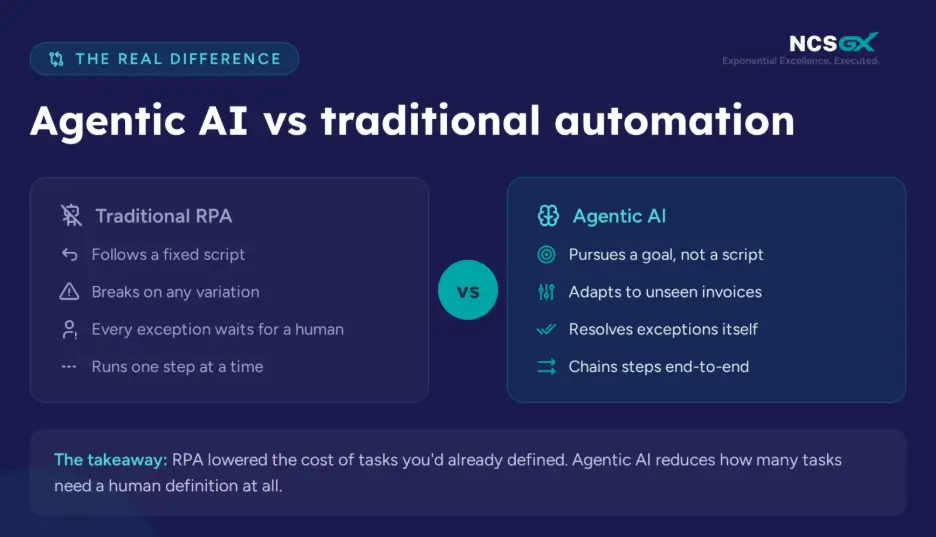
Traditional RPA and AP automation is deterministic. It works beautifully on clean, consistent inputs and fails on variation. Every exception is a handoff to a person. Every new invoice format is a change request to your automation team. The system does not learn; it does what it was built to do until you rebuild it.
Agentic AI is adaptive. It handles the invoice it has never seen because it reasons about the content rather than matching a template. It resolves the exception instead of only flagging it. It chains multiple steps toward a goal read, match, investigate, decide, act, where RPA does one step at a time in a fixed line. And it improves as it sees more of your data.
The honest framing for agentic AI vs traditional automation is this: RPA lowered the cost of the tasks you had already defined. Agentic AI reduces how many tasks need a human definition in the first place. Both have a place; plenty of stable, high-volume steps are still best served by simple RPA but they are not the same tool, and paying agentic prices for RPA capability is a common way to be disappointed.
What CFOs should realistically expect in 2026 and what’s still hype
Cutting through it, here is a grounded view of the agentic AI use cases in finance that are genuinely ready this year, and the ones still being oversold.
Realistic in 2026. Automated invoice ingestion and matching with agent-led exception handling. AI cash application clearing the large majority of receipts without a person. Collections prioritization and drafted outreach with human sign-off. Duplicate and anomaly detection running continuously. Expect meaningful reductions in cost-per-invoice and DSO, and expect your team to shift from processing to review and exception work not disappear.
Still hype. A fully autonomous AP or AR function with no humans in the loop. Agents releasing payments with no approval controls. Plug-and-play deployment that ignores the state of your master data. Any promise that the technology fixes a broken process it will automate the mess faster, not clean it up.
The useful mental model for 2026 is a capable, tireless analyst who does the first 80 percent of the work and hands you the 20 percent that needs a human. That is a real gain. It is not the same as replacing the function, and any vendor implying otherwise is selling you the 2028 slide today.
The risks and controls CFOs can’t ignore
Agentic AI acts. That is the whole value, and it is also the whole risk. An agent that can pay a supplier can pay the wrong supplier. Controls are not optional add-ons here; they are the price of letting the system act at all.
The ones that matter most:
Payment authorization. No agent should release funds without an approval control appropriate to the amount and risk. Keep segregation of duties intact the thing that initiates a payment should not be the only thing that approves it. Set hard limits and human sign-off thresholds before go-live, not after the first incident.
Fraud and manipulation. The same intelligence that spots fraud can be targeted by it: a spoofed supplier email, a manipulated bank-detail change. Bank-detail changes in particular should always require independent human verification.
Explainability and audit trail. You need to be able to answer “why did the system do that” for your auditors and for yourself. Insist on a full, reviewable decision log. If a vendor cannot show you why an agent made a call, that is a control gap, not a feature you can defer.
Data governance and accuracy. Agents act on your data. Poor master data produces confident, wrong actions. And AI can be wrong in fluent, plausible language, so amounts and vendor details still need validation, not blind trust.
Over-reliance and skills drift. If the team stops reviewing because the agent is usually right, the one time it is wrong gets expensive. Keep humans genuinely in the loop, not rubber-stamping.
None of this is a reason to stay out. It is a reason to deploy with the controls designed in from day one, and to phase autonomy up as the system earns trust starting with the agent recommending and a human approving, before you let it act on its own for low-risk, low-value cases.
How to assess whether your finance function is ready
Before you sign anything, look at your own house. Agentic AI amplifies whatever process it is dropped into, so readiness is mostly about the state of the ground it will stand on.
Ask honestly:
- Is your data clean enough to act on? Duplicate vendors, inconsistent coding, and stale customer records will surface as agent errors. Clean master data is the real prerequisite.
- Are your approval workflows actually defined? An agent can only follow rules you can state. If approvals live in people’s heads, write them down first.
- Is enough of your volume digital? Paper and scattered email attachments cap what any agent can reach.
- Does it integrate with your ERP? Value comes from the agent reading and writing where your data already lives, not from another disconnected tool.
- Do you have the oversight capacity? You need people who can review exceptions and challenge the system arguably more skill, not less.
Conclusion
Agentic AI is not the end of the finance team, and it is not the fully autonomous back office the loudest decks promise. In 2026 it is something more useful than either: a capable operator that takes on the routine 70 to 80 percent of AP and AR work, resolves a good share of the exceptions, and hands your people the judgment calls that were always The point of the job. The gains are real and measurable: lower cost per invoice, faster cash application, shorter DSO, but they land only when the process underneath is sound and the controls are built in from day one.
So the CFOs who win with this in 2026 will not be the ones who move fastest or spend the most. They will be the ones who get their data and workflows clean, deploy with human oversight and hard approval limits, and scale autonomy as the system earns trust rather than on a vendor’s timeline. Start narrow, prove it on one process, keep your hand on the controls, and widen from there. That is the unglamorous path, and it is the one that actually pays. If you are mapping where agentic AI fits in your 2026 finance plan, connect with the NCSGX team to see where a human-plus-agent model would genuinely pay off in your AP and AR.
How NCSGX can help
If most of those are shaky, the right first move is not a bigger AI project. It is getting the process and data in order; often the fastest standardizer is a finance partner who standardizes the back office first, then layers the technology on a clean foundation.
That is where NCSGX works with finance leaders: running AP and AR operations with the controls, structured data, and human oversight that make agentic AI safe to adopt, rather than automating a mess and calling it transformation. If you are weighing where agentic AI fits in your 2026 plan, the practical starting point is a review of how your procure-to-pay and order-to-cash processes run today, and where a human-plus-agent model would actually pay off.
Frequently Asked Questions (FAQ)
1. Will agentic AI replace AP/AR staff?
No, not in 2026, and not in the way the headlines suggest. It takes over the routine, high-volume processing and handles the first pass on exceptions, which shifts your team’s work toward review, judgment, supplier and customer relationships, and oversight of the system itself. Roles change, and the balance of skills rises; the function does not vanish. Teams that treat it as augmentation get the value. Teams that treat it as pure headcount reduction tend to remove the oversight they most need.
2. How is it different from RPA?
RPA follows a fixed script and breaks on anything it was not built for, handing every exception to a person. Agentic AI is given a goal and works out the steps, so it handles variation, resolves exceptions instead of only flagging them, and chains multiple actions together. RPA lowered the cost of tasks you had already defined; agentic AI reduces how many tasks need a human definition at all. Both are useful, but paying for one expecting the other is a common and expensive mistake.
3. Is it safe for payment approvals?
Only with the right controls, and those controls are non-negotiable. Keep segregation of duties intact, set value thresholds that require human sign-off, verify any bank-detail change independently of the agent, and insist on a full audit trail for every decision. Phase autonomy up over time: start with the agent recommending and a human approving, and only let it act unattended on low-risk, low-value cases once it has earned that trust. Deployed that way, it is safe. Deployed as “let the AI pay everyone,” it is not.
4. What does a realistic 2026 rollout look like?
Narrow and phased, not big-bang. Pick one process: invoice matching or cash application is a common first choice. Clean the underlying data, define the rules and approval thresholds, and run the agent alongside your team with a human approving its actions. Measure against clear metrics such as cost-per-invoice, exception rate, and DSO. Once it is proven and the controls hold, widen the scope and lift the level of autonomy for the lowest-risk cases. Expect a few months to see real value on a first process, not a few days and expect the payoff to be a leaner, faster function with your people focused on the work that needs judgment.

Bijal Bodiwala
Bijal Bodiwala is a Chartered Accountant with over 10 years of experience at NCSGX Australia, where he serves as AVP - Accounting & Bookkeeping. He specialises in bookkeeping, BAS and IAS, GST, payroll and STP reporting, financial reporting, and management accounts for Australian accounting firms and SMEs. With command of Australian tax frameworks and tools like Xero, MYOB, and QuickBooks Online, he has driven 50-70% reductions in operating costs for top firms, delivering scalable, partner-ready solutions.
All Posts