

 USA
USA
 Canada
 Australia


Most finance leaders heading into 2026 are not short on work. They are short on people to do it. Hiring a qualified controller now takes months, the accountants already on the team are stretched across the close, reconciliations, and reporting, and the month-end keeps arriving on schedule regardless. When the gap finally must be filled, the choice usually narrows to three paths: build vs buy vs outsource accounting capacity.
This NCSGX guide walks through what each option involves, what it costs you in time and money, and a simple framework for picking the right one for where your business sits today.
What is the controller and accountant gap?
The gap is the distance between the finance work a business needs done and the qualified people available to do it. It shows up in two layers, which is why the controller vs accountant distinction matters when you start solving it.
Accountants keep the engine running: data entry, reconciliations, accounts payable and receivable, payroll processing, and the day-to-day ledger work.
Controllers sit above that: owning the close, enforcing controls, producing management reporting, and making sure the numbers are accurate and on time.
When either layer is understaffed, the symptoms are familiar. The close slips past day ten. Reconciliations pile up. Reporting goes out late or with errors. Your most experienced person spends their week doing work two levels below their pay grade. The gap is rarely about effort. It is about capacity and the right mix of skills.
Why is it so hard to fill accounting roles in 2026?
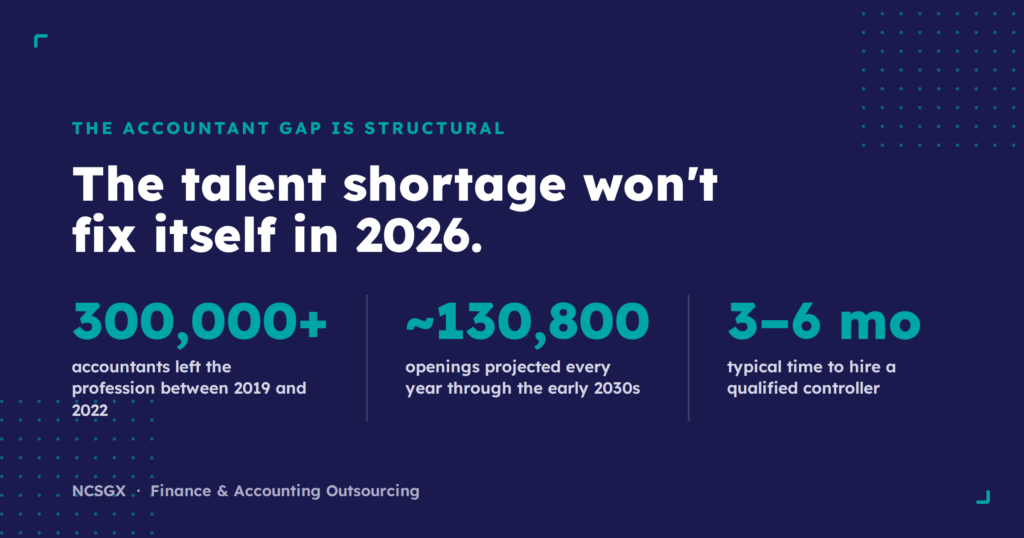
The short answer is that the accounting talent shortage has been building for years and is now structural, not seasonal. A few numbers explain the squeeze. The U.S. Bureau of Labor Statistics projects roughly 130,800 openings for accountants and auditors every year through the early 2030s, with most of those created by retirements and people leaving the profession altogether. Widely reported analysis of federal labour data found that more than 300,000 accountants and auditors left their roles between 2019 and 2022, a drop of around 17%. At the same time, the AICPA has tracked a multi-year decline in the number of students graduating with accounting degrees, so fewer people are coming in to replace those walking out. For an individual business, that pipeline problem turns into:- Longer time-to-hire, often three to six months for a controller.
- Higher salary expectations as firms compete for a shrinking pool.
- More turnover, because good accountants get poached.
- Pressure on the people who stay, which feeds the cycle.
Option 1 – Build: hire and develop an in-house team
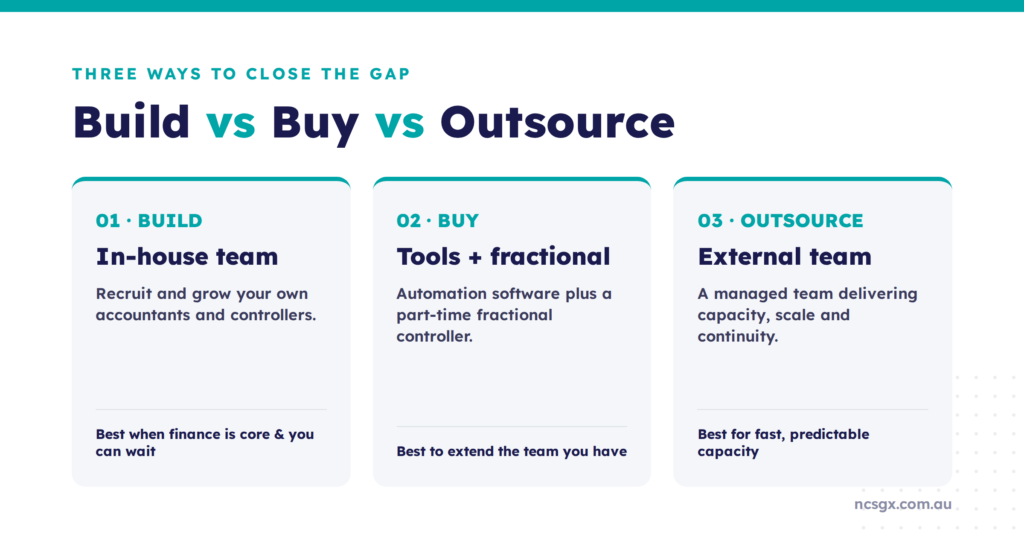
Building means recruiting accountants and controllers onto your own payroll and growing the function from the inside. It is the right move when finance is core to how you compete, when you need people physically in the building, or when the work is too sensitive or bespoke to sit anywhere else. An in-house team also gives you the deepest institutional knowledge over time. The trade-offs are real, though:- Time. Months to hire, then more months to onboard before someone is fully productive.
- Cost. Salary is only part of it. Add benefits, recruitment fees, software seats, training, and the cost of management attention.
- Single points of failure. When your one controller resigns or goes on leave, the gap reopens overnight.
Option 2 – Buy: automation tools and fractional talent
“Buy” covers everything you can purchase off the shelf to cover the gap without a full-time hire. Two levers dominate here. The first is accounting for automation software, tools that handle bank feeds, automated reconciliations, invoice capture, expense management, and approval of workflows. Good automation removes a large share of the manual, repetitive work that eats an accountant week and is the single fastest way to give your existing team room to breathe. The second is the fractional controller: an experienced controller you engage part-time, often a few days a month, to own the close, tighten controls, and produce reporting. It gives you senior capability without a senior salary, and it is well suited to a growing business that has outgrown bookkeeping but cannot yet justify a full-time controller. Where “buy” falls short:- Automation needs clean processes and someone to configure and maintain it. Software does not run itself.
- Fractional talent is part-time by definition, so it does not solve a volume problem, only a seniority one.
- Stitching several tools and contractors together can create its own coordination overhead.
Option 3 – Outsource: an external finance team
Outsourcing means handing out a defined scope of finance operations to an external provider who runs it for you, under your direction, as a managed service. A modern outsourced accounting engagement is not the off-shore data-entry shop of a decade ago. With a provider that operates across multiple delivery centres, you get a trained team handling reconciliations, accounts payable and receivable, payroll processing, the month-end close, and management reporting preparation, with built-in cover so no single person leaving reopens the gap. The advantages stack up where build and buy struggle:- Speed. Capacity in weeks, not the months a hire takes.
- Scale. Add or reduce volume as your business changes, without a hiring or redundancy cycle.
- Continuity. A team rather than an individual, so leave and turnover are absorbed by the provider.
- Predictable cost. A defined monthly fee instead of fully loaded salaries plus on costs.
How to choose: a simple decision framework
There is no single right answer. The right path depends on urgency, budget, and how core the work is. This table is a quick way to narrow it down.
| If your situation is… | The strongest option is usually… |
| Finance is core and you can wait 3–6 months | Build an in-house team |
| Existing team is good but drowning in manual work | Buy automation software |
| You need senior oversight but not full-time | Buy a fractional controller |
| You need volume capacity fast and predictable cost | Outsource an external finance team |
| You are scaling quickly and volumes keep shifting | Outsource, then build selectively later |
Most businesses do not pick one and stop. A common pattern is to buy automation to clean up the basics, outsource the high-volume processing, and build a small senior in-house layer to own strategy and relationships. The framework is a starting point, not a cage.
Common mistakes when closing the gap
A few errors show up again and again:
- Hiring to fix a process problem. If the close is messy, another headcount just gives you a faster mess. Fix the process first.
- Buying software without owning it. Automation that nobody configures or maintains becomes shelfware within a quarter.
- Outsourcing without clean scope. Vague boundaries create rework and finger-pointing. Define exactly what sits where.
- Treating it as one big decision. You can pilot a single process, learn, and expand. You do not have to move the whole function at once.
- Waiting for the market to ease. The talent shortage is structural. The gap will not close on its own.
Conclusion
The build vs buy vs outsource accounting decision is really a question about time, money, and how core the work is to your business. Build when you have the runway and finance is your edge. Buy when you need to extend the team you already have. Outsource when you need reliable capacity quickly, at a predictable cost, without carrying the hiring and retention burden yourself. For most businesses in 2026, the answer is a blend, sequenced to where you are right now.
If you would like to map your own finance operations against these three paths, talk to the NCSGX team about where a managed model fits.
How NCSGX can help
NCSGX runs finance and accounting operations for businesses and professional firms across our global delivery centres in Australia, Canada, the United States, India, and the Philippines. We administer the work; we never advise it.
That means trained teams handling your reconciliations, accounts payable and receivable, payroll processing, month-end close, and management reporting preparation, executed under your direction and your controls, with built-in cover so a single departure never reopens the gap. You keep ownership of the numbers and the decisions. We provide the operational capacity behind them.
If you are weighing build vs buy vs outsource for your own finance team, explore our outsourced finance and accounting services or learn more about our global delivery model. When you are ready, get in touch and we will scope a model that fits where your business is today.
Frequently asked questions (FAQ)
1. Is outsourcing cheaper than hiring an accountant?
Often, yes, once you compare the full picture. A salary is only part of an in-house cost; you also carry benefits, recruitment, software, training, and management time. An outsourced engagement bundles trained capacity and cover into a defined monthly fee. The right comparison is total cost of the function, not salary against invoice.
2. When should a company hire a controller?
When the volume and complexity of the work need full-time senior ownership, the close requires daily oversight, or finance is central enough to your business that the knowledge should live in-house. If you only need senior oversight a few days a month, a fractional controller usually makes more sense first.
3. Can automation replace an accountant?
No, but it changes what they spend their time on. Accounting automation software handles repetitive, rules-based work such as reconciliations and invoice capture, which frees skilled people for review, controls, and analysis. Automation removes tasks, not the judgement an accountant brings.
Utsavi Bhatia
Utsavi Bhatia is a seasoned financial services professional serving as AVP - Paraplanning at NCSGX. She specialises in delivering high-quality paraplanning support to financial advisers and planning firms across Australia, covering Statement of Advice (SOA) preparation, portfolio analysis, research, and risk profiling. With a strong grasp of the Australian financial planning landscape and platforms like Xplan and Midwinter, she helps advisory businesses streamline back-office operations and reduce turnaround times significantly. Utsavi has supported numerous practices in scaling their service capability without adding overhead, making her a trusted partner to some of Australia's leading financial advice businesses
All Posts