
 USA
USA
 Canada
 Australia

Canadian businesses have adopted automation faster than most regions in North America. Tools that once took hours to code transactions, reconcile bank feeds, and chase receipts now finish the work in minutes. But here is the quiet problem few software vendors mention: a proper AI bookkeeping review is still essential, and skipping it can cost a company far more than the software ever saves.
Technology is impressive. It is also imperfect. Machine learning models make confident decisions on incomplete information, miscode transactions that share keywords, and replicate small errors at a speed no human bookkeeper could match. The CRA does not accept “the software did it” as a defence during an audit. Make it easier and better with NCSGX.
Why AI Bookkeeping Is Growing So Quickly
The shift is hard to ignore. Cloud platforms like QuickBooks Online and Xero have built machine learning into their core workflows. Recent Xero industry research shows automation now handles a meaningful share of transaction coding for Canadian small businesses and BDC Canada has tracked sharp digital adoption among Canadian SMEs since 2020, with finance functions among the most automated.
Three forces drive the curve:
- Cost pressure on in-house finance teams
- Easier access to bank feeds and OCR receipt capture
- Owner-operators wanting real-time cash flow visibility
The promise is real. A founder can open an app on Monday morning and see Friday’s transactions already categorized. That ease creates a false sense of completeness, and that is where trouble starts.
Key Takeaways
- AI bookkeeping tools speed up data entry but introduce errors that look correct on the surface.
- Human review bookkeeping remains the most reliable safeguard against compliance gaps and audit exposure.
- A structured AI bookkeeping review should cover reconciliation, exception review, and tax coding verification.
- Canadian SMEs that pair automation with skilled oversight see fewer year-end surprises.
- Outsourcing bookkeeping oversight is often more cost-efficient than building review capacity in-house.
Where AI Bookkeeping Systems Commonly Make Mistakes
Most bookkeeping automation errors fall into predictable patterns. The software is not careless. It is just optimizing speed, not context. Here is a snapshot of the most common AI bookkeeping mistakes we see during clean-up engagements:
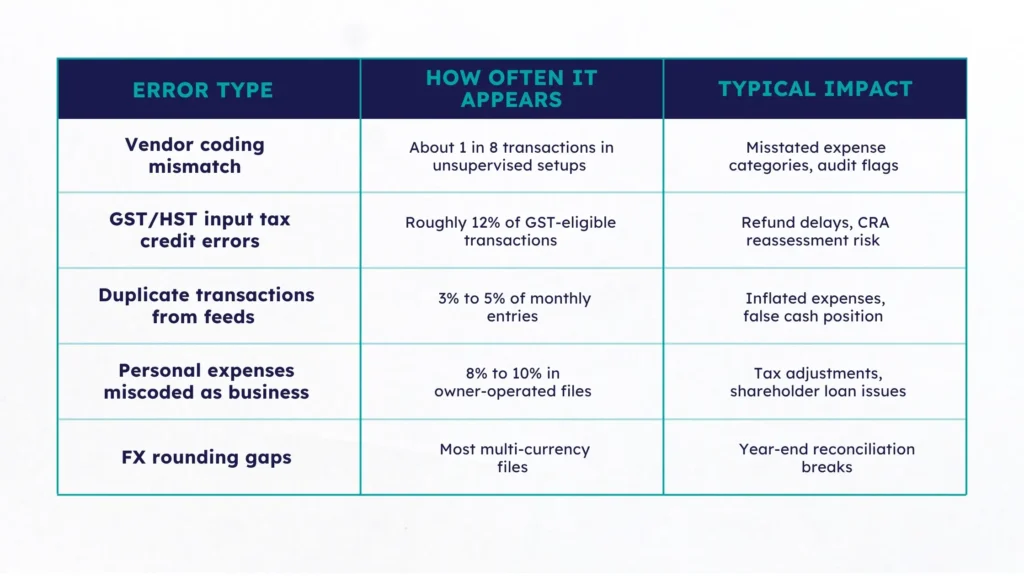
Sources: NCSGX clean-up engagement data, consistent with CPA Canada commentary on small business bookkeeping risks.
Why Human Oversight Still Matters in Bookkeeping
A skilled bookkeeper does something software cannot. They ask why.
When a $4,200 invoice from a new vendor appears, AI will categorize it based on keyword similarity to past entries. A human reviewer asks whether the contract is on file, whether the GST number is valid, whether the cost belongs in inventory or operating expenses, and whether the timing matches the deliverables.
That layer of judgment matters most during three moments:
- Year-end close, when small errors compound into material misstatements
- CRA correspondence, when transaction history needs to support a position
- Funding events, when investors and lenders scrutinize the books
A real-world example
A Toronto marketing agency relied entirely on automation for two fiscal years. When they applied for a $750,000 working capital facility, the lender flagged inconsistent revenue recognition across retainer clients. The software had been recognizing cash receipts rather than earned revenue. A six-week review and restatement was required before approval, and the delay cost the firm a key hire. That is what happens when automation runs without bookkeeping oversight.
Warning Signs Your Automation Setup Needs Closer Review
Some red flags signal that an automated setup is running without enough oversight:
- The “uncategorized” account holds more than 2% of monthly transactions
- Bank reconciliations are not closing cleanly month over month
- GST/HST returns require frequent adjustments at filing time
- Vendor records show duplicates or inconsistent naming
- Year-over-year reports look stable but do not match operational reality
- Your accountant spends more time fixing entries at year-end than advising on strategy
If three or more apply, the gap between what the software reports and what is happening has likely grown wider than the team realizes.
Risks of Relying Too Heavily on Automation
The most under-discussed risk is confidence. When an owner sees a clean dashboard, they trust the numbers. They hire, take on debt, and price contracts based on them. If the numbers are wrong, the decisions are too.
The Government of Canada’s position on books and records is clear: the business owner remains responsible for accuracy regardless of which tools produced the records. Other risks include fraud detection gaps, loss of institutional knowledge, and weak audit trails when positions need defending. The right balance is not “more software” or “more humans.” It is both working together.
Final Thoughts
AI has earned its place in modern bookkeeping. It moves faster and processes more than any team could manually. But speed without verification creates expensive blind spots. A proper AI bookkeeping review keeps the gains of automation while protecting against the errors only people can catch. The Canadian businesses that will outperform over the next five years are not the ones with the most software. They are the ones treating bookkeeping as a strategic asset, supported by both technology and trained oversight.
How NCSGX Canada Can Help
At NCSGX Canada, we work with Canadian businesses to combine the efficiency of automation with the accuracy of professional human review. Our outsourced bookkeeping services are built around scalable support that grows with your transaction volume.
Our work covers:
- Full-cycle bookkeeping with built-in review controls
- Compliance accuracy across GST/HST, payroll, and CRA filings
- Reporting visibility through monthly management reports
- Cost efficiency by reducing the need for an expanded in-house finance team
Whether you are scaling fast or cleaning up legacy data, our team brings the oversight that automated tools cannot replicate on their own. Get in touch with NCSGX Canada to talk through what your bookkeeping function actually needs.
Frequently Asked Questions (FAQ)
1. Why does AI bookkeeping still need human review?
AI software handles repetitive tasks well, but cannot interpret context, intent, or unusual transactions. Human review bookkeeping catches errors in GST/HST coding, vendor classification, and revenue recognition.
2. What bookkeeping mistakes can automation create?
Common bookkeeping automation errors include duplicate bank-feed transactions, miscoded vendors, incorrect GST/HST input tax credits, and personal expenses logged as business costs. These often look correct on dashboards but surface as problems at year-end.
3. Can AI reconcile accounts accurately on its own?
AI matches most transactions to bank statements, but struggles with timing differences, transfers, and unusual journal entries. Bookkeeping accuracy checks by a qualified reviewer remain essential.
4. What should businesses review in automated bookkeeping?
Focus on uncategorized transactions, sales tax coding, payroll entries, intercompany activity, and any item above your materiality threshold.
5. Is AI bookkeeping reliable for small businesses?
It is reliable when paired with human oversight. Businesses relying entirely on automation tend to face larger year-end adjustments and higher exposure to AI bookkeeping mistakes.