

 USA
USA
 Canada
 Australia


Introduction
Many bookkeeping firms are under increasing pressure to deliver reconciliations, financial reports, and month-end work on tighter deadlines. Faster bookkeeping with AI has become a practical way to handle growing client workloads by reducing repetitive preparation tasks while keeping professional reviews in place. Businesses looking to improve efficiency can explore our bookkeeping and accounting services at NCSGX.
Tools such as Claude and other AI systems can help organize transactions, detect duplicates, prepare reconciliation summaries, and support month-end workflows. While AI can significantly speed up administrative work, experienced bookkeepers still play a critical role in reviewing exceptions, validating entries, and ensuring accurate financial reporting.
Key Takeaways
- Claude AI bookkeeping speed can help reduce the time spent on transaction review and document organization.
- Firms can cut bookkeeping turnaround time by automating repetitive preparation tasks before human review.
- AI accounting workflow automation can speed up client bookkeeping while maintaining professional oversight.
- Pattern recognition and exception reporting help reduce bookkeeping backlog during busy month-end periods.
- The best results come from combining AI accounting workflow automation with an experienced bookkeeping review and final approval.
How we can faster our clients bookkeeping work using Claude and AI
Many bookkeeping firms are under increasing pressure to deliver reconciliations, financial reports, and month-end work on tighter deadlines. Faster bookkeeping with AI has become a practical way to handle growing client workloads without simply adding more manual processing hours.
Tools such as Claude and other AI systems can reduce repetitive administrative work, organize financial data, and assist with transaction review. Human oversight still remains essential because every suggested entry, reconciliation adjustment, and final posting must be reviewed by an experienced bookkeeper.
What “Faster” Really Means When You Cut Bookkeeping Turnaround Time
When bookkeepers talk about speed, they usually do not mean posting entries without checking them. They mean reducing the time spent on repetitive preparation tasks so that professional review can happen sooner.
For example, a firm may spend several hours each week:
- Sorting bank transactions
- Matching receipts to expenses
- Preparing reconciliation worksheets
- Identifying duplicate entries
- Organizing client documents
Bookkeeping services Incorporating AI-assisted workflows can handle much of this preliminary work while allowing bookkeepers to focus on review and exception management. That allows bookkeepers to focus on reviewing exceptions, correcting unusual items, and communicating with clients. This is one of the main ways firms cut bookkeeping turnaround time without compromising quality.
The Bottlenecks Behind a Growing Bookkeeping Backlog
A bookkeeping backlog rarely appears because one transaction takes too long. It usually grows because thousands of small tasks accumulate over time.
Common bottlenecks include:
- Unsorted bank feeds
- Missing receipts
- Duplicate transactions
- Inconsistent vendor naming
- Delayed client responses
- Month-end reconciliation preparation
During busy periods, these issues can cause a firm to reduce bookkeeping backlog much more slowly than planned. AI-assisted tools help by identifying patterns, flagging duplicates, and organizing supporting documents before the bookkeeper begins with detailed review.
Many firms that use AI support find that they can speed up client bookkeeping because less time is spent searching for information. Firms that have adopted Real-time Bookkeeping practices often find it easier to prevent backlogs from building up between month-end cycles.
AI Workflow Automation for Bookkeepers: Where Claude Fits In
Claude is not accounting software, but it can support AI accounting workflow automation when integrated into bookkeeping processes.
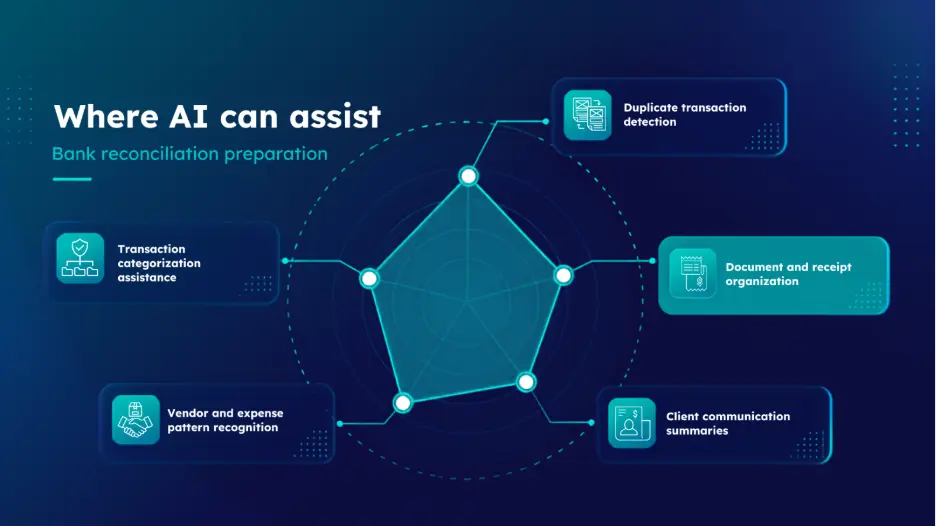
Where AI can assist
Bank reconciliation preparation
Summarizing transactions and identifying unmatched items.
Transaction categorization assistance
Suggesting likely expense or revenue categories.
Duplicate transaction detection
Flagging entries with similar dates, amounts, or vendors.
Vendor and expense pattern recognition
Identifying recurring payments and unusual changes.
Document and receipt organization
Grouping files by vendor, date, or account.
Client communication summaries
Drafting concise follow-up notes for missing information.
This is where Claude AI bookkeeping speed becomes valuable. The AI handles repetitive analysis, while the bookkeeper makes the final accounting decision.
A Before-and-After Look at AI Transaction Categorization for Bookkeepers
One of the most noticeable improvements comes from transaction categorization. AI can review descriptions, vendor names, and historical patterns to suggest categories before a human reviews them.
| Task | Before AI | With AI Assistance |
| Transaction categorization | Manual review | Suggested categories |
| Duplicate checks | Manual search | Automated detection |
| Receipt matching | Manual matching | AI-assisted matching |
| Month-end preparation | Several hours | Reduced preparation time |
Where Speed Has to Stop for Accuracy
Not every bookkeeping task should be automated. Certain items require professional judgment, especially when:
- A transaction appears unusual
- A vendor changes billing pattern
- A large adjustment is needed
- Sales tax treatment is unclear
- Payroll-related entries are involved
Professional accounting organizations such as CPA Canada and CPA Ontario emphasize the importance of maintaining appropriate review procedures when technology is used in financial processes.
The safest approach is:
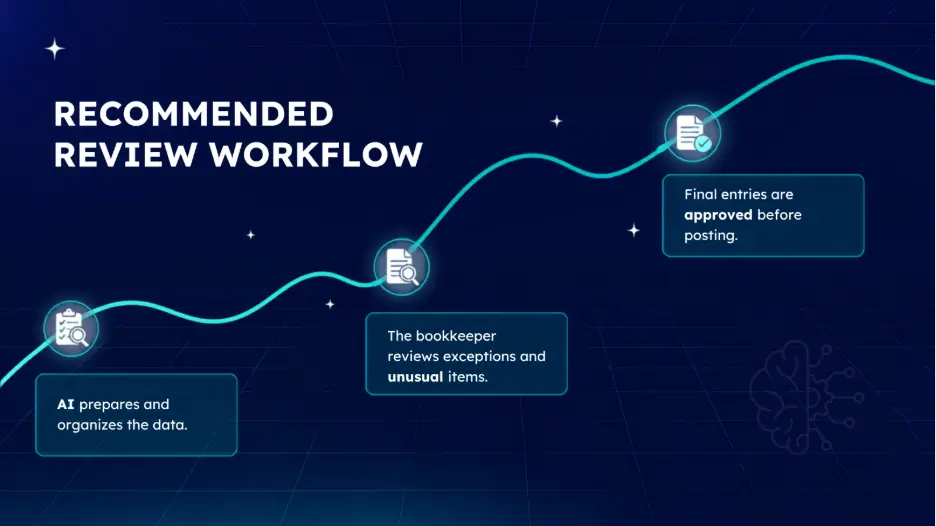
This process helps firms speed up client bookkeeping while maintaining control over accuracy.
Measuring AI Bookkeeping Efficiency for Small Firms
Small bookkeeping firms should track measurable results rather than relying on impressions.
Useful metrics include:
Hours saved
Compare preparation time before and after AI-assisted workflows.
Turnaround time
Measure how quickly reconciliations and reports are completed.
Categorization accuracy
Track how often suggested categories are accepted without changes.
Exception volume
Monitor the number of transactions flagged for professional attention.
Backlog reduction
Track whether the firm is successfully reducing delayed or incomplete client work.
Tools such as Dext are often used alongside AI systems to improve receipt capture and document management. When combined with AI-assisted analysis, firms can reduce bookkeeping backlogs more effectively during busy periods. Accurate month-end measurement becomes easier when firms follow structured Accrual Bookkeeping Workflows for prepaids, accruals, and deferrals.
Maintaining organized digital records is also important for compliance with Canada Revenue Agency record-keeping requirements.
Conclusion
Faster bookkeeping with AI comes from reducing repetitive work such as transaction sorting, duplicate detection, receipt organization, and month-end preparation. It does not eliminate the need for professional oversight, and every final posting should still be reviewed by an experienced bookkeeper.
The best results come from combining AI accounting workflow automation with knowledgeable bookkeeping reviews and strong internal controls. If your business is looking to improve turnaround times and streamline financial processes, our AI-enabled bookkeeping and accounting services can help support that goal. Contact us today to discuss how we can help make your bookkeeping faster, more organized, and easier to manage.
How NCSGX Can Help
NCSGX combines experienced bookkeeping professionals with AI-assisted workflows to help businesses process financial records more efficiently. By using tools such as Claude alongside established bookkeeping controls, we can support faster transaction categorization, reconciliation preparation, receipt organization, and month-end processing while ensuring that all critical entries receive proper human review before final posting.
Frequently Asked Questions (FAQ)
1. How much faster is bookkeeping with AI compared to manual work?
The improvement varies by firm, but many bookkeepers see the biggest time savings in transaction categorization, receipt organization, and reconciliation preparation. AI usually reduces preparation time rather than eliminating the need for review. Firms that already have standardized processes tend to benefit the most.
2. What causes the biggest bookkeeping backlog, and can AI fix it?
Backlogs are often caused by unsorted transactions, missing receipts, duplicate entries, and delayed client responses. AI can help identify and organize these items more quickly, but it cannot fully replace client cooperation or professional review. It is most effective as a tool for reducing administrative delays.
3. How does AI transaction categorization actually work for bookkeepers?
AI reviews transaction descriptions, vendor names, amounts, and historical coding patterns. It then suggests likely account categories based on previous examples and recognized patterns. The bookkeeper reviews those suggestions and approves or adjusts them before posting.
4. Does faster bookkeeping with AI mean sacrificing accuracy?
Not if the workflow includes proper human review. AI is best used for organizing data, detecting duplicates, and flagging exceptions. Final accounting decisions should still be made by a qualified bookkeeper or accountant.
5. How can a small bookkeeping firm measure AI bookkeeping efficiency?
Track hours spent on month-end preparation, turnaround time per client file, backlog size, and the percentage of AI category suggestions that are accepted without changes. Comparing these metrics before and after implementation provides a clear view of the actual productivity gains.