
 USA
USA
 Canada
 Australia

Introduction
Real-time bookkeeping is changing the way Canadian businesses manage their finances. Instead of waiting until month-end to review financial records, businesses can now access timely financial information through cloud-based accounting systems and automated workflows. This helps improve cash flow visibility, supports faster decision-making, and enables businesses to respond more effectively to changing financial needs.
At NCSGX, we provide bookkeeping and accounting solutions that help businesses maintain accurate financial records throughout the month, reducing reliance on traditional month-end processes. By combining experienced financial professionals with modern accounting technology, we help businesses gain better financial visibility and make more informed business decisions.
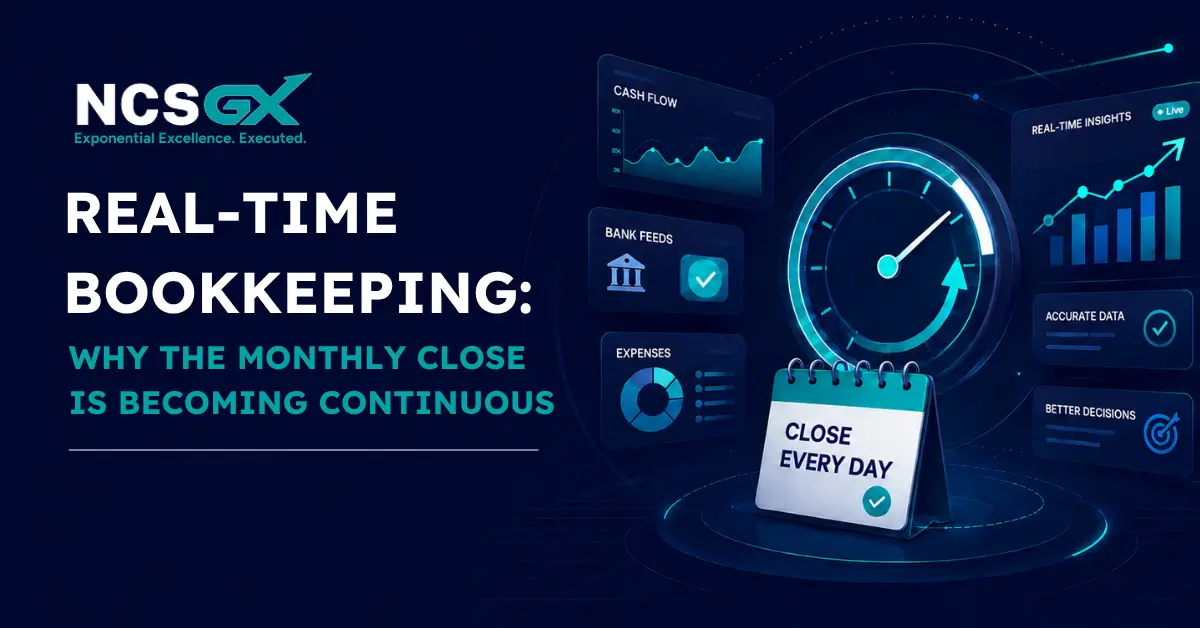
Real-time bookkeeping: why the monthly close is becoming continuous
For many Canadian business owners, financial information arrives too late to be truly useful.
By the time the monthly close process is completed, reconciliations are finalized, and reports are distributed, the business may already be operating based on outdated information. Decisions about hiring, purchasing, pricing, or cash flow management are often made without a current view of financial performance.
This delay is one reason why more organizations are shifting toward Real-Time Bookkeeping.
Advances in cloud accounting software, automated bank feeds, and automation tools now allow businesses to maintain financial records throughout the month instead of waiting for the traditional monthly close.
Instead of closing the books once a month, businesses increasingly maintain books that remain accurate and up to date throughout the month.
Key Takeaways
- Real-time bookkeeping updates financial records continuously rather than monthly.
- Cloud bookkeeping software enables live access to financial information.
- Continuous accounting improves cash flow visibility and decision-making.
- Automated workflows reduce manual bookkeeping effort and errors.
- Canadian businesses benefit from faster GST/HST preparation and CRA reporting readiness.
What real-time bookkeeping means
Real-time bookkeeping refers to the continuous recording, categorization, reconciliation, and monitoring of financial transactions as they occur.
Rather than collecting information at month-end, financial data flows into accounting systems throughout the month. In practice, this means financial information is updated regularly as business activity occurs, giving owners a clearer picture of their financial position without waiting for month-end reports.
Key components include
- Cloud bookkeeping software
- Automated bank feeds
- Digital payment integrations
- Bookkeeping automation tools
- Real-time financial reporting dashboards
Many Canadian businesses use cloud accounting platforms such as QuickBooks Online, Xero, Sage Accounting, and FreshBooks to automate routine bookkeeping tasks and improve access to financial information.
Choosing the right cloud accounting platform is only one part of the process. CPA Canada recommends maintaining reliable financial records and implementing sound accounting practices to support informed business decisions.
These systems automatically synchronize information from
- Bank accounts
- Credit cards
- Payroll systems
- Accounts receivable platforms
- Accounts payable workflows
Many businesses also integrate payroll, invoicing, and banking systems with their accounting software to reduce manual data entry and improve reporting accuracy.
Practical example
A Toronto consulting firm invoices a client for a completed project on Monday. When the client pays electronically later that week, the transaction is automatically imported into the accounting software, matched to the outstanding invoice, and reflected in the business’s cash flow dashboard. Instead of waiting until month-end to confirm the payment, the business owner immediately knows that funds are available for payroll, supplier payments, or new investments.
How the traditional monthly close works (and where it strains)
The traditional monthly close process is designed to ensure financial records are accurate before reports are produced.
Typical steps include:
Although every business follows its own accounting procedures, the traditional monthly close generally includes several core activities that help ensure financial records are accurate before reports are prepared.
- Data Collection
Gathering invoices, receipts, bank statements, payroll records, and expense reports.
- Bank Reconciliation
Matching recorded transactions against bank activity.
- Accounts Receivable Review
Verifying customer invoices and outstanding balances.
- Accounts Payable Review
Reviewing supplier invoices and upcoming payment obligations.
- Adjustments
Recording accruals, depreciation, corrections, and journal entries.
- Financial Reporting
Preparing month-end reporting packages and management reports.
Common pain points
While this process helps maintain accurate financial records, it can also create several operational challenges.
- Delayed financial visibility
- Manual data entry
- Last-minute reconciliations
- Reporting bottlenecks
- Increased error risk
- Limited cash flow insight
- Time-consuming month-end reporting
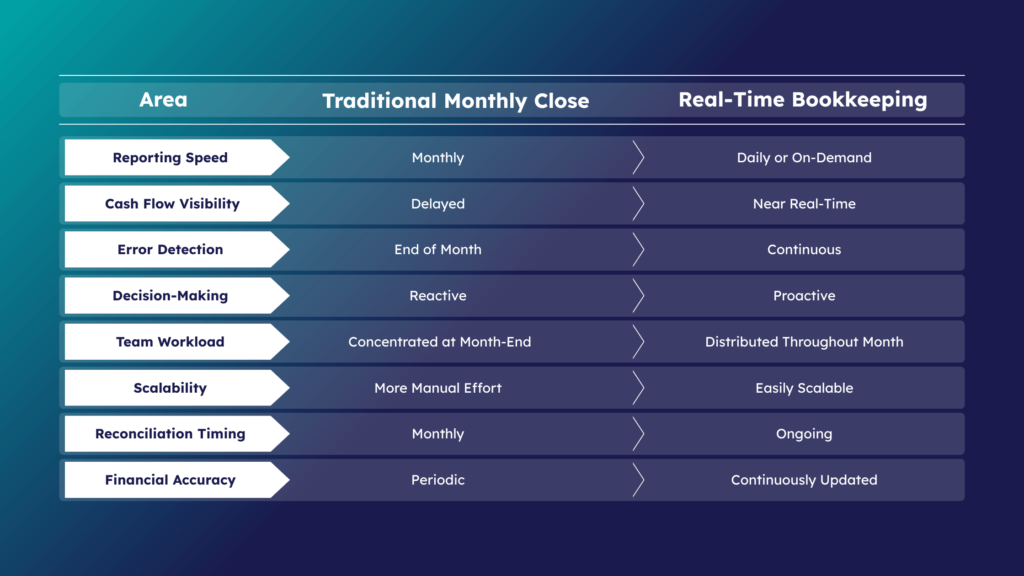
Traditional Monthly Close vs Real-Time Bookkeeping
Why the monthly close is becoming continuous
Several technological developments are transforming bookkeeping workflows.
Today’s businesses generate financial transactions every day, not just at the end of the month. Waiting several weeks to review that information can delay important business decisions, which is why many organizations are shifting toward more continuous financial processes.
Cloud Technology
Cloud bookkeeping platforms provide secure, centralized access to financial information from anywhere.
Automated Bank Feeds
Transactions can flow directly from financial institutions into accounting software.
Digital Payments
Electronic invoicing and payment systems create faster transaction visibility.
AI-Assisted Categorization
Modern bookkeeping automation tools can classify transactions and flag anomalies automatically.
Continuous Accounting
Instead of waiting until month-end, accounting activities happen continuously.
Tasks such as:
- Reconciliations
- Invoice tracking
- Expense categorization
- Financial reporting
occur throughout the month.
Why finance teams want daily visibility
Business conditions can change rapidly.
Waiting until month-end to understand revenue, cash flow, customer collections, or supplier obligations can delay important business decisions. Continuous bookkeeping provides finance teams with more timely information, allowing them to identify potential issues before they become larger problems.
What continuous bookkeeping looks like day-to-day
Continuous bookkeeping does not mean every accounting task is performed daily. Instead, activities are completed on different schedules to keep financial records accurate throughout the month.
Daily Activities:
- Transaction review
- Bank feed monitoring
- Expense categorization
- Invoice processing
- Cash flow tracking
Weekly Activities
- Bank reconciliation reviews
- Accounts receivable follow-up
- Accounts payable monitoring
- Financial dashboard updates
Monthly Activities
- Management reporting
- GST/HST review
- Financial analysis
- Strategic planning discussions
Continuous Accounting Workflow
Although many of these updates are automated, businesses should still review their financial records regularly to verify accuracy and resolve exceptions before they affect financial reports.
What it changes for Canadian businesses
The benefits extend beyond convenience.
Improved Cash Flow Management
Business owners gain immediate insight into:
- Available cash
- Outstanding receivables
- Upcoming payables
Faster GST/HST Preparation
Up-to-date books make GST/HST calculations more accurate and less stressful.
Businesses can refer to the CRA’s GST/HST guide for businesses to understand filing requirements, deadlines, and record-keeping responsibilities.
Better CRA Reporting Readiness
Accurate records throughout the year to reduce reporting challenges and support compliance requirements.
Faster Decision-Making
Management can act on current information instead of historical reports.
Better Budgeting
Forecasting becomes more reliable when financial data remains current. When combined with strategic CFO advisory services, real-time financial data can help business owners make more informed decisions about growth, cash flow planning, and profitability.
Reduced Financial Surprises
Ongoing reconciliation helps identify
- Duplicate transactions
- Missing revenue
- Unexpected expenses
According to the Government of Canada, maintaining complete and accurate business records is essential for meeting tax obligations and supporting business decision-making. This becomes significantly easier when bookkeeping processes are maintained continuously rather than updated periodically.
Did you know? According to Statistics Canada, over 98% of employer businesses in Canada are small businesses, making efficient financial management and accurate bookkeeping essential for long-term growth.
How do bookkeeping services support continuous Accounting?
Technology alone does not create accurate financial records.
Successful continuous accounting requires
- Consistent transaction review
- Reconciliation oversight
- Exception management
- Financial reporting expertise
Professional bookkeeping services help businesses
- Implement cloud bookkeeping systems
- Maintain accurate books
- Monitor accounts payable
- Manage accounts receivable
- Prepare GST/HST filings
- Support CRA compliance
Technology can automate many bookkeeping tasks, but it cannot replace professional judgment. Regular reviews by experienced bookkeepers help identify unusual transactions, correct errors, and ensure financial records remain compliant with CRA requirements.
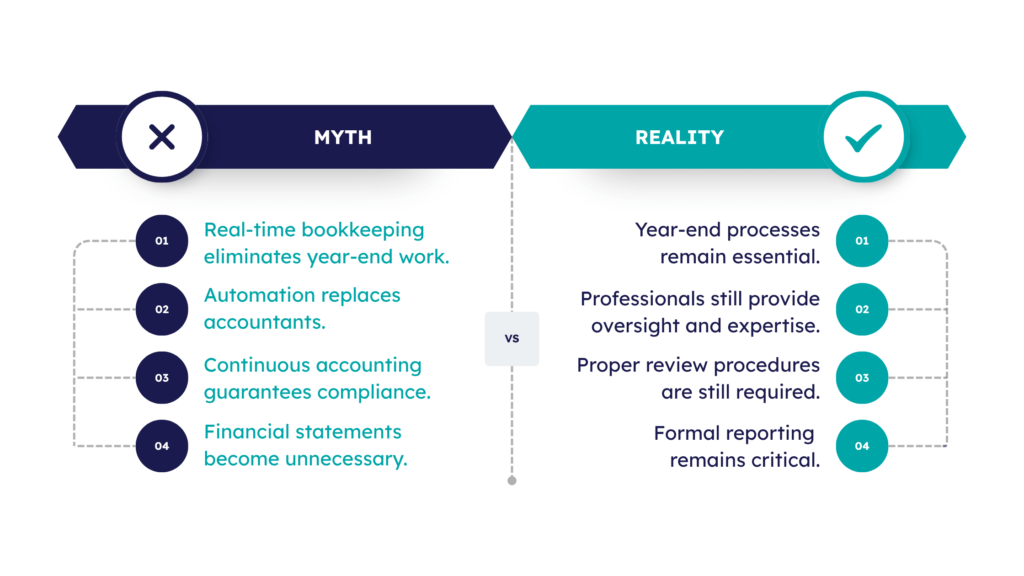
Does the continuous close replace year-end?
No.
Continuous accounting improves financial visibility throughout the year, but it does not eliminate year-end responsibilities.
Businesses still require:
- Year-end financial statements
- Corporate tax filings
- Accountant reviews
- Audit procedures
- Regulatory compliance reporting
Myth vs Reality
Is real-time bookkeeping right for every business?
Pros
- Better cash flow visibility
- Faster reporting
- Reduced manual work
- Earlier error detection
- Improved forecasting
- Easier scalability
Cons
- Initial implementation effort
- Staff training requirements
- Dependence on software integrations
- Ongoing process management
Ideal Business Types
Real-time bookkeeping is particularly beneficial for businesses with frequent transactions, multiple locations, growing teams, or complex cash flow requirements. This includes professional service firms, e-commerce businesses, construction companies, agencies, and rapidly growing startups.
Continuous Accounting Readiness Checklist
If several boxes are checked, real-time bookkeeping may be a strong fit.
Ready to Move Beyond Month-End Bookkeeping?
Many businesses still spend weeks trying to understand what happened last month.
The challenge is that growth decisions need to be made today.
With real-time bookkeeping and continuous accounting practices, you gain:
- Faster financial reporting
- Better cash flow visibility
- More accurate GST/HST preparation
- Improved CRA reporting readiness
- Greater confidence in business decisions
Ready to move beyond the traditional monthly close? Explore how real-time bookkeeping can help you make more informed business decisions.
Conclusion
The traditional monthly close process is evolving. With advances in cloud bookkeeping, bookkeeping automation, and real-time financial reporting, businesses can now access more timely financial insights and improve day-to-day decision-making.
While year-end reporting and tax obligations remain essential, real-time bookkeeping provides greater visibility into cash flow and financial performance throughout the year.
At NCSGX, we help Canadian businesses simplify their bookkeeping with cloud-based solutions, accurate financial reporting, and ongoing support tailored to their unique needs. Whether you’re looking to streamline your monthly close or transition to continuous accounting, our team can help you build a more efficient and reliable financial process.
If you’re ready to move toward continuous accounting, contact our team to learn how modern bookkeeping solutions can support your business.
Frequently Asked Questions (FAQ)
1. What's the difference between real-time bookkeeping and a monthly close?
Traditional bookkeeping concentrates on accounting activities at the end of the month. Real-time bookkeeping spreads these activities throughout the month using automation, cloud systems, and ongoing reconciliation processes.
2. Is real-time bookkeeping suitable for small businesses in Canada?
Many cloud accounting platforms make real-time bookkeeping affordable for Canadian SMBs. Businesses can benefit from faster access to financial information without requiring a large finance department.
3. Do you still need a year-end close with continuous bookkeeping?
Continuous bookkeeping improves record accuracy but does not replace year-end financial statements, tax filings, accountant reviews, or audit procedures.
4. How does real-time bookkeeping help with GST/HST and CRA reporting?
Up-to-date bookkeeping helps businesses track taxable transactions, prepare GST/HST returns efficiently, and maintain records required for CRA reporting.
5. Can bookkeeping automation eliminate bookkeeping work entirely?
Automation reduces manual tasks but still requires professional oversight, review, and financial expertise to ensure accuracy and compliance.
6. What industries benefit most from continuous accounting?
Professional services, construction, retail, e-commerce, technology startups, and multi-location businesses often see the greatest value from continuous accounting workflows.