
 USA
USA
 Canada
 Australia

Introduction
In Canada, controllers are spending hours on transactional entries they should not be touching. Founders are signing cheques without a clear picture of their actual cash position. And finance teams are patching the gap with part-time hires, strained staff, or software that no one has properly set up.
Outsourced bookkeeping is how many Canadian businesses are solving this right now as a scalable approach to keeping their books accurate, their CRA obligations met, and their reporting timely.
What the Bookkeeping Talent Gap in Canada Actually Looks Like
Across Canada, accounting and bookkeeping roles are going unfilled for longer than they did five years ago. The numbers back this up. According to CPA Canada, the profession is facing a significant pipeline problem, with fewer post-secondary graduates entering accounting programs relative to the number of senior practitioners retiring. The average age of a CPA in Canada is rising, and the bottleneck is not going away on its own.
For SMEs and growing businesses, the impact lands hardest. Large corporations can absorb the cost of premium salaries or absorb short-term gaps with cross-functional teams. Smaller operations cannot be done. A business doing $3 million to $15 million in annual revenue does not have that buffer.
The result is a familiar situation that many finance leads recognize immediately: a bookkeeper role that takes four months to fill, a junior hire who needs six months of supervision before they are operating independently, and a controller who ends up doing data entry because no one else is handling it.
Key Takeaways
- Canada’s bookkeeping and accounting workforce is shrinking faster than it is being replenished
- The bookkeeper shortage in Canada is driving up hiring costs, increasing errors, and delaying reporting for SMEs
- Outsourced bookkeeping covers day-to-day transactional work, GST/HST filings, payroll remittances, and month-end close
- Offshore bookkeeping for Canadian firms can cut resourcing costs significantly without compromising CRA compliance
- Data security and PIPEDA compliance are manageable and should be addressed in any outsourcing agreement
Why Canada Is Short on Bookkeepers
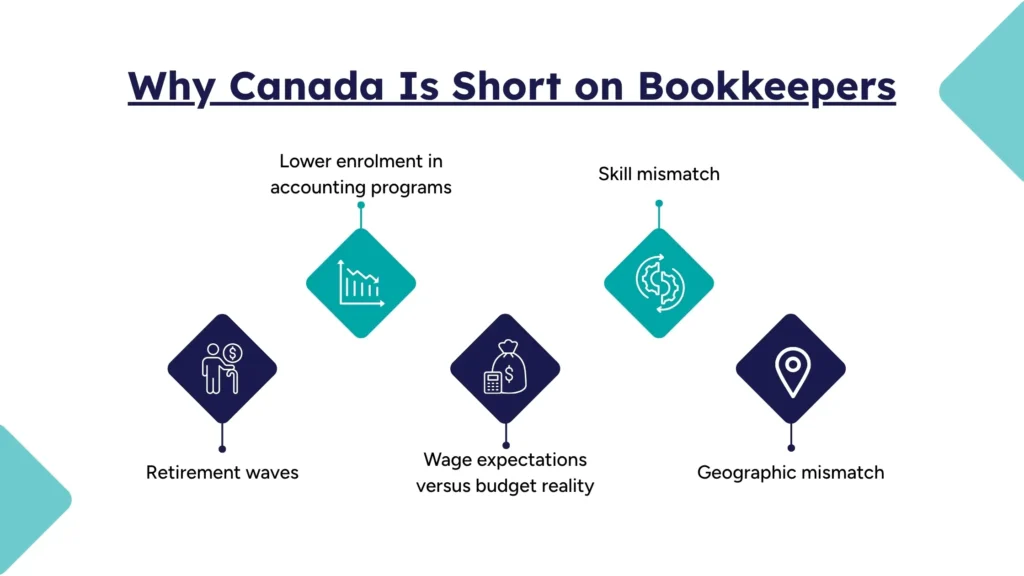
Several factors are driving the bookkeeper shortage in Canada at once.
Retirement waves: A significant portion of the accounting and bookkeeping workforce entered the profession in the 1980s and 1990s. Many are now exiting. The knowledge and institutional experience leaving the workforce are not being replaced at the same rate.
Lower enrolment in accounting programs: Competition from technology, finance, and data science programs has pulled students away from traditional accounting pathways. The profession has struggled to communicate its long-term value proposition to younger graduates.
Wage expectations versus budget reality: Skilled, experienced bookkeepers now command salaries that put pressure on SME budgets. A qualified full-time bookkeeper in Toronto or Vancouver can cost $55,000 to $75,000 CAD per year, before benefits, training, or management overhead.
Skill mismatch: The tools have changed faster than the training. Businesses running QuickBooks Online, Xero, or cloud-based ERP systems need bookkeepers who are proficient in these platforms, not just in the underlying principles. Many candidates are not.
Geographic mismatch: Rural and smaller-market businesses face acute shortages because qualified candidates tend to cluster in urban centres. Remote work has helped the margins but has not closed the gap entirely.
What the Shortage Actually Costs a Canadian Business
The Direct Costs
The most visible cost is payroll. Businesses that do manage to hire are often paying above-market salaries and still seeing turnover within 18 months.
The Hidden Costs
The bigger cost is operational. When bookkeeping is delayed, incomplete, or inaccurate, it cascades:
- Month-end close takes two to three weeks instead of five to seven days
- GST/HST filings are submitted late, triggering CRA penalties and arrears interest
- Payroll remittances slip, which carries significant consequences under the Income Tax Act
- Year-end preparation becomes a scramble, driving up accounting fees
- Management decisions get made on stale or inaccurate data
According to BDC Canada research, administrative and operational inefficiencies cost Canadian SMEs an estimated 30 percent of productive capacity annually. Poor bookkeeping is not a minor line item. It is a compounding operational drain.
Mini Case Study: A Toronto-Based Professional Services Firm
A 22-person consulting firm in Toronto spent eight months trying to replace a bookkeeper who left on short notice. During that period, the operations manager absorbed the accounts payable and receivable workload. GST/HST was filed two quarters late. The year-end took the external accountant three times as long to prepare, at double the usual cost.
After engaging an outsourced bookkeeping provider, the firm stabilized its month-end close to seven days, restored on-time GST/HST filing, and freed the operations manager to return to their actual role. The monthly cost of the outsourced service was 40 percent less than the salary of the position they had been trying to fill.
How Outsourcing Closes, the Gap
Outsourced bookkeeping is not about replacing a full-time employee with a cheaper version of the same thing. It is about accessing a team of people with defined expertise, technology infrastructure, and process discipline that most SMEs cannot replicate through a single hire.
For Canadian businesses specifically, the right outsourcing partner understands CRA-compliant bookkeeping requirements, provincial sales tax obligations, payroll remittance schedules, and year-end preparation standards. This is not generic bookkeeping. It is Canadian bookkeeping.
What Outsourced Bookkeeping Covers for Canadian Books
This is where many business owners have misconceptions. Outsourced bookkeeping is not just data entry. A well-structured engagement typically covers:
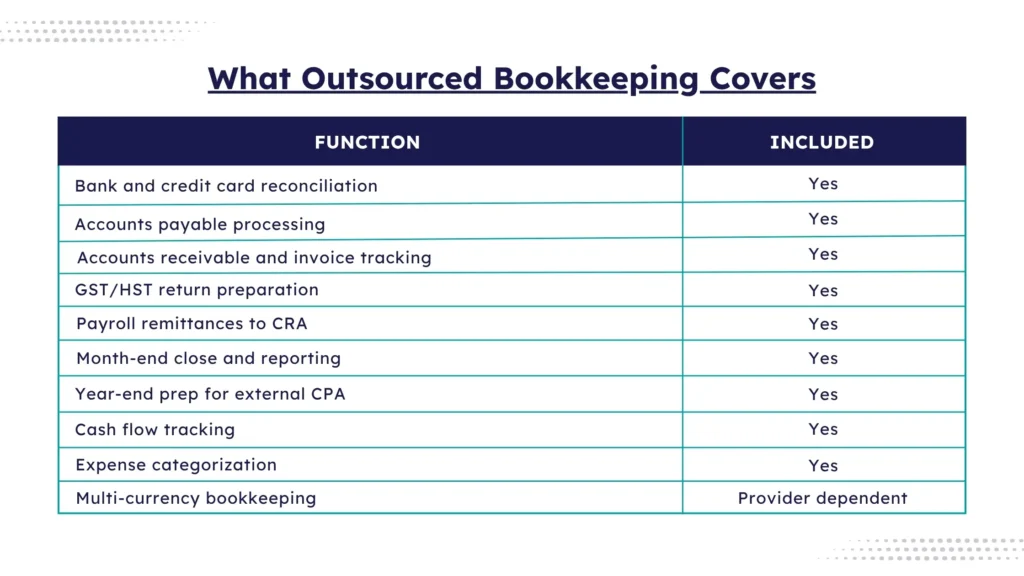
The outsourced bookkeeper does not replace your external CPA or tax advisor. They handle the day-to-day and period-end work that makes your CPA’s job faster, and your year-end far less expensive. Think of it as the foundation your accountant builds on.
Keeping Client Data Secure and PIPEDA-Compliant
Data security is a legitimate concern and deserves a direct answer. When you share financial records with any third-party provider, you are handling information that may be subject to Canada’s Personal Information Protection and Electronic Documents Act (PIPEDA).
Here is what to verify before signing any outsourcing agreement:
Data security checklist:
- [ ] Does the provider use encrypted file transfer and storage?
- [ ] Is access to your data role-restricted and audit-logged?
- [ ] Does the provider have a documented data retention and disposal policy?
- [ ] Is the agreement clear on data ownership and return of records on termination?
- [ ] Does the provider carry professional liability (errors and omissions) insurance?
- [ ] Have they disclosed where data is stored (Canada, US, offshore)?
- [ ] Are their team members subject to confidentiality agreements?
Offshore bookkeeping for Canadian firms is legal and widely practised. The compliance obligation sits with the Canadian business to ensure the arrangement meets PIPEDA requirements. This is manageable with the right contractual structure. For guidance, the Office of the Privacy Commissioner of Canada publishes resources specifically for businesses using third-party service providers.
Is Outsourcing the Right Fix for Your Situation?
Warning Signs Your Current Setup Is Not Working
If two or more of these apply, your bookkeeping function is already at risk:
- You cannot produce a clean set of financials within 10 days of month-end
- Your CRA filing history includes late submissions or penalties
- Your bookkeeper is the only person who understands how your books are structured
- Your external accountant spends significant time cleaning up records before starting year-end
- You have gone more than three months without a proper bank reconciliation
- Key business decisions are being made without current financial data
How NCSGX Canada Can Help
At NCSGX Canada, we work with Canadian businesses that need reliable, CRA-compliant bookkeeping support without the overhead and uncertainty of building an in-house team.
Our outsourced bookkeeping service is built for the realities of Canadian operations: GST/HST and payroll remittance obligations, provincial compliance requirements, year-end preparation that your CPA can actually work with, and monthly reporting that gives decision-makers a clear view of where the business stands.
Talk to our team about your bookkeeping needs, and we will put together a scope that fits where your business is right now.
Conclusion
For Canadian business owners and finance leaders, the practical answer is not to wait for the talent market to recover. It is to build a bookkeeping function that does not depend on it.
Outsourced bookkeeping gives you accuracy, continuity, CRA compliance, and financial visibility without the hiring cycle, salary pressure, and single-point-of-failure risk that comes with building that function entirely in-house. For businesses at the right stage and with the right partner, it is a better operating model.
Frequently Asked Questions (FAQ)
1. Will outsourcing my bookkeeping cause CRA problems?
No, provided you choose a provider who understands Canadian compliance requirements. CRA-compliant bookkeeping is entirely achievable with an outsourced team.
2. Can outsource bookkeepers handle GST/HST and payroll remittances?
Yes. A qualified outsourced bookkeeping provider can prepare your GST/HST returns and calculate payroll remittances on your behalf.
3. How does my data stay protected?
Through a combination of encrypted systems, access controls, confidentiality agreements, and contractual data governance provisions.
4. Does outsourcing replace my accountant?
No. Outsourced bookkeeping and your CPA serve different functions. Bookkeeping covers day-to-day and month-end transactional work.
5 Is offshore bookkeeping for Canadian firms legally permitted?
Yes. Using an offshore provider for bookkeeping services is legal for Canadian businesses.