
 USA
USA
 Canada
 Australia


Introduction
Bookkeeping for real estate agents in Canada is different from bookkeeping for most small businesses. Commission income, brokerage splits, GST/HST obligations, and CRA reporting all require accurate financial records throughout the year. At NCSGX, we understand that staying organized is the key to simplifying tax season and making informed business decisions.
Whether you operate as a sole proprietor or through a personal real estate corporation (PREC), consistent bookkeeping helps you track income, claim eligible deductions, and remain CRA compliant. With the right system in place, managing your finances becomes easier and more efficient.
Key Takeaways
- Bookkeeping for real estate agents requires careful tracking of commission income, brokerage splits, GST/HST, and business expenses.
- Your bookkeeping responsibilities depend partly on whether you operate as a sole proprietor or through a personal real estate corporation (PREC).
- Maintaining complete records helps maximize real estate agent tax deductions Canada allows while supporting CRA compliance.
- Keeping business and personal finances separate simplifies reporting and improves financial visibility.
- Accurate records make preparing a T2125 real estate agent return and calculating commission income tax much easier.
- Staying current with GST/HST, CPP obligations, and tax instalments helps avoid interest and penalties.
Bookkeeping for Real Estate Agents in Canada
Real estate is a commission-driven business where income can fluctuate from month to month. Between brokerage commission splits, marketing costs, vehicle expenses, GST/HST obligations, and CRA reporting requirements, staying organized can quickly become challenging. That’s why bookkeeping for real estate agents in Canada is more than simply recording transactions. It is about maintaining accurate financial records that support tax compliance, improve cash flow visibility, and help you claim every eligible deduction.
Whether you’re working as a sole proprietor or operating through a personal real estate corporation (PREC), good bookkeeping helps you track commission income tax, manage self-employed real estate agent expenses, prepare your T2125 real estate agent reporting where applicable, and remain compliant with current Canada Revenue Agency (CRA) requirements. Establishing good habits throughout the year makes tax season significantly less stressful and helps you focus on growing your business.
Why bookkeeping is different for real estate agents
Real estate bookkeeping has a few moving parts that do not show up in many other small businesses. Commission income may be paid after a closing, may be split with the brokerage, and may include referral income or bonuses, so you need to record the full amount and keep the support behind each payment. This is why many agents struggle with commission income tax planning if they rely only on bank deposits instead of proper source records. As commission income changes from month to month, Real-time bookkeeping provides better visibility into income, expenses, and profitability without waiting until month-end.
You also need to separate business-use expenses from personal spending, especially for car costs, phone bills, advertising, and home office use. The CRA expects business income and expenses to be reported accurately and Form T2125 is the standard reporting form for self-employed commission sales. Good bookkeeping keeps your real estate agent tax deductions Canada claims defensible if the CRA asks for support.
What income you need to track
Many agents assume recording deposited commissions is enough. In reality, your bookkeeping should capture every source of business income to ensure complete reporting.
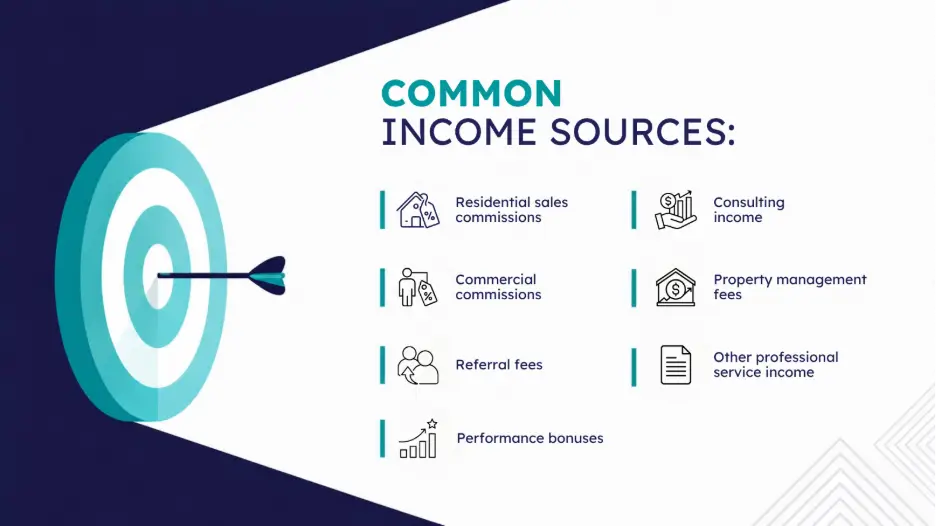
Your records should also show any brokerage commission split or deductions separately rather than simply recording the final deposit into your bank account. This creates a clearer audit trail and supports accurate reporting for commission income tax purposes.
GST/HST for real estate agents
Many Canadian real estate agents are required to register for GST/HST once they meet the CRA’s registration requirements, although some may choose to register voluntarily earlier depending on their circumstances. Once registered, GST/HST becomes an important part of everyday bookkeeping.
Your records should clearly distinguish:
- Commission income before GST/HST
- GST/HST collected from clients or brokerages
- GST/HST paid on eligible business purchases
- Input Tax Credits (ITCs)
- GST/HST remittances
Accurate GST/HST tracking not only supports compliance but also helps ensure you claim eligible input tax credits where permitted.
Whether you’re a sole proprietor or operating through a personal real estate corporation (PREC), maintaining separate GST/HST records throughout the year simplifies filing and reduces the risk of CRA questions.
Separating business and personal finances
One of the simplest ways to improve bookkeeping for real estate agents in Canada is to keep business and personal transactions separate. Using a dedicated business bank account and credit card creates a much clearer financial record and makes reconciliation faster.
When personal and business spending are mixed, it becomes harder to identify eligible real estate agent tax deductions Canada allows. It also increases the likelihood of overlooking deductible costs or claiming personal expenses by mistake.
A separate financial system makes it easier to:
- Reconcile monthly transactions
- Track self-employed real estate agent expenses
- Monitor cash flow
- Prepare GST/HST returns
- Support CRA documentation requests
Even for sole proprietors, separating finances is considered a best practice that saves considerable time during tax season.
Doing your own books vs. getting help
Many new agents begin by managing their own bookkeeping. With relatively few monthly transactions, this approach may work during the early stages of a business. However, as transactions increase, bookkeeping often becomes more time-consuming and complex.
Professional bookkeeping support can help ensure commission income, brokerage deductions, GST/HST, and self-employed real estate agent expenses are recorded consistently throughout the year. This also helps simplify T2125 real estate agent reporting for sole proprietors or corporate reporting for those operating through a personal real estate corporation (PREC).
Whether you handle your books yourself or work with a professional, consistency is what matters most. Recording transactions every month instead of once a year improves accuracy, reduces stress, and helps maximize eligible real estate agent tax deductions Canada while remaining compliant with CRA requirements.
Conclusion
Accurate bookkeeping for real estate agents in Canada helps you stay organized, track commission income, manage GST/HST, claim eligible deductions, and remain compliant with CRA requirements. Whether you’re filing a T2125 real estate agent return or operating through a personal real estate corporation (PREC), keeping your records current throughout the year makes tax season much easier.
If you need guidance with commission tracking, bookkeeping, or tax-ready financial records, Contact Us to learn how professional bookkeeping support can help keep your business organized and CRA compliant.
How NCSGX Can Help
NCSGX supports Canadian real estate professionals with accurate bookkeeping services tailored to commission-based businesses. From commission tracking and GST/HST recordkeeping to monthly reconciliations, CRA-compliant financial reporting, and tax-ready records, our team helps agents maintain organized books so they can spend more time serving clients and less time managing paperwork.
Frequently Asked Questions (FAQ)
1. Do real estate agents in Canada need to register for GST/HST?
Yes. Real estate agents must register for GST/HST once they meet the CRA’s registration requirements. Some may also register voluntarily if it benefits their business.
2. What tax form do self-employed real estate agents use?
Self-employed real estate agents usually report business income and expenses using Form T2125 (Statement of Business or Professional Activities) with their personal tax return.
3. What expenses can a real estate agent claim?
Common deductible expenses include advertising, vehicle costs, licensing fees, professional memberships, office supplies, marketing, bookkeeping, and eligible home office expenses.
4. Should I record gross commission or my net after the brokerage split?
Record the full commission earned and show the brokerage split separately. This provides a clear record for accurate tax reporting.
5. How long does the CRA require me to keep my records?
The CRA generally requires business records to be kept for at least six years from the end of the relevant tax year.
6. Do I need a separate bank account for my real estate business?
While not always required for sole proprietors, a separate business bank account is strongly recommended to simplify bookkeeping and tax reporting.