
 USA
USA
 Canada
 Australia


Introduction
Several important provincial measures are affecting corporate taxation in 2026, but the new rate is only part of the calculation. These corporate tax changes 2026 involve Ontario, Quebec, Newfoundland and Labrador, and Saskatchewan, with different effective dates, eligibility rules, and legislative status. Two measures also have retroactive application. Before preparing a T2 return, businesses should confirm whether a change applies to their taxation year, whether a rate must be prorated, and whether a previously prepared or filed return requires review. At NCSGX, we understand that keeping up with changing tax rules requires careful attention to dates, eligibility, and the specific circumstances of each business.
Key Takeaways
- Ontario has proposed reducing its small business corporate income tax rate from 3.2% to 2.2% effective July 1, 2026, with prorating for taxation years that straddle that date.
- Quebec increased its small business deduction rate for taxation years beginning after April 29, 2026, reducing the minimum provincial rate on eligible income from 3.2% to 2.2%.
- Newfoundland and Labrador’s small business corporate tax rate was reduced from 2.5% to 2.0%, retroactive to January 1, 2026, and the related legislation has received Royal Assent.
- Saskatchewan expanded its R&D tax credit, including a retroactive increase in the annual qualifying expenditure limit.
- Businesses affected by a retroactive change should review prepared or filed T2 calculations based on the applicable legislation and CRA administration.
Four Provinces Changed Corporate Tax in 2026, and Two Changes Are Retroactive
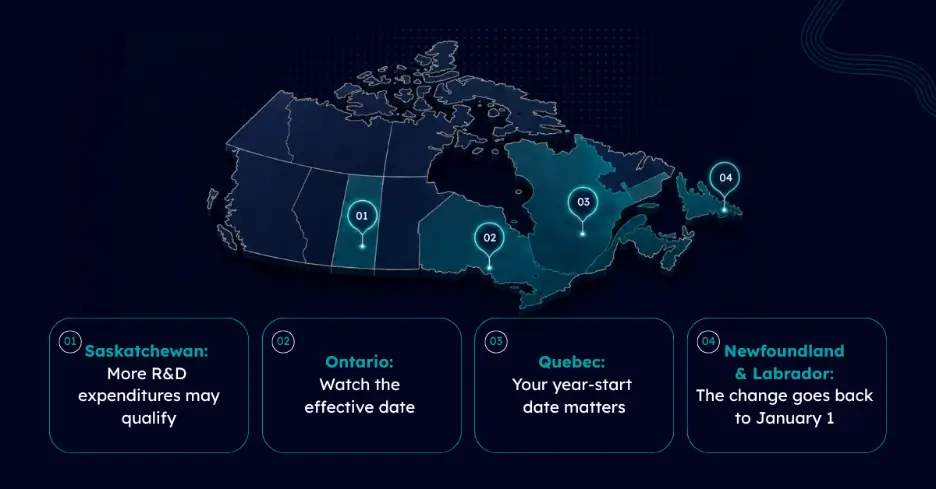
Canada’s corporate tax landscape has shifted in several provinces during 2026. The most important corporate tax changes 2026 are not limited to the headline rate. Effective dates, taxation-year rules, eligibility conditions, retroactive application and legislative status can all affect a corporation’s tax calculation and T2 filing. Ontario, Quebec, Newfoundland and Labrador, and Saskatchewan require particular attention, although the changes differ in form and may not all apply to the same businesses.
1. Ontario Small Business Tax Rate 2026: 3.2% Drops to 2.2% on July 1
The Ontario small business tax rate 2026 is scheduled to fall from 3.2% to 2.2%, effective July 1, 2026. The measure is intended for qualifying Canadian-controlled private corporations, or CCPCs, earning eligible active business income.
The reduced rate does not apply automatically to every Ontario corporation. Generally, the provincial small business rate applies to up to $500,000 of eligible active business income, subject to the federal and Ontario small business deduction rules. The business limit may be reduced when a corporation, or an associated group, has taxable capital employed in Canada above $10 million and is eliminated at $50 million.
Keeping your financial information organized throughout the year can also make it easier to review eligibility, income limits, and changing tax rules before filing. An accounting services can support businesses in maintaining accurate financial records and reporting.
2. If Your Fiscal Year Straddles July 1, 2026, Your Rate Is Prorated
The proposed Ontario small business tax rate change July 2026 would be prorated for a taxation year that straddles July 1, 2026. Ontario’s budget specifically states that the rate reduction would not automatically apply to the entire year.
For example, a corporation with an October 1, 2025, to September 30, 2026, taxation year would have days before and after July 1. If the measure becomes applicable as proposed, the calculation will reflect the number of days each rate is in effect rather than applying 2.2% to the full taxation year.
3. Quebec Small Business Deduction 2026: The Trigger Is Your Year-Start Date
The Quebec small business deduction 2026 change uses a different timing rule. For taxation years beginning after April 29, 2026, Revenu Québec increased the maximum small business deduction rate from 8.3% to 9.3%. As a result, the minimum Quebec tax rate on eligible income decreases from 3.2% to 2.2%.
The taxation-year start date is important. A corporation whose taxation year began on or before April 29 does not qualify for this small business deduction 2026 change simply because part of its year falls later in 2026. The new rate applies based on taxation years beginning after that date.
The change applies to taxation years beginning after April 29, 2026. The corporation’s taxation-year start date therefore matters more than the date on which income was earned during the year. A calendar-year corporation beginning its year on January 1, 2026 would generally remain subject to the former rules for that taxation year, while a year beginning after April 29 may qualify for the new treatment. Quebec’s administration is separate from the CRA, so corporations should also check Revenu Québec guidance.
In corporate tax, timing can change the calculation.
4. Newfoundland Corporate Tax Rate 2026: 2.0%, Backdated to January 1
The Newfoundland corporate tax rate 2026 is reduced from 2.5% to 2.0% for eligible income subject to the province’s lower corporate tax rate. The change is retroactive to January 1, 2026. Newfoundland and Labrador has also announced further reductions to 1.5% in 2027 and 1% in 2028.
The CRA identifies the January 1, 2026 reduction as a 2026 provincial corporate tax change. However, the province’s budget announcement and the final legislation are not necessarily the same thing. Businesses should verify whether the implementing bill has received the required approval and how the CRA will administer returns filed before the law was enacted.
The rate applies only to corporations and income that qualify for the lower rate. The general corporate rate and eligibility rules remain relevant. Do not assume that all Newfoundland and Labrador corporate income qualifies for the 2.0% rate.
5. Saskatchewan R&D Tax Credit 2026
The Saskatchewan R&D tax credit 2026 includes an important expansion for corporations carrying out qualifying research and development in the province. The annual qualifying expenditure limit for the 10% refundable credit available to qualifying Saskatchewan CCPCs increased from $1 million to $2 million, retroactive to December 16, 2024.
The provincial change also expanded qualifying expenditures to include capital expenditures in connection with the related federal SR&ED expansion. Other corporations and qualifying expenditures above the refundable limit may qualify for the non-refundable credit, subject to the program’s rules. For businesses undertaking eligible R&D, the Saskatchewan R&D tax credit 2026 can therefore affect both current and earlier calculations covered by the retroactive effective date.
6. What a Retroactive Tax Rate Change Means on Your T2
A retroactive tax rate change Canada measure applies from a date earlier than the date on which the measure is finalized or otherwise administered. This can affect a taxation year that has already ended and, in some cases, a return that has already been prepared or filed.
That does not mean every corporation must immediately amend its T2. The correct action depends on the legislation, CRA administrative treatment, the corporation’s filing status, and its specific facts. A business affected by a retroactive tax rate change Canada should review the original calculation and check current CRA and provincial guidance before deciding whether reassessment, adjustment, or another step is required. The same principle of keeping accurate records applies across other tax obligations, including GST/HST bookkeeping, where transaction records can also affect reporting accuracy and compliance.
Conclusion
The 2026 provincial corporate tax changes involve more than simply applying a new rate. Effective dates, taxation-year rules, prorating, eligibility, retroactive application, and the legal status of each measure can all affect your final T2 calculation.
Before filing, review how these changes apply to your corporation and confirm that your calculations reflect the latest rules. If you need professional guidance with your 2026 corporate tax position, contact us to discuss your requirements with the NCSGX team.
How NCSGX Can Help
Provincial corporate tax changes can be difficult to apply correctly when effective dates, prorating rules, eligibility requirements, and retroactive changes affect the same taxation year. NCSGX can help you review your 2026 corporate tax position, identify how the latest provincial changes may affect your calculations, and ensure your financial records are properly organized before your T2 return is finalized.
By helping you understand the rules relevant to your corporation and reviewing potential issues early, we can support a more accurate and informed approach to your year-end tax preparation.
Frequently Asked Questions (FAQ)
1. Which provinces changed corporate tax in 2026?
The four provinces covered are Ontario, Quebec, Newfoundland and Labrador, and Saskatchewan. The changes involve small business tax rates, a small business deduction, and an R&D tax credit.
2. My fiscal year ends on September 30. Does the Ontario rate cut apply to my whole year?
Not automatically. If the proposed change takes effect, a taxation year that straddles July 1, 2026, would require the applicable rate to be prorated between the relevant periods.
3. What does a retroactive tax rate change mean for a return I already filed?
A later change may apply to an earlier taxation period. Review the legislation and CRA guidance to determine whether your return requires reassessment, an adjustment, or another action.
4. When exactly does the Quebec small business rate cut take effect?
The Quebec change applies to taxation years beginning after April 29, 2026. For eligible income, the maximum small business deduction rate increases from 8.3% to 9.3%.
5. Did the federal corporate tax rate change in 2026?
No general federal corporate income tax rate change has been identified for 2026. The general federal rate remains 15%, while qualifying small business income may be taxed at 9%.
6. Are these 2026 rate changes actually law?
Their status differs. Ontario’s rate reduction remains proposed, while Newfoundland and Labrador’s reduction received Royal Assent. Quebec and Saskatchewan changes are reflected in current official tax guidance.