
 USA
USA
 Canada
 Australia


Introduction
Q4 2026 brings another quarterly update to the CRA prescribed interest rates used across several areas of Canadian tax and accounting work. From October 1 to December 31, 2026, the rates affect overdue tax and remittances, government overpayments, and taxable benefits related to certain employee and shareholder loans.
For Canadian tax professionals and businesses, keeping these rates current is essential for accurate year-end reviews. This guide covers the key Q4 rates and their practical impact, with accounting and bookkeeping support available through NCSGX Canada.
Key Takeaways
- CRA prescribed interest rates are updated quarterly, so tax professionals should use the rate applicable to the period being reviewed.
- For Q4 2026, the CRA overdue tax interest rate is 7%, while corporate and non-corporate overpayment rates are 3% and 5%, respectively.
- The CRA employee loan interest rate and the prescribed rate used for certain shareholder loan benefit calculations are 3% for Q4 2026.
- The CRA corporate overpayment interest rate is different from the rate applied to overdue tax and should be reviewed separately.
- The CRA GST HST interest rate for overdue remittances is 7%, with different rates applying to eligible GST/HST overpayments.
- CRA quarterly prescribed interest rates should be checked when reviewing shareholder loans, employee loans, tax balances, and year-end accounting calculations.
CRA Interest Rates for Q4 2026 and What Tax Professionals Should Know
CRA prescribed interest rates for Q4 2026 affect several areas of Canadian tax and accounting, including overdue tax, GST/HST remittances, overpayments, and certain employee and shareholder loans. The Q4 rates apply from October 1 to December 31, 2026.
For tax professionals, CPAs, accounting firms, and Canadian businesses, using the right rate is important when completing year-end reviews. This guide breaks down the Q4 rates, explains where they apply, and highlights the key changes from Q3.
CRA Prescribed Interest Rates 2026 Q4 Overview
CRA prescribed interest rates are the baseline rates the Canada Revenue Agency uses to calculate interest on amounts owed to the CRA and amounts the CRA owes to taxpayers. They are set quarterly, based on the average yield of three-month Government of Canada Treasury Bills, and then adjusted according to specific rules in the Income Tax Act and related legislation.
| Rate type / application | Q4 2026 rate (Oct 1 – Dec 31, 2026) |
|---|---|
| Overdue taxes, CPP contributions, and EI premiums | 7% |
| Corporate taxpayer overpayments (income tax and most other taxes) | 3% |
| Non-corporate taxpayer overpayments (individuals, trusts, etc.) | 5% |
| Prescribed rate for employee and shareholder loan benefits | 3% |
| Corporate taxpayers’ pertinent loans or indebtedness | 6.29% |
| GST/HST and most other tax remittances – overdue | 7% |
| GST/HST and most other tax remittances – overpaid (corporate) | 3% |
| GST/HST and most other tax remittances – overpaid (non-corporate) | 5% |
Since CRA prescribed rates are updated quarterly, professionals can also check the CRA’s prescribed interest rate tables when reviewing rates for another quarter.
CRA Prescribed Interest Rates for October to December 2026
For the period October 1 to December 31, 2026, the CRA has confirmed the following key figures for CRA prescribed interest rates 2026:
- Base prescribed rate: 3%
- Used to calculate taxable benefits on interest free and low‑interest employee and shareholder loans.
- Overdue tax rate: 7%
- This is the base prescribed rate (3%) plus 4 percentage points, applied to overdue income tax, CPP, EI, and most other tax balances.
- Overpayment rates:
- 3% for corporate taxpayers
- 5% for noncorporate taxpayers (individuals, trusts, etc.)
- Corporate taxpayers’ pertinent loans or indebtedness: 6.29%
- Relevant for certain corporate financing arrangements under the Income Tax Act.
These rates apply uniformly across Canada for the fourth quarter, regardless of province or territory, although specific rules (for example, instalment interest or penalty provisions) may still vary by situation.
What the CRA Overdue Tax Interest Rate Means for Canadian Businesses
The 7% overdue tax interest rate is often the most consequential number for Canadian businesses carrying unpaid balances into year-end. This rate applies to:
- Outstanding personal and corporate income tax balances after the filing and payment deadlines
- Unremitted source deductions (payroll withholdings)
- Late CPP contributions and EI premiums
- Many other federal tax and duty balances
Interest is compounded daily and is not deductible for income tax purposes. For businesses with cashflow pressure, even a short delay in payment can generate meaningful interest charges, especially on larger balances.
What the CRA Overdue Tax Interest Rate Means for Canadian Businesses
The 7% overdue tax interest rate is often the most consequential number for Canadian businesses carrying unpaid balances into year-end. This rate applies to:
- Outstanding personal and corporate income tax balances after the filing and payment deadlines
- Unremitted source deductions (payroll withholdings)
- Late CPP contributions and EI premiums
- Many other federal tax and duty balances
Interest is compounded daily and is not deductible for income tax purposes. For businesses with cashflow pressure, even a short delay in payment can generate meaningful interest charges, especially on larger balances.
How CRA Interest Rates Apply to GST/HST and Other Tax Remittances
For Q4 2026, the CRA GST HST interest rate for overdue GST/HST remittances is 7%. Where a business has an amount owing after the applicable remittance deadline, interest can apply to the overdue amount.
GST/HST overpayments are treated differently. CRA lists a 3% rate for corporate taxpayers and a 5% rate for non-corporate taxpayers.
The CRA GST HST interest rate therefore needs to be considered in context. Professionals should first determine whether the amount is overdue or an overpayment and whether the taxpayer is a corporation or a non-corporate taxpayer.
CRA Prescribed Rate for Shareholder Loans in 2026
The CRA prescribed interest rate for shareholder loans in Q4 2026 is 3%. Under subsection 15(2) of the Income Tax Act, certain shareholder loans may need to be included in the borrower’s income. Where subsection 15(2) does not apply, subsection 80.4(2) may require a taxable benefit to be calculated on an interest-free or low-interest shareholder loan. The CRA explains these rules in its Income Tax Folio S3-F1-C2, Deemed Interest Benefit on Shareholder Loans and Debts.
Key points for tax professionals:
- If a corporation lends money to a shareholder (or a person connected to a shareholder) at an interest rate below the CRA prescribed rate, the difference can create a taxable benefit to the borrower.
- Charging interest at or above the prescribed rate, and actually paying that interest by the statutory deadline, can avoid or reduce the taxable benefit.
- The prescribed rate is fixed for the quarter in which the loan is made, but once a loan is established under a prescribed rate strategy, the rate generally remains tied to the quarter of origination for the life of the loan, subject to specific rules.
CRA Employee Loan Interest Rate Rules for Q4 2026
The CRA employee loan interest rate for Q4 2026 is also 3%, as this uses the same prescribed rate that applies to shareholder loans. This rate is used to calculate the taxable benefit on interest free or low‑interest loans provided by employers to employees.
In broad terms:
- If an employer provides a loan to an employee at an interest rate below the CRA prescribed rate, the employee may have a taxable employment benefit equal to the difference between the prescribed rate and the actual rate charged.
- Certain exceptions and special rules can be applied like, home purchase loans, home relocation loans, and loans made because of the employee’s employment
- The benefit is generally calculated quarterly, based on the prescribed rate in effect for each quarter the loan is outstanding.
What Changed in CRA Interest Rates from Q3 to Q4 2026
The CRA’s CRA quarterly prescribed interest rates remained broadly stable from Q3 to Q4 2026, with only a minor adjustment in one corporate financing rate.
Q3 2026 vs Q4 2026 CRA interest rates
| Rate / category | Q3 2026 (Jul 1 – Sep 30) | Q4 2026 (Oct 1 – Dec 31) | Change |
|---|---|---|---|
| Overdue taxes, CPP, EI | 7% | 7% | No change |
| Corporate overpayments | 3% | 3% | No change |
| Non-corporate overpayments | 5% | 5% | No change |
| Prescribed rate (employee & shareholder loans) | 3% | 3% | No change |
| Corporate taxpayers’ pertinent loans or indebtedness | 6.30% | 6.29% | −0.01% |
| GST/HST overdue remittances | 7% | 7% | No change |
| GST/HST overpaid (corporate) | 3% | 3% | No change |
| GST/HST overpaid (non-corporate) | 5% | 5% | No change |
In practical terms, most Canadian tax files will see no change in the rates used for overdue balances, refunds, or loan benefit calculations between Q3 and Q4 2026. The slight reduction in the “pertinent loans or indebtedness” rate is relevant mainly for specific corporate financing computations and is unlikely to affect routine small business files.
Year end Checklist for Canadian Tax Professionals Reviewing CRA Rates
As you close out 2026, use this checklist to ensure CRA prescribed interest rates are correctly applied across your files:
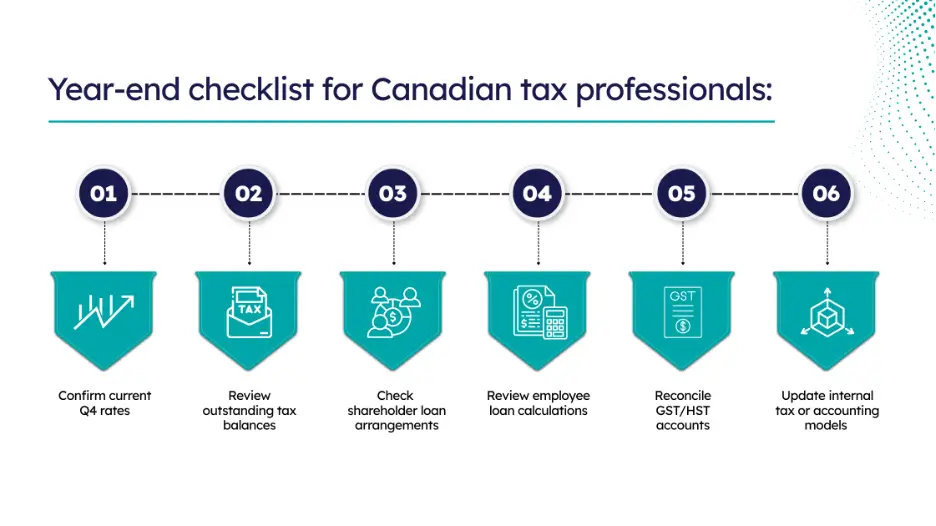
- Confirm current Q4 rates:
Verify the 3% prescribed rate, 7% overdue rate, and applicable overpayment rates from the CRA website before finalizing calculations. - Review outstanding tax balances:
Identify clients with unpaid income tax, source deductions, CPP, or EI and estimate interest to December 31 using the 7% overdue rate. - Check shareholder loan arrangements:
Confirm the interest rate charged, whether interest was paid on time, and whether any taxable shareholder benefits arise using the 3% prescribed rate. - Review employee loan calculations:
Ensure payroll and T4 figures reflect the correct quarterly prescribed rates for all employee loans outstanding in 2026. - Reconcile GST/HST accounts:
Apply the correct 7% overdue and 3%/5% overpayment rates when assessing interest on late or excess GST/HST remittances. - Update internal tax or accounting models:
Refresh spreadsheets, engagement templates, and client letters with the Q4 2026 rates to avoid carrying forward outdated numbers. - Confirm year-end documentation;
Ensure loan agreements, board resolutions, and payroll records support the rates and treatments applied in the file. - Flag items requiring professional review;
Identify complex shareholder or employee loan situations, large overdue balances, or unusual tax regimes for deeper analysis by a Canadian tax specialist.
For firms looking to offload routine bookkeeping and reconciliation work during busy season, NCSGX Canada’s bookkeeping services can help keep client files current.
Conclusion
CRA prescribed interest rates for Q4 2026 are an important part of accurate year-end tax and accounting work. While most key rates remain unchanged from Q3, the corporate pertinent loan rate has moved slightly from 6.30% to 6.29%. Reviewing the applicable rate for overdue tax, GST/HST, overpayments, and employee or shareholder loans can help keep calculations accurate and avoid using outdated figures.
Keeping supporting records updated can also make year-end reviews easier. If you need additional support with recurring bookkeeping and accounting tasks, contact us to discuss how NCSGX Canada can support your team.
How NCSGX Can Help
NCSGX can help Canadian businesses and tax professionals keep their financial records organized and up to date, making it easier to review CRA-related balances, identify items that need attention, and maintain accurate records throughout the year. Through finance and accounting support, teams can maintain greater consistency in their financial workflows and spend less time resolving routine record-keeping issues while focusing on year-end reviews, tax preparation, and informed financial decisions.
Frequently Asked Questions (FAQ)
1. What are the CRA prescribed interest rates for Q4 2026?
The CRA overdue tax interest rate is 7% for Q4 2026, from October 1 to December 31.
2. What is the CRA overdue tax interest rate for Q4 2026?
The CRA overdue tax interest rate is 7% for Q4 2026, from October 1 to December 31.
3. How often does CRA change prescribed interest rates?
CRA prescribed interest rates are updated quarterly, with new rates applying for each three-month period.
4. What CRA prescribed rate applies to shareholder loans in Q4 2026?
The prescribed rate for taxable benefits on qualifying interest-free or low-interest shareholder loans is 3% for Q4 2026.
5. Did CRA interest rates change from Q3 to Q4 2026?
Most key rates remained unchanged. The corporate pertinent loan rate decreased slightly from 6.30% in Q3 to 6.29% in Q4 2026.
6. How should tax professionals use CRA prescribed interest rates during year-end reviews?
Tax professionals should confirm the applicable quarterly rate, identify the transaction type, update calculations, and keep supporting documentation for year-end records.