
 USA
USA
 Canada
 Australia

Introduction
The Old Age Security recovery tax, commonly called the OAS clawback, reduces OAS payments when a recipient’s income exceeds the applicable threshold. The deduction is generally based on the previous year’s income and may be collected from monthly OAS payments during the following OAS recovery tax period.
Form T1213(OAS) is a request to reduce Old Age Security recovery tax at source. It may help when your expected income has fallen, and the recovery tax deducted from your OAS payments would be higher than your final liability. For more information and professional financial support, NCSGX can help you stay organized with your accounting and tax-related financial information. Understanding the current threshold, income definition, and CRA approval process is essential before filing.
Key Takeaways
- Form T1213(OAS) allows eligible taxpayers to request a reduction in OAS recovery tax withheld from their monthly OAS payments.
- The OAS recovery tax is based on income from the applicable year and the OAS clawback threshold, so accurate income estimates are important.
- CRA approval is not automatic, and an approved request generally applies only to the relevant OAS recovery tax period.
- Reviewing income, deductions, and supporting documents early can help taxpayers understand how to reduce OAS clawback and avoid unexpected tax amounts.
Form T1213(OAS): How to Stop OAS Clawback Deductions (2026)
For some Canadian seniors, a higher income can lead to Old Age Security (OAS) recovery tax being deducted from their OAS payments. Form T1213(OAS) may allow eligible taxpayers to request a reduction in this amount at source when their current-year circumstances support a lower recovery-tax liability.
What Is Form T1213(OAS)?
Form T1213(OAS), Request to Reduce Old Age Security Recovery Tax at Source, is completed by an individual who wants CRA to authorize a reduction in the recovery tax withheld from OAS payments. The CRA form is specifically concerned with OAS recovery tax, not ordinary income-tax withholding.
Submitting the form does not automatically stop the clawback. CRA must review and approve the request. If approved, the authorization may allow Service Canada to reduce the amount deducted from future OAS payments.
How the OAS Recovery Tax Works
The OAS recovery tax is calculated when the relevant income used for the calculation exceeds the applicable OAS clawback threshold. For the July 2026 to June 2027 recovery tax period, the income year is 2025 and the threshold is $93,454. The 2026 income-year threshold is $95,323, which applies to the July 2027 to June 2028 period.
Generally, the recovery tax is 15% of the amount by which the relevant income exceeds the threshold, subject to limits based on the OAS pension received. For example, $100,000 of relevant 2025 income is $6,546 above the $93,454 threshold, producing a basic recovery amount of $981.90 before applying the applicable limits.
The OAS recovery tax period runs from July 1 of the current year to June 30 of the following year.
Which Income Counts Toward the Threshold?
The calculation uses income after the adjustments specified by CRA. For non-residents, CRA describes net world income as income from Canadian and foreign sources minus allowable deductions. Examples include:
- Employment, business, and pension income.
- Social security benefits.
- Interest, dividends, and capital gains.
- Rental-property income.
- Other income required by the applicable return.
Who Can File Form T1213(OAS)?
Form T1213(OAS) may be appropriate when your current-year income is expected to be lower than the previous year and you meet the other CRA conditions for requesting a reduction. The current form specifically asks the taxpayer to confirm that the current-year income estimate will be lower than the previous year’s income.
Being above the OAS clawback threshold does not automatically mean that CRA will approve the request. The decision depends on the information provided, including expected income, deductions, credits and tax already deducted.
Information You Need Before Completing the Form
Gather:
- Your personal identification and contact details.
- Information about your OAS payments and current deductions.
- Expected annual income for the applicable year.
- Pension, employment, business, investment, rental, and foreign income details.
- Relevant deductions or adjustments.
- Any supporting information requested by the current form.
Use the current 2026 version rather than an older PDF. CRA currently provides fillable and print versions of Form T1213(OAS). Keeping these records organized through Bookkeeping services can make it easier to review income and supporting information before completing the form.
How to Complete Form T1213(OAS) Step by Step
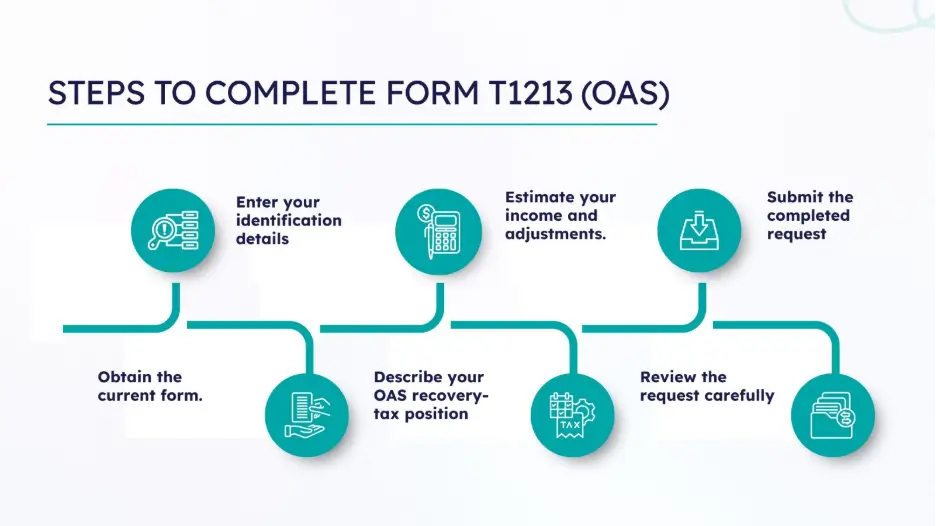
- Obtain the current form: Download the 2026 version from CRA and open the fillable PDF in compatible PDF software.
- Enter your identification details: Provide the information CRA needs to match the request to your tax and benefit records.
- Describe your OAS recovery-tax position: Use current OAS deduction information and identify why the existing withholding may exceed your expected liability.
- Estimate your income and adjustments: Include all relevant Canadian and foreign income, along with deductions that are permitted under the applicable rules.
- Review the request carefully: Check that the estimate is reasonable and supported by your records.
- Submit the completed request using CRA’s current instructions: Keep a copy of the form and supporting documents.
Estimating Your Income Accurately
Your estimate is central to the request. Consider changes in employment or pension income, investment income, RRSP or RRIF withdrawals, rental income, capital gains and taxable foreign income.
Avoid assuming that deductions will be larger than they are simply to reduce the estimated income. If your circumstances materially change, review whether the original request still reflects your expected position.
Where and When to Submit the Request to CRA
Form T1213(OAS) can be submitted online through CRA’s My Account or Represent a client using the Submit Documents service. You can also send the completed form and required supporting documents by mail or fax to the Sudbury Tax Centre.
There is no single annual T1213(OAS) deadline specified by CRA. However, it is best to submit the request early enough to allow time for CRA review and Service Canada processing. Once CRA accepts the request, the information is sent to Service Canada, which processes the reduction in OAS recovery tax withholding.
What Happens After CRA Reviews Your Request?
CRA reviews the information and supporting documents. If the request is accepted, CRA sends the information to Service Canada, which processes the reduction in OAS recovery tax withholding.
If the request is not accepted, the existing recovery tax withholding position remains unchanged. Keep a copy of the form and supporting documents for your records.
Filing Again for Future Periods
An approved request does not automatically continue indefinitely. The current form states that the OAS recovery-tax period runs from July 1 to June 30 and that a new request is needed if the situation remains unchanged after that period.
This means taxpayers should reassess their income each year rather than assuming a previous authorization will carry forward.
Common Mistakes When Filing Form T1213(OAS)
- Using an outdated OAS clawback threshold
- Underestimating net world income
- Forgetting taxable foreign income
- Confusing OAS recovery tax with regular income tax withholding
- Assuming CRA approval is automatic
- Failing to account for changes in pension or investment income
- Waiting too long to submit the request
- Not retaining supporting records
Other Ways to Reduce Net Income Below the Threshold
Some taxpayers may be able to reduce the income used in the OAS calculation through legitimate tax planning. Depending on eligibility and circumstances, this can include RRSP contributions, eligible deductions and appropriate timing of income or deductions. These strategies can help taxpayers understand how to reduce OAS clawback by lowering the income used in the calculation, where permitted under the applicable tax rules.
Pension-income planning may also affect a taxpayer’s overall position. However, these strategies should not be viewed as guaranteed ways to eliminate the OAS recovery tax. The effect depends on the taxpayer’s income, deductions, age, investments and other circumstances.
The goal should be accurate tax planning based on the rules that actually apply, rather than attempting to artificially keep income below the OAS clawback threshold.
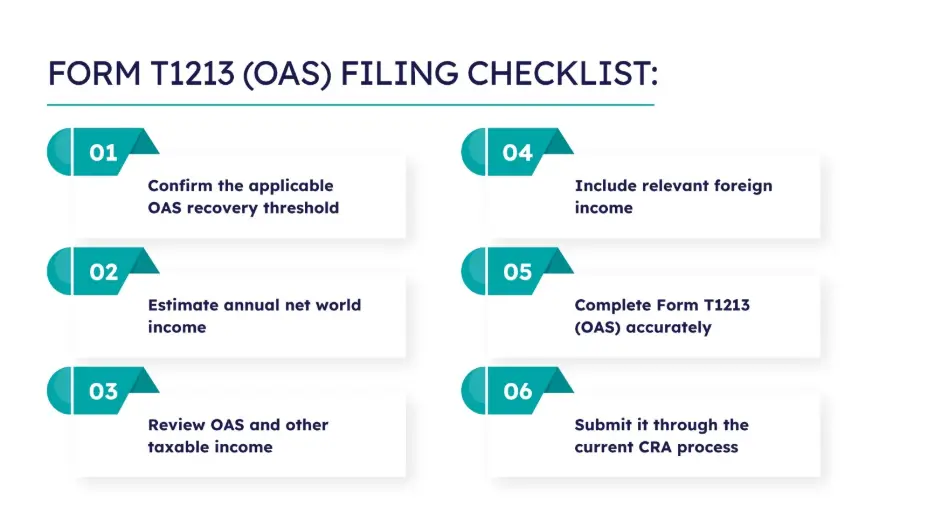
Form T1213(OAS) Filing Checklist
Conclusion
Form T1213(OAS) can help eligible taxpayers request a reduction in OAS recovery tax withheld at source when their current income and circumstances support it. Accurate income estimates are essential because CRA approval does not eliminate the underlying recovery tax liability.
Before submitting the request, review your income, deductions, supporting documents, and the latest CRA requirements carefully. For assistance with organizing your financial information for tax-related matters, contact us to learn how NCSGX can help.
How NCSGX Can Help
NCSGX can help organize financial records, review income information, and maintain accurate books to support tax preparation and planning. Clear, up-to-date financial information can make it easier to identify income changes and keep the documentation needed for tax professionals organized.
Frequently Asked Questions (FAQ)
1. Can I file Form T1213(OAS) if I have already had a recovery tax deducted for several months?
Yes. You can still request a reduction in future OAS recovery tax withholding. Amounts already withheld are generally dealt with when you file your tax return.
2. Does an approved T1213(OAS) request stay in effect for future years?
No. The authorization applies to the relevant recovery-tax period. A new request may be needed for a future period.
3. What is the difference between Form T1213 and Form T1213(OAS)?
Form T1213 generally requests reduced income tax deductions at source for eligible deductions or credits. Form T1213(OAS) specifically concerns OAS recovery tax withheld from OAS payments.
4. Do TFSA withdrawals affect the OAS recovery tax calculation?
Generally, no. TFSA withdrawals are not included in taxable income and therefore do not normally increase the income used to calculate OAS recovery tax.
5. What happens if my actual income ends higher than the estimate I submitted?
You may have a higher OAS recovery tax liability than expected. Any shortfall in withholding may need to be paid when your tax return is assessed.
6. Can both spouses file Form T1213(OAS) in the same year?
Yes. Each spouse’s OAS recovery tax is based on their own income and circumstances, so each person must make their own request if eligible.