
 USA
USA
 Canada
 Australia

Introduction
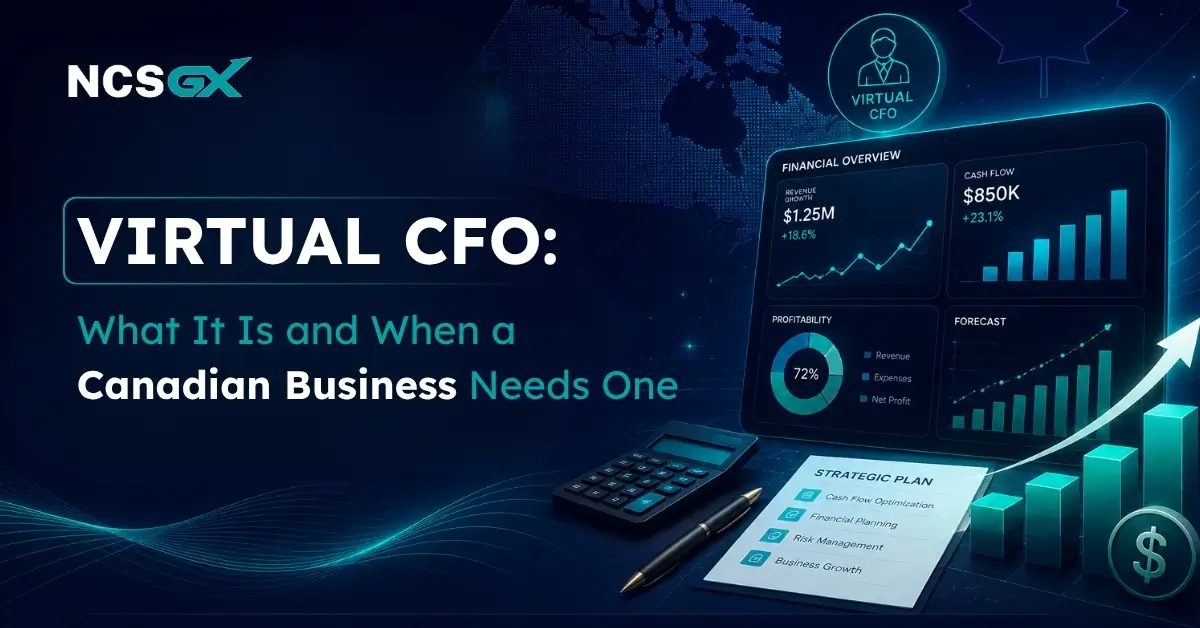
A virtual CFO functions as a senior financial strategist embedded in your business, on your terms, without the $200,000-plus salary that comes with a full-time hire.
For growing Canadian companies navigating financing rounds, CRA compliance, multi-entity structures, or aggressive expansion plans, this model is increasingly less of a luxury and more of a competitive necessity. According to BDC Canada, businesses that access senior financial leadership earlier tend to make better capital decisions and avoid costly structural mistakes down the road.
This article breaks down exactly what a virtual CFO does, how they differ from your bookkeeper, controller, and accountant, and how to know when your business is ready for one.
What Is a Virtual CFO?
A virtual CFO (sometimes called a fractional CFO or outsourced CFO) is an experienced finance professional who provides chief financial officer-level services to a business on a part-time or contracted basis. They work remotely or on-site as needed, typically for a fixed monthly retainer or hourly arrangement.
The word “virtual” refers to the engagement model, not the quality of the work. A seasoned virtual CFO brings the same strategic finance expertise a public company expects from its CFO, financial modelling, board reporting, capital strategy, risk management, and investor relations, scaled to what a private Canadian company actually needs at its stage of growth.
This matters because Statistics Canada consistently shows that small businesses make up over 98% of all Canadian businesses, yet most lack the internal finance leadership to make high-stakes capital and operational decisions with real precision.
A virtual CFO fills that gap, part-time in cost, full-time in impact.
Key Takeaways
- A virtual CFO delivers senior-level financial strategy without the cost of a full-time hire
- Virtual CFO services fill the gap between basic bookkeeping and executive finance leadership
- Growing Canadian businesses typically need one when revenue, complexity, or investor pressure outpaces their existing finance function
- Outsourced CFO services in Canada can be structured on a part-time, project, or retainer basis
- The right engagement model scales with your business and keeps you CRA-compliant, cash flow-positive, and investor-ready
What Does a Virtual CFO Actually Do?
The scope varies by firm and engagement, but in a well-structured outsourced CFO relationship, expect the following:
Financial Strategy and Planning
Your virtual CFO translates your numbers into a forward-looking plan. That includes building and maintaining financial models, running scenario analyses (what happens if revenue drops 20%, or you add a new product line), and helping leadership make capital allocation decisions with clear data behind them.
Cash Flow Management
Cash flow kills more viable businesses than poor products do. A virtual CFO monitors your working capital cycle, identifies payment gaps before they become crises, and structures payment terms, credit lines, and inventory policies to keep the business liquid.
Management Reporting and Board Packages
If you have investors, a board, or lenders, your virtual CFO owns the monthly and quarterly reporting. That means KPI dashboards, variance analysis, and the narrative that ties the numbers to what actually happened in the business.
CRA Compliance Oversight
A virtual CFO doesn’t replace your accountant, but they coordinate the full compliance calendar, GST/HST filings, T2 deadlines, SR&ED claims, payroll remittances, and any CRA correspondence, so nothing slips through the cracks.
Fundraising and Lender Readiness
Whether you’re approaching the BDC, a chartered bank, or private investors, your virtual CFO prepares the financial package lenders and investors actually want to see: a well-structured set of financials, a credible forecast, and a clear use-of-funds narrative.
Signs Your Canadian Business Needs a Virtual CFO
This is the question most business owners wrestle with. Not “what is it” but “do I actually need one right now?”
Here are the clearest signals:
Warning Signs You’ve Outgrown Your Current Finance Setup
- You’re making major decisions (hiring, new locations, equipment purchases) based on gut instinct because your numbers aren’t current or clear
- Your accountant only talks to you between February and May
- You’ve been turned down for financing, or you don’t know how to approach lenders
- Cash flow feels unpredictable even when revenue is growing
- You have no rolling forecast, only backwards-looking reports
- A potential investor or acquirer has asked for a financial model, and you don’t have one
- You’re running multiple entities or preparing for a corporate restructure
- CRA has flagged your account, or you’ve missed filing deadlines
If two or more of these describe your business, the question isn’t whether you need a virtual CFO. It’s how quickly you can onboard one.
How Much Does a Virtual CFO Cost in Canada?
Pricing varies significantly depending on scope, seniority, and the firm providing the service. Here’s a general framework:
| Engagement Type | Monthly Cost (CAD) | Best For |
|---|---|---|
| Advisory only (4–6 hrs/month) | $1,500 – $3,000 | Early-stage startups, basic oversight |
| Part-time embedded CFO (10–20 hrs/month) | $3,500 – $7,000 | Growing SMEs, reporting-heavy businesses |
| Fractional CFO with full finance support | $7,000 – $15,000 | Pre-revenue raise, multi-entity, scaling |
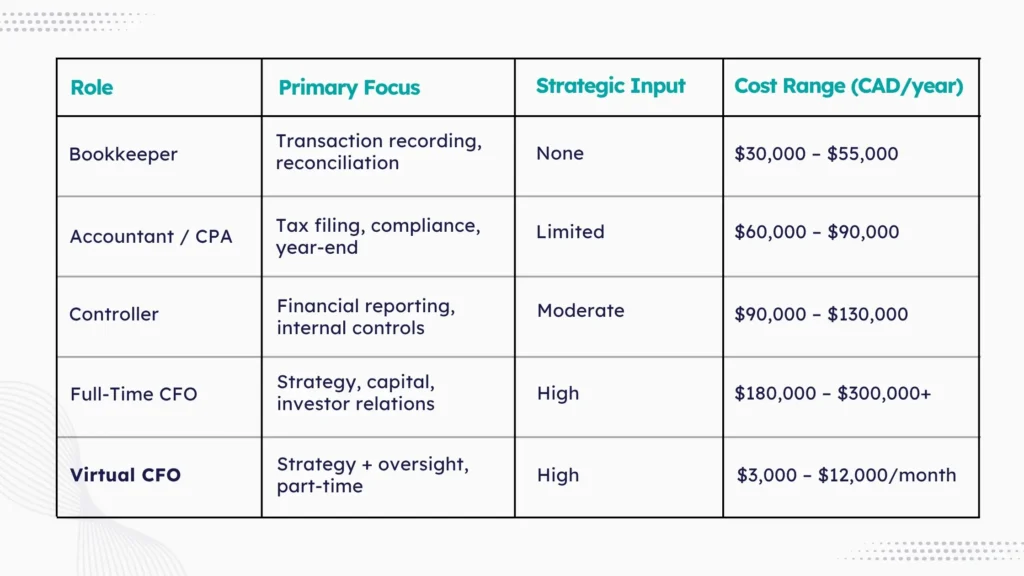
Compare this to a full-time CFO, where base salary alone typically starts at $180,000 in most Canadian urban markets, before benefits, bonuses, and equity. The math is clear.
For most businesses in the $2M to $15M revenue range, a well-scoped virtual CFO engagement delivers more actionable value per dollar than any other finance hire they can make.
Virtual CFO vs. a Full-Time CFO Hire
The case for a full-time CFO makes sense at a certain scale. If you’re doing $50M+ in revenue, running a complex multi-entity structure, or preparing for a major transaction, you likely need someone embedded five days a week.
Below that threshold, however, a full-time hire often creates a different problem: you’re paying for 40 hours a week of CFO capacity when your business realistically needs 10 to 15. The outsourced CFO model solves for this directly.
There’s also a talent access argument. The best CFO talent in Canada gravitates toward public companies, private equity-backed firms, and major enterprises. A virtual CFO model gives a $5M founder access to someone who has guided businesses through financing rounds, acquisitions, and restructures, experience that would be almost impossible to recruit for a full-time role at that revenue level.
Mini Case Study: A Canadian E-Commerce Brand Closes Its First Line of Credit
A Toronto-based e-commerce company with $4.2M in annual revenue had been running their finance function with one part-time bookkeeper and a CPA firm that prepared their year-end T2. Revenue was growing at 30% year over year, but the owner had no forecast, no cash flow visibility, and had been rejected twice by their bank for a $500,000 working capital line.
They engaged a virtual CFO through an outsourced finance firm for $5,200 per month.
Within 90 days, the virtual CFO had restructured the management accounts, built a 13-week cash flow model, prepared a lender-ready financial package, and coached the owner through the bank presentation. They secured the credit facility on the third application.
The owner credited the engagement not with having better numbers, but with finally understanding what their numbers meant and being able to explain them confidently to a lender.
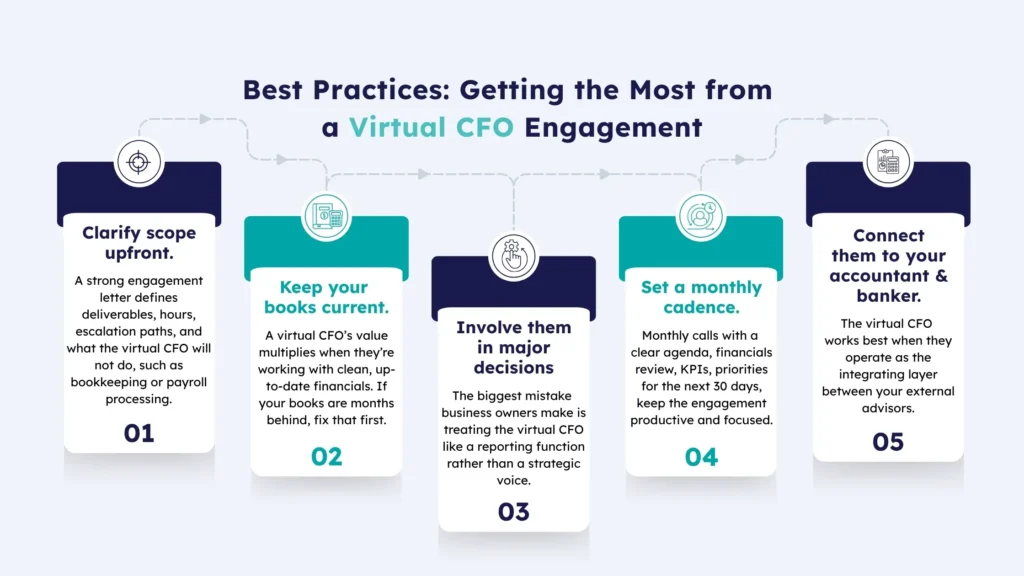
Virtual CFO Readiness Checklist
Before engaging an outsourced CFO, confirm the following:
- Books are reconciled and current within 30 days
- You have a clear picture of current revenue and gross margin
- You can articulate your top 3 financial challenges
- You know your next 12-month capital requirements
- You have buy-in from ownership/leadership to act on CFO recommendations
- You’ve identified whether the engagement should be advisory, part-time, or full-scope
How NCSGX Canada Can Help
At NCSGX Canada, we work with Canadian businesses that have outgrown basic bookkeeping but aren’t yet ready, or don’t need, a full-time CFO. Our outsourced CFO and finance consulting services are built to scale with your business at every stage.
If your business is growing faster than your finance function can support, the smartest move you can make is a conversation. Connect with our team and let’s talk through what the right engagement looks like for your business.
Conclusion
A virtual CFO is a deliberate finance decision that gives Canadian business owners access to strategic thinking, financial discipline, and reporting clarity they can’t build with a bookkeeper and a year-end accountant alone.
The businesses that invest in a virtual CFO early tend to raise capital faster, manage cash flow more precisely, and avoid the expensive surprises that come from making major decisions without strong financial guidance behind them.
Frequently Asked Questions (FAQ)
1. Is a virtual CFO the same as a fractional CFO?
Yes, both terms describe a senior finance professional working on a part-time or contracted basis. “Fractional” emphasises split time across clients; “virtual” highlights the remote model. The core service is identical: CFO-level leadership without the full-time cost.
2. Does a virtual CFO replace my accountant or bookkeeper?
No. Your bookkeeper records transactions, your accountant handles year-end and tax filings, and your virtual CFO sits above both, using that output to drive strategy and decisions. It adds a leadership layer; it doesn’t remove an existing one.
3. Can a virtual CFO handle CRA filings and GST/HST?
A virtual CFO oversees compliance rather than preparing filings directly. They coordinate your filing calendar, review submissions, and manage CRA correspondence, keeping your accountant or tax preparer on track and accountable.
4. How small is too small for a virtual CFO?
Most businesses see clear ROI at $1.5M or more in annual revenue, or when facing a significant decision like financing or ownership transition. Below that, a strong bookkeeper and year-end CPA may be enough, but if your decisions feel bigger than your financial visibility, it’s worth the conversation.
5. What's the difference between a virtual CFO and a business advisor?
A business advisor works broadly across operations, marketing, and strategy. A virtual CFO is a finance specialist whose work is grounded in your actual numbers, forecasts, management reports, and financial models, with accountability for accuracy and strategic value.